Social Media Video Ads: The Complete Playbook

Ryan Bennett • September 26, 2026
Master social media video ads with this guide. Learn platform specs, creative best practices, AI production workflows, and measurement strategies for 2026.
Social video advertising is no longer a test budget. One industry forecast values the global market at $47.2 billion in 2025 and projects $174.8 billion by 2034, while another estimates $31.3 billion in 2025 rising to $444.5 billion by 2035. The gap between forecasts reflects a rapidly expanding category, not a lack of importance, as explained in Future Market Insights' social video advertising market analysis.
The practical consequence is clear. Brands need more than attractive clips. They need platform-native creative, a production system that can generate variations without exhausting the team, and measurement that shows whether viewers stayed long enough to absorb the message and later convert.
Why Social Media Video Ads Matter Now
Social media video ads have moved from a specialist format to a core advertising line item in less than a decade. Instagram, YouTube, TikTok, Reddit, and other video environments now compete for the same brand budgets as broader online video and connected television. That shift changes the marketer's job. Video is no longer an occasional campaign asset, it's a repeatable acquisition and demand-generation system.
The market estimates illustrate the scale. One forecast expects a 14.8% compound annual growth rate, while another projects a 30.4% CAGR, with different methodologies producing very different totals. The useful conclusion isn't choosing one forecast as the definitive figure. It's recognizing that social video is scaling quickly enough for creative operations and measurement discipline to become competitive advantages.
Social video is competing for serious budgets
The U.S. market shows the same transition. The Interactive Advertising Bureau's 2026 forecast projected social video ad spending growth of 13% year over year, ahead of connected television at 11% for the first time, according to Digiday's coverage of the forecast. The forecast also placed total U.S. digital video spending at $80 billion in 2026, a category that includes social video.
That matters because social video is no longer being judged as a cheap way to produce short clips for feeds. It's being evaluated alongside channels expected to support brand reach, consideration, retargeting, and sales. A video that earns views but fails to communicate a product benefit has a different problem from a video that communicates well but attracts the wrong audience.
Scale creates an operational problem
In-stream ads represent 42.5% of the market, and Asia Pacific accounts for 38.2% of revenue share, according to the Future Market Insights report. Those figures point to a fragmented environment with different viewing habits, placements, and creative expectations.
A single master asset rarely fits every context. Vertical feed placements need immediate visual clarity, skippable YouTube inventory must earn continued attention, and platform-native creative often benefits from a less polished presentation. Teams that treat production as a one-off design request will struggle to keep pace with testing and refresh requirements.
Practical rule: Treat every ad as a hypothesis about an audience, message, hook, and platform behavior. Production should make those hypotheses easy to test, not difficult to reproduce.
The strategic opportunity is substantial, but scale alone won't improve performance. Marketers still need to build for the placement, protect the opening seconds, generate enough meaningful variations, and judge the campaign on retention and business outcomes rather than surface-level activity.
Platform Specs and Requirements
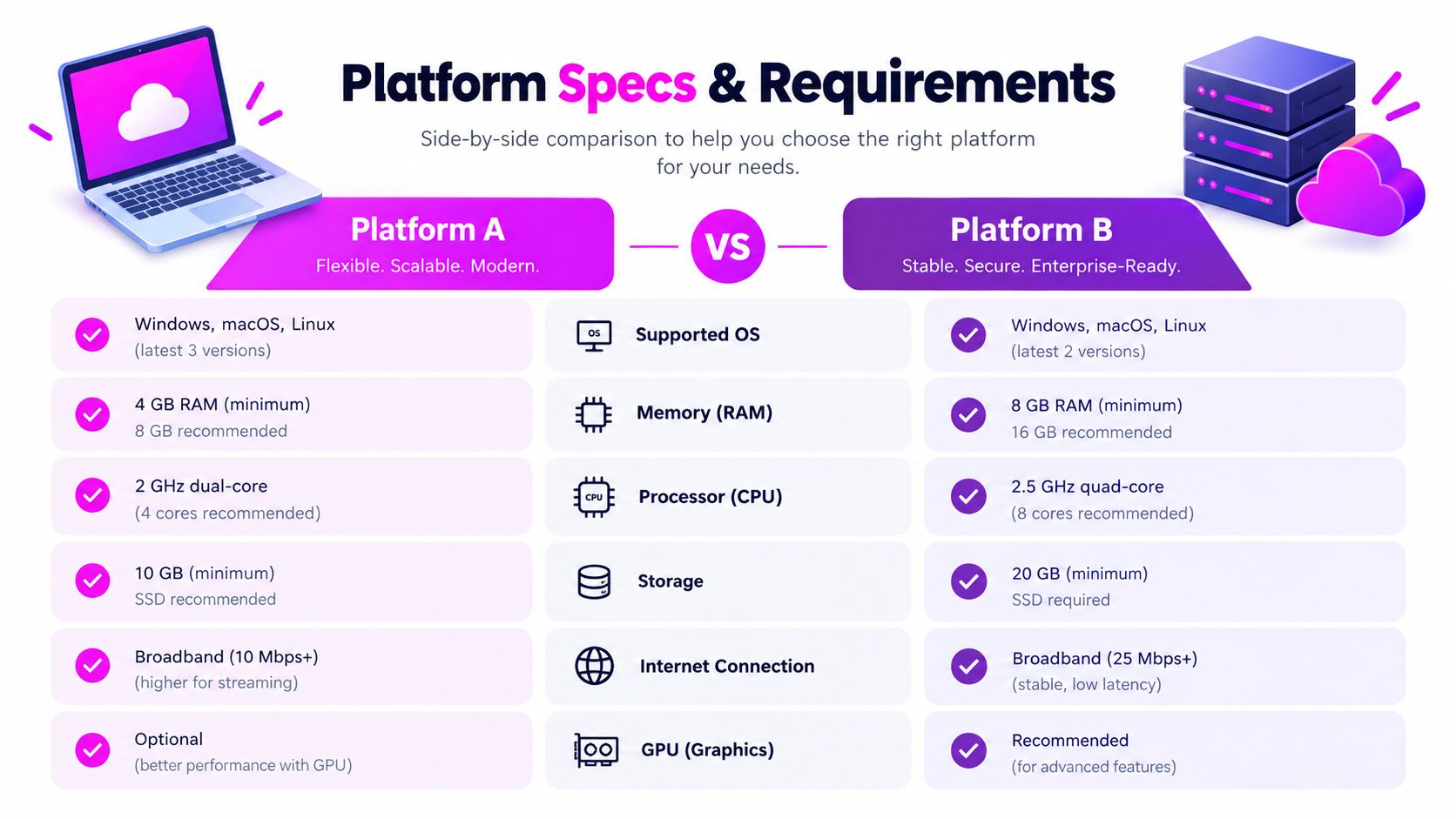
A social video ad can be technically correct and still perform poorly because the creative ignores the platform's viewing behavior. TikTok, Instagram Reels, YouTube Shorts, and standard in-feed placements all support vertical video, but they don't create identical attention environments. The same file may be accepted everywhere while feeling native nowhere.
Start with the delivery context rather than exporting one universal asset. Confirm the required aspect ratio, resolution, file type, duration, safe zones, caption treatment, audio behavior, and call-to-action placement inside each platform's current ad manager. Requirements change, so production teams should maintain a live specification sheet instead of relying on an old export preset.
Compare the viewing environments
| Environment | Creative priority | Common failure | Better production decision |
|---|---|---|---|
| TikTok in-feed | Immediate, creator-like movement and a direct premise | Polished commercial language that feels disconnected from the feed | Build a fast opening, native captions, and a clear visual demonstration |
| Instagram Reels | Strong vertical composition and recognizable brand cues | Important text placed under interface controls | Keep the subject and message inside safe areas, with a clean first frame |
| YouTube Shorts | Rapid storytelling with enough clarity to survive quick swipes | Reusing a landscape video with cropped product details | Reframe the story vertically and make the value proposition legible without context |
| Standard in-feed video | Flexible storytelling, often with sound-off viewing | Delayed branding or a benefit that appears too late | Put the product, problem, or outcome on screen immediately |
For a deeper production reference, use this guide to aspect ratio for social media before creating a batch of assets. Aspect ratio isn't a finishing detail. It determines how much room the subject has, where captions can sit, and whether the first visual survives the platform interface.
Build exports around adaptation
Create a master storyboard with platform-specific versions rather than a single master video. Keep the central proposition consistent, but change the opening frame, pacing, captions, crop, and final action according to the placement.
A useful asset naming system includes the platform, audience, concept, hook, aspect ratio, and version. That makes performance analysis possible later. If a team can't identify which opening, edit, or placement generated a result, the campaign produces activity without useful learning.
Also check the audio experience. Some viewers encounter the ad with sound disabled, while others respond to recognizable music or spoken delivery. Captions should communicate the essential promise on their own, and music should support the edit rather than carry the entire message. If a track's identity matters to the concept, an audio recognition tool can help identify the source during creative research, but licensing still needs to be handled separately.
Technical compliance gets an ad delivered. Native adaptation gives it a chance to earn attention.
Creative Best Practices for Video Ads
The first 6 seconds deserve their own creative brief. A 2026 marketing statistics summary reports average video-ad CTR of 1.84%, compared with 0.35% for display, and identifies six seconds as the optimal hook window because attention can disappear quickly before a viewer skips. The benchmark appears in Digital Applied's video marketing statistics.

A hook isn't just a loud opening or a fast cut. It's the first piece of information that answers, “Why should I keep watching?” For a product demonstration, show the result before the process. For a problem-led ad, make the friction visible. For a testimonial, lead with the specific outcome or objection the speaker will address.
Engineer the opening
Use this sequence when developing a short-form ad:
- Start with a visible tension. Show the broken workflow, confusing choice, unwanted result, or unmet need. The viewer should recognize the situation without waiting for narration.
- Introduce the promised change. Present the product, method, or insight as the next logical step. Don't bury the offer behind an abstract brand introduction.
- Prove the claim on screen. Demonstrate the interface, physical product, before-and-after state, or customer behavior. Visual evidence carries more weight than adjectives.
- Resolve the next action. Tell the viewer what to do and what happens after the click, signup, purchase, or visit.
Sound-off viewing makes on-screen text essential, but captions shouldn't become a transcript. Use short phrases that reinforce the visual, and make sure the message remains understandable when a viewer sees only the opening frame and a few cuts.
The TikTok video template guide can help teams structure repeatable layouts, but templates should support testing rather than force every concept into the same rhythm. A reusable pattern is useful when it preserves the message. It becomes a liability when viewers can predict the ad before the benefit appears.
Choose the right level of polish
UGC-style and polished brand creative solve different problems. UGC-style footage can make a product feel familiar and usable, especially when the speaker demonstrates a real task or addresses a believable objection. Polished footage can clarify product details, establish a premium visual system, or support a launch where brand control matters.
Don't choose based on taste alone. Test the creative style against the audience, offer, and buying stage. A founder-led explanation may work for a considered purchase, while a product-in-use demonstration may work better for discovery. The strongest campaigns often use both, with authentic footage earning attention and more controlled assets handling proof, product detail, and retargeting.
The best hook isn't the most dramatic one. It's the one that makes the right viewer understand the relevance immediately.
Keep motion purposeful. Change the visual when the information changes, not just because the editor wants more cuts. A close-up, screen recording, caption shift, or product demonstration should each advance the argument. Fast editing without new information creates stimulation, not persuasion.
Building Scalable Production Workflows
Creative volume becomes a bottleneck when each variation needs a new brief, manual asset search, custom edit, and separate approval cycle. A scalable system defines which inputs can change, then protects the offer, brand rules, and measurement structure. The goal is controlled testing, not a stream of random versions.
AI-powered bulk generation tools can create up to 100 unique visuals in under 20 seconds with models such as Flux 1.1. They also support batch tasks such as background removal and face swapping. The stated capability is to reduce manual post-production editing time by half while maintaining professional quality, according to Bulk Image Generation.
Start with a creative matrix
Define the variables before opening a generation tool or video editor:
- Audience: New prospect, engaged viewer, site visitor, or existing customer.
- Message: Problem, benefit, proof, objection, comparison, or offer.
- Visual world: Product-in-use, lifestyle scene, interface view, close-up detail, or abstract background.
- Hook: Question, result, mistake, demonstration, customer tension, or direct claim.
- Format: Reels, Shorts, TikTok in-feed, or another placement-specific export.
- Action: Learn, compare, sign up, shop, or return to the product page.
This matrix prevents teams from producing cosmetic variations that express the same idea. Ten background colors are not ten creative hypotheses. A useful batch changes the opening situation, proof method, or audience framing while preserving the central promise.
Connect image generation to video editing
Use a repeatable workflow:
- Write the message architecture. Define the audience, problem, benefit, proof, and action before requesting visuals.
- Generate visual families. Create backgrounds, product contexts, mockups, and supporting scenes that share a visual direction.
- Batch-edit the assets. Remove backgrounds, resize for placements, swap approved faces where appropriate, and export consistently named files.
- Assemble modular edits. Build opening, proof, product, and CTA modules that editors can recombine without rebuilding every timeline.
- Apply platform rules. Check safe areas, captions, duration, audio, and framing for each destination.
- Tag every variation. Record the hook, audience, platform, offer, and version in the filename or campaign metadata.
- Launch a controlled test. Change a limited set of variables so the result remains interpretable.
For a fuller automation reference, see the guide to creative workflow automation.
Keep humans in the approval loop
Bulk generation increases production speed, but it does not replace judgment. Review each visual for product accuracy, awkward anatomy, inconsistent branding, misleading context, and rights or disclosure concerns. Generated backgrounds can also introduce details that compete with the offer, so a creative lead should approve the visual hierarchy before paid distribution.
Use a documented workflow from Prompt Builder to standardize briefing, prompting, review, and repurposing. Automate repetitive handoffs while keeping decisions about concepts, evidence, and performance with the appropriate specialists.
Separate generation, editing, assembly, approval, and measurement. If one person owns all five steps, production stops when that person is unavailable. Clear ownership lets a strategist update the message, a designer maintain the visual system, an editor assemble variants, and a performance marketer connect each asset to the right outcome.
The strongest workflow turns a proven concept into platform-ready executions while preserving consistency, accountability, and a clear link between each creative change and its measured result.
Measuring Performance Beyond Clicks
CTR answers one narrow question: did someone click? It doesn't tell you whether the opening earned attention, whether the viewer understood the offer, or whether the video influenced a later conversion without receiving the final click.
Platform benchmarks support a broader view. Benchmarketing's 2026 video advertising benchmarks report a median 1.3% CTR for short-form video, 24% YouTube view rate, 18% video completion rate, and a +9% median video-assisted conversion-rate lift, as reported in its video advertising benchmarks. These measures describe different stages of the journey, so they shouldn't be collapsed into a single performance score.
Read the attention curve
Use the following metrics as a diagnostic sequence:
- Hook rate: Did viewers remain through the opening moment? A weak result points to the first frame, premise, or relevance.
- Hold rate: Did viewers continue after the hook? A drop here often signals that the ad promised one thing and delivered another, or that the pacing stalled.
- ThruPlay or completion: Did the audience watch enough to reach the proof and CTA? This matters when the argument unfolds over time.
- CTR: Did the message create an immediate action? A high CTR with weak retention can indicate curiosity clicks, accidental taps, or a mismatch between the hook and landing page.
- Assisted conversions: Did viewers who engaged with the video later convert through another touchpoint? This helps capture discovery influence that last-click reporting misses.
- ROAS: Did the total economics support continued spend? Revenue efficiency remains important, but it should be interpreted alongside creative retention and audience quality.
Diagnose before changing the ad
A video with strong hook rate and weak hold rate needs a different fix from one with weak hook rate and strong completion among the few who stay. The first problem is usually promise delivery or pacing. The second is usually the opening frame, audience fit, or placement adaptation.
Compare metrics within comparable contexts. Don't rank a TikTok in-feed asset against a YouTube skippable ad using CTR alone, because the platforms encourage different viewing behaviors. The 2026 summary cited earlier reports TikTok in-feed video ads averaging 1.02% CTR and $0.02 to $0.10 CPV, while YouTube skippable pre-roll averages 0.65% CTR, $0.10 to $0.30 CPV, and 31% completion. Those figures should inform platform-specific evaluation, not serve as universal targets.
For teams building a repeatable reporting habit, this guide to content performance analysis for creators offers a useful framework for organizing signals beyond surface engagement. The reporting sheet should connect creative metadata to retention, conversion, and spend, so the next production cycle knows what to change.
Measurement principle: Optimize the earliest metric that explains the failure, then verify the change against downstream conversion quality.
Run creative reviews on a fixed cadence, but do not pause an ad just because one metric moved. Look for patterns across audience, placement, frequency, landing-page behavior, and assisted conversion. A winning hook with poor economics may need a stronger offer or page. A modest CTR with strong assisted conversions may deserve more investment than a click-heavy curiosity ad.
Putting It All Together
A practical campaign begins with one audience and one business action, then branches into platform-native executions. The strategist defines a problem-led message, the creative team develops several hooks, and the production team creates the supporting visual families and modular edits.
Each platform receives its own crop, caption treatment, pacing, and CTA. The campaign launches with clear metadata, so the team can compare hook rate, hold rate, completion, CTR, assisted conversions, and ROAS without confusing one placement's behavior with another's.
After the first learning cycle, the team keeps the strongest message, replaces weak openings, and produces new visual contexts rather than endlessly polishing one exhausted asset. That loop connects strategy, scalable production, and meaningful measurement.
Bulk Image Generation supports the visual production side of social media video ads by creating batches of image assets and applying edits such as background removal, resizing, and face swaps. Use Bulk Image Generation to build more platform-ready creative variations and give your testing workflow a steadier supply of visual inputs.