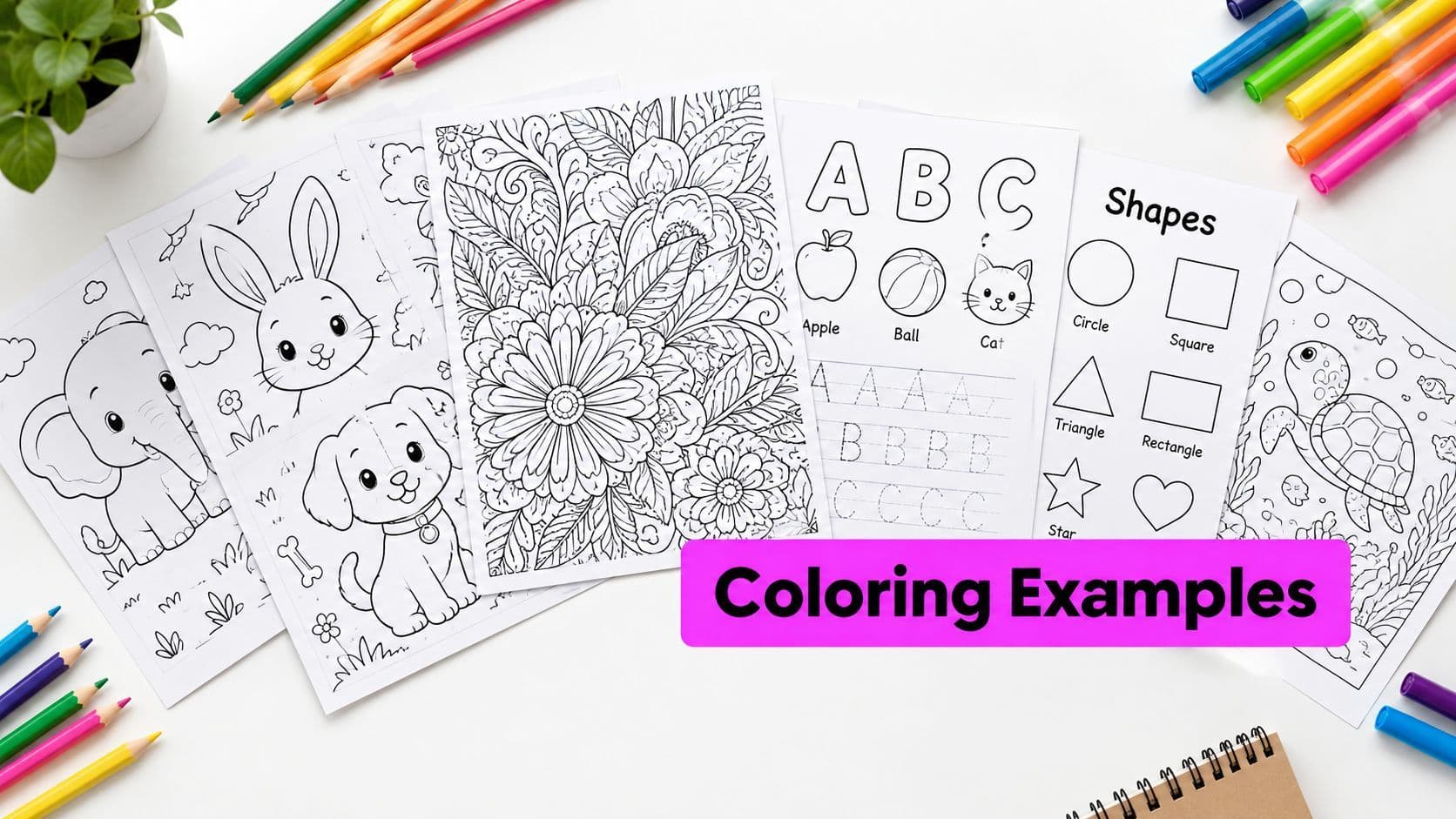
8 Coloring Pages with Example Ideas for Every Age

Ryan Bennett • October 8, 2026
Explore 8 coloring pages with example ideas for kids, adults, education, and marketing, plus practical tips for creating printable batches with AI.
The most successful coloring page isn't necessarily the most detailed one. A randomized study of 104 female university students found that daily adult coloring produced lower depressive symptoms and anxiety than a logic-puzzle control condition, while a 2025 experiment with 188 participants linked anxiety reduction more strongly to flow and enjoyment than to visual complexity alone. The university-student study and the mandala experiment point to a practical rule: choose the format for the person using it, not for the image generator producing it.
A useful coloring pages with example collection should match its audience, learning or relaxation goal, print medium, and distribution channel. The eight formats below work as distinct production strategies, from mandalas for focused adult sessions to curriculum pages and branded lead magnets. Each one deserves a different decision about line clarity, complexity, customization, batch potential, and review.
Bulk Image Generation can help scale a tested concept into a consistent collection, but generation is only the production step. You still need to inspect anatomy, unwanted text, page margins, contrast, print quality, accessibility, and intellectual-property risks. For fundamentals on converting images into clean outlines, see this line art guide from MyImageUpscaler.
1. AI-Generated Mandala Coloring Pages
Mandalas are a strong choice when the user wants a quiet, repeatable activity rather than a quick children's worksheet. Their radial structure gives the eye a clear center and a predictable path outward, while enclosed regions create many small decisions without requiring a narrative or factual explanation.
The production challenge is restraint. A generator may create dense intersections, inconsistent symmetry, tiny islands, or lines that look elegant on screen but disappear when printed. Start with a clear instruction for black-and-white line art, enclosed shapes, balanced radial symmetry, no shading, and a clean white background. Then create separate difficulty groups instead of asking every page to be intricate.
Design for flow, not visual overload
The 2025 mandala experiment found that perceived flow and enjoyment were stronger predictors of anxiety reduction than complexity alone. That makes a moderately detailed page a better product candidate than a technically impressive page that users abandon. Build progression into the collection, with open central shapes, medium-detail rings, and a few intricate designs for experienced colorers.
A practical batch workflow looks like this:
- Define the tiers: Separate beginner, standard, and intricate prompts before generation.
- Control line weight: Request outlines that remain distinct after ordinary home printing.
- Inspect intersections: Remove accidental black patches and areas too small for the intended coloring tools.
- Test the medium: Print samples and try pencils, crayons, or markers before releasing a full set.
- Keep the series coherent: Use a shared page size, margin, title treatment, and visual vocabulary.
Practical rule: A mandala should invite the first coloring decision immediately. If the user has to decode the composition before starting, simplify it.
Publishers can use mandalas for themed books, wellness providers can distribute them as low-friction activity sheets, and creators can package downloadable collections. The line art coloring page trend guide is useful when planning a repeatable visual system. For broader tool comparisons, review Skup's AI design tool recommendations, then judge every output with printed samples rather than screen previews.
2. Character-Based Coloring Pages for Children
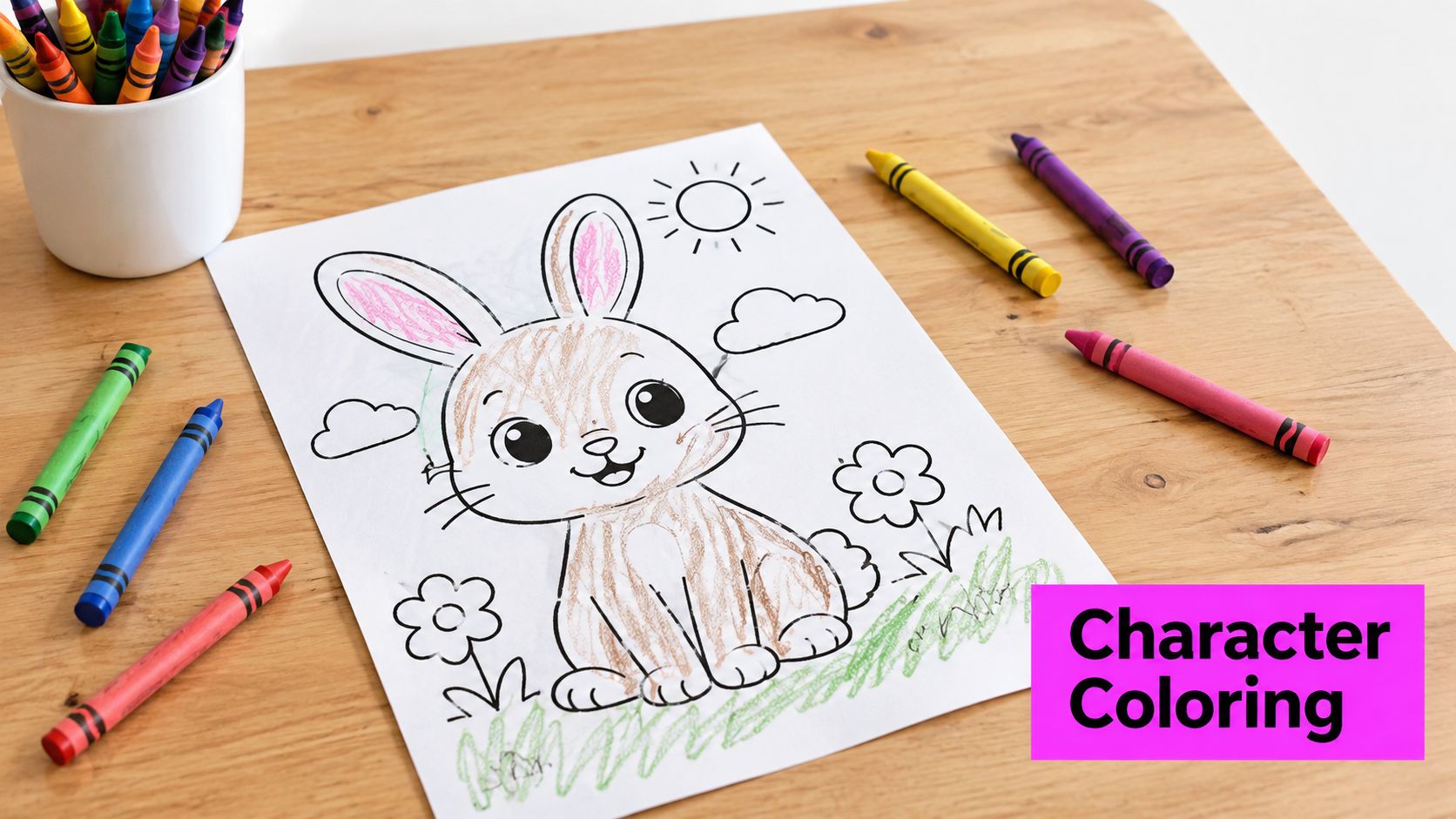
Character pages work because children recognize a subject before they start coloring. A bunny, robot, explorer, or friendly monster gives the page an immediate role, a simple action, and a clear mood. That makes the sheet useful for coloring, storytelling, and short guided activities.
Production decisions start with age fit, not decoration. Younger children need large enclosed areas, expressive faces, few background elements, and simple silhouettes. Older children can handle props, setting details, and more layered scenes. A character that looks appealing on screen can still fail in print if the hands are awkward, the facial features are too small, or the body proportions are unclear, so human review is required.
Build a character system before making variations
Set the character rules first, then generate the series. Write down body shape, clothing, eye style, accessories, and the personality cues that should stay stable. After that, vary the situation, not the identity. One bunny can plant a seed, read a book, visit a museum, or help a friend while still feeling like the same character.
That approach matters because batch work breaks fast when the character drifts from page to page. A child notices when the ears change shape, the outfit disappears, or the face suddenly feels older or harsher.
Use these checks before release:
- Identity consistency: Compare ears, face shape, clothing, and proportions across the set.
- Age suitability: Check whether the smallest regions still fit the intended tools.
- Story clarity: Confirm that the action reads without extra explanation.
- Emotional safety: Keep expressions and situations calm when the pages are for young children.
- Rights review: Use original characters or properly licensed properties, not recognizable protected characters presented as original work.
The strongest batch is the one that survives printing and feedback. Start with a small sample, show it to educators, caregivers, or children in the target age range, and revise the prompt where the page causes confusion. Once the character holds up, Bulk Image Generation can produce a coherent scenario library faster than building each variation by hand. Even then, manual cleanup still matters, especially around hands, faces, overlapping objects, and stray lettering.
3. Nature and Wildlife Coloring Pages
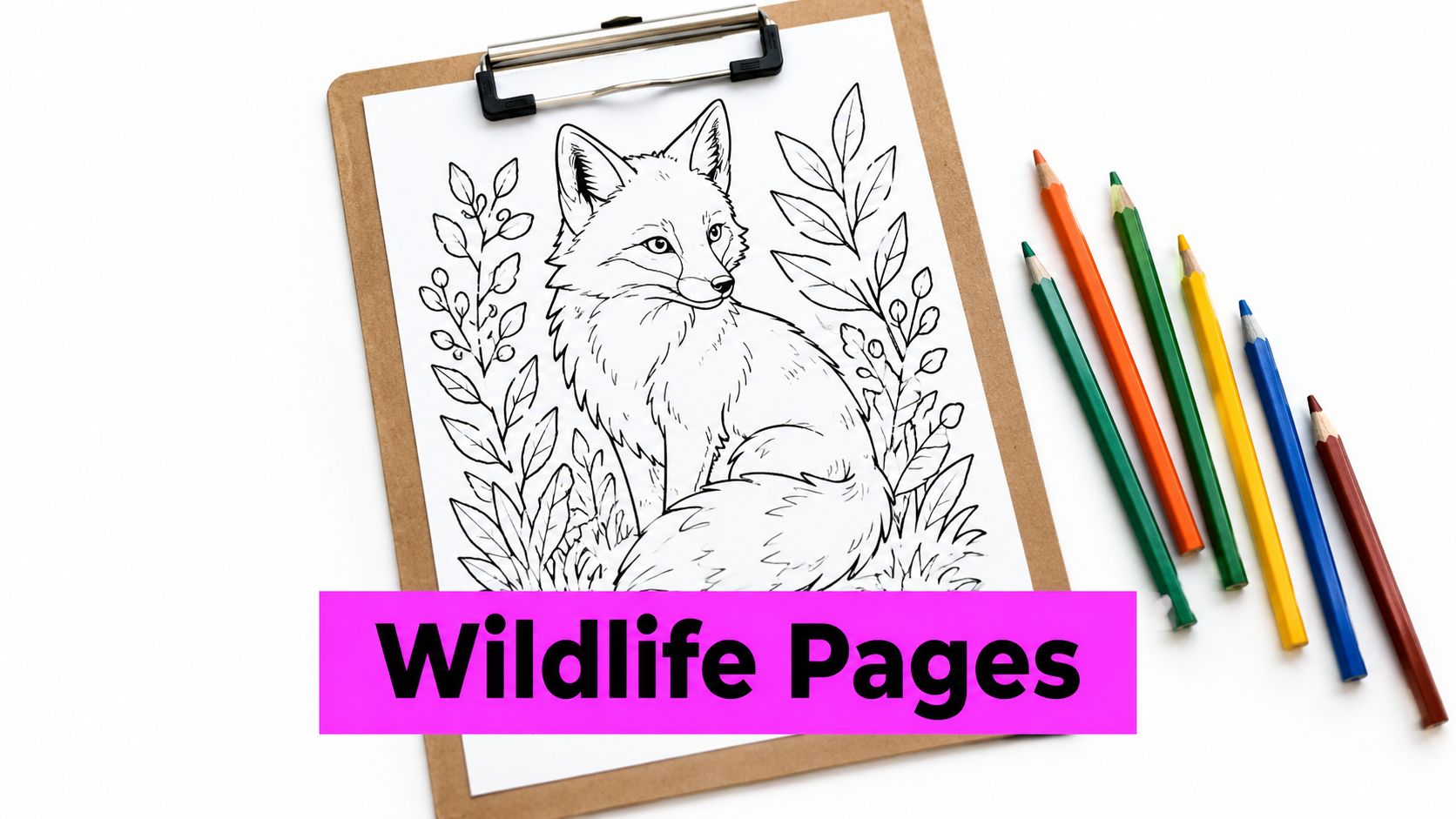
Nature pages work well because they combine clear subject matter with practical educational value. A fox on a forest path, a sea turtle among reef plants, or a bird beside regional foliage gives the user a recognizable animal and a setting that can support vocabulary, habitat discussion, or independent creative work.
The production risk sits in accuracy. Generators can make attractive animals with wrong anatomy, mismatched paws, extra limbs, feathers that do not fit the species, or plants built from unrelated traits. A page for a science classroom or conservation campaign needs subject review, not only visual approval.
Make the habitat carry the lesson
Prompt for the species, habitat, viewpoint, and surrounding objects. “Fox” is a starting point, not a complete brief. A woodland series can specify leaf litter, native trees, and a den, while an ocean series can use coral, kelp, and open water. Keep the background detailed enough to establish place, but leave broad regions open for comfortable coloring.
A regional collection can be organized around species groups and user needs, then scaled for batch production without flattening the content. Rainforest, wetland, grassland, ocean, arctic, and urban ecology each support different visual density. Mammals, birds, insects, marine life, and native plants each need different anatomy checks and different prompt language. Learning support can be added with a species name, pronunciation aid, short fact sheet, or observation prompt. Difficulty should also vary, from a simple animal portrait for beginners to a layered ecosystem scene for experienced colorers.
Check every page for recognizable anatomy, sensible scale, clean outlines, and enough white space. If fine botanical lines matter, print an enhanced sample and inspect it at the intended size. Watch the species details closely. A fox with feline pupil shapes or a canid body paired with merged front and hind legs signals a generation error that needs correction before release.
A zoo gift shop may want friendly portraits. An environmental organization may prefer habitat scenes paired with educational information. Match the page format to the intended use case.
4. Seasonal and Holiday-Themed Coloring Pages
Seasonal coloring pages succeed or fail on timing. A winter activity sheet, Halloween scene, spring celebration, or harvest illustration needs a production window that allows for editing, printing, listing, and distribution before interest peaks. Familiar occasions simplify subject selection, while regional traditions and cultural symbols require deliberate review.
Build the release calendar before writing prompts. Group each occasion into a small batch, then define the audience, page size, line density, and customization needs for that batch. A family bundle might combine simple shapes for younger users, moderately detailed scenes for older children, and decorative pages for adults. A retailer may need a narrower set connected to its products.
Customization works best as a separate production layer. Teachers may request a classroom name, retailers may add a logo, and wellness centers may need a short greeting. Generate the line art without lettering or branding, then typeset approved text afterward. This avoids unreliable AI lettering and makes spelling changes easier.
A practical workflow looks like this:
- Core scene: Create the illustration without words, logos, or complex text.
- Regional adaptation: Check symbols, clothing, foods, and traditions for cultural fit.
- Difficulty variants: Reduce background density while keeping the main subject recognizable.
- Brand layer: Add approved logos, colors, disclaimers, or calls to action during editing.
- Release review: Verify dates, spelling, margins, grayscale clarity, and print performance.
Bulk Image Generation can produce several seasonal variations from one defined prompt system. Keep the subject, composition, and line style consistent, while changing greetings, objects, or difficulty levels in controlled batches. Review representative pages before processing the full set, since a single prompt error can spread across every variation.
Print testing decides whether the files are ready. Thin decorative lines and pale elements may disappear on inexpensive paper, even when they look clear on screen. A winter bundle can serve families, classrooms, and community programs without assuming one celebration. Speed matters only when review preserves clarity and appropriateness.
5. Geometric and Pattern-Based Coloring Pages
Geometric coloring pages work best when treated as a controlled production system. Tessellations, bilateral designs, radial patterns, Celtic knots, organic repeats, and optical compositions can share one visual grammar, allowing you to build a recognizable series instead of a set of unrelated experiments.
Start with the audience because density determines usability. A mathematics worksheet may need visible rotations, translations, and repeating units. An adult coloring collection can support finer detail, while a mindfulness page usually benefits from open regions and steady rhythm. Narrow sections, crowded intersections, and weak print margins can make even a symmetrical design unpleasant to color.
Build a repeatable pattern system
Define the construction method in each prompt. Specify symmetry, repetition, line weight, region size, and difficulty rather than asking for a “beautiful pattern.” The AI pattern generator can support prompt development for collections built around a consistent structure.
Use a small production brief:
- Pattern family: Choose radial, bilateral, translational, or organic repetition.
- Coloring access: Keep regions large enough for the intended pencil, marker, or crayon.
- Line integrity: Remove broken paths, accidental fills, and muddy intersections.
- Print readiness: Check centering, contrast, grayscale clarity, and practical margins.
- Batch consistency: Hold line style and complexity steady while varying the motif.
A tessellation series might teach translation and rotation through examples that become gradually more intricate. An adult collection might move from broad shapes to fine detail, giving users a clear progression without making every page equally dense. Customization can follow the same system: retain the grid or symmetry rules, then change a name, theme, motif, or difficulty level during editing.
Batch generation is efficient for this category, but variation still needs boundaries. Review representative outputs for duplicate layouts, broken symmetry, and regions too small to print or color. Generate the full set only after those checks pass. The goal is a usable pattern family, not unlimited novelty.
6. Fantasy and Adventure-Themed Coloring Pages
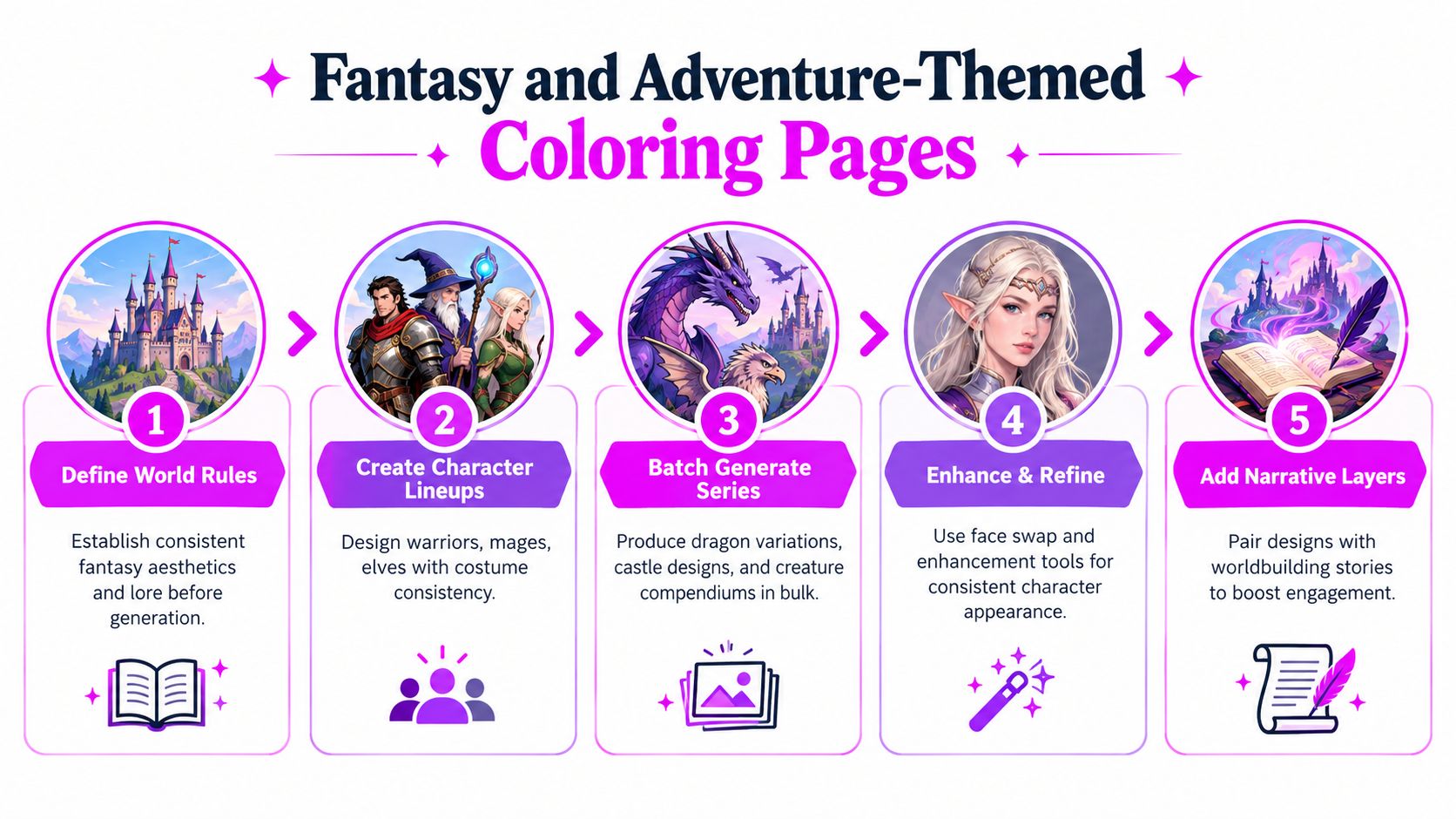
Fantasy coloring pages work best as connected worlds, not collections of unrelated dragons and castles. Each page gives users choices about costumes, architecture, scenery, and mood. That makes the category suitable for children seeking imaginative play, authors introducing settings, and brands extending a fictional world beyond a single product.
Production starts with a compact world guide. Set recurring characters, creature anatomy, architectural motifs, costume details, symbols, and an appropriate level of darkness or peril. These decisions control complexity. Younger audiences need open shapes and clear silhouettes, while older colorers can handle layered scenery, textured clothing, and detailed structures.
A useful batch plan follows one narrative thread:
- Character lineup: Define body shape, facial features, clothing, props, and identifying colors before generating scenes.
- Scene progression: Place the same figures in travel, discovery, problem-solving, or creature encounters.
- Customization points: Reserve editable elements such as names, banners, locations, companion creatures, or quest objects.
- Quality checks: Compare pages for continuity, readable silhouettes, clear scene hierarchy, and age-appropriate intensity.
A small character test should come first. Generate several scenes with the same figures, then compare clothing, proportions, props, and facial details. Scale the batch only after those elements remain recognizable. This reduces the cost of correcting a recurring design error across an entire collection.
Bulk Image Generation can support this workflow by producing variations from a controlled prompt structure. Keep the world rules fixed while changing the setting, action, or supporting creatures. Review representative outputs for tangled wings, collapsed castle geometry, inconsistent symbols, frightening imagery, and accidental resemblance to protected characters or a living artist's distinctive style.
Post-processing can strengthen contrast and remove distracting background marks, but it cannot repair a broken narrative or unreliable anatomy. The finished series should feel like one world with several scenes, giving users creative freedom without sacrificing continuity.
7. Educational and Curriculum-Based Coloring Pages
The educational value of a coloring page comes from its objective and the adult guidance around it; a school-related object alone does not create a lesson. A page featuring numbers, animals, or historical figures needs a defined task, suitable prompts, and an activity that extends learning beyond coloring.
Start with the learner and the intended outcome. A preschool teacher could use a farm scene for oral vocabulary and counting. A primary teacher might ask students to label plant parts, while a language instructor could use the same scene to practise descriptive sentences. Each version needs enough open space for the interaction, with visual detail matched to the learner's age and task.
Build a repeatable learning-page workflow
Write the learning objective before selecting the subject, complexity, or format. A curriculum batch may cover geography, science, language learning, history, or social studies. Give every page a specific role in that sequence.
Use a short production brief:
- Objective: What should the learner identify, describe, compare, or recall?
- Visual model: Which objects and relationships must be unmistakable?
- Guided prompts: What can an adult ask before, during, and after coloring?
- Independent extension: Can the learner draw, label, sort, or explain something afterward?
- Validation: Will an educator check age fit, factual accuracy, and classroom usefulness?
Batch generation works well when the objective and visual vocabulary stay fixed while examples change. Review line weight, region size, labels, cultural context, and whether the page still supports the intended activity after printing. A crowded illustration can turn a lesson into a tracing exercise.
Accessibility decisions belong in the brief. Use thicker outlines, larger regions, strong contrast, uncluttered compositions, and tactile or verbal alternatives where appropriate. Instructions should not depend entirely on reading ability, as discussed in this 2025 inclusive coloring resource directory.
Use the educational coloring pages guide for production inspiration. Bulk Image Generation can help create controlled variations, while educators must test the finished pages in context. Their feedback shows whether a page teaches, distracts, excludes, or only occupies time.
8. Social Media and Marketing-Ready Coloring Templates
A marketing coloring page must earn attention through use, then carry the brand naturally. A coffee shop can offer a printable cup illustration, a beauty company can build a page around a product shape, and a software brand can provide a simple activity as an email incentive. These concepts serve families, customers, and followers who want a quick creative task. Keep the line art uncomplicated for broad participation, while adding detail only when the audience has time and interest to color carefully.
Set up the production brief before generating a batch. Define the page size, line weight, empty space for branding, and the visual elements that may change across versions. Batch generation can produce a weekly challenge, product collection, or campaign series, but every variation needs the same recognizable visual identity. Review hands, packaging, text areas, and repeated motifs for distorted lines or accidental clutter.
Platform fit needs its own exports. Prepare 1080x1080 artwork for feed previews and 1080x1920 artwork for stories without stretching the line art. The printable PDF needs readable margins, a clear file name, and a landing page that states what the user receives. Keep promotional copy outside the coloring area, and add logos, approved typography, product names, and calls to action during editing rather than relying on image generation.
Use this release check:
- Brand accuracy: Apply approved logos and typography after generation.
- Platform fit: Check every crop and export at its intended dimensions.
- Lead capture: Explain the download and consent experience clearly.
- Shareability: Make the artwork appealing even if nobody posts it.
- Rights and claims: Review product depictions, character references, and promotional language.
A handout and a downloadable campaign can use different layouts while sharing restrained colors, line treatment, and brand cues. Track downloads, completion feedback, repeat participation, and comments to select the next batch. Judge every branded page by one test: would a user still print and color it if the logo were removed? If yes, the campaign asset is doing its job.
8-Category Coloring Pages Comparison with Examples
| Title | Implementation complexity | Resource requirements | Expected outcomes | Ideal use cases | Key advantages |
|---|---|---|---|---|---|
| AI-Generated Mandala Coloring Pages | Low–Medium, standard prompts with optional refinement for complexity | Low, compute for batch generation, minimal editorial review, high-res export | Large volume of precise, scalable mandalas suitable for adult meditative coloring | Adult coloring books, mindfulness resources, bulk print-on-demand | Fast bulk output, consistent line quality, adjustable complexity |
| Character-Based Coloring Pages for Children | Medium, requires design guidelines for consistency and age-appropriateness | Moderate, prompt tuning, child testing, copyright checks | Diverse character sets and scenes tailored to ages 3–12 | Educational publishers, apps, children's merchandise | Rapid character variation, adaptable across age groups, supports licensing |
| Nature and Wildlife Coloring Pages | Medium–High, needs accurate anatomical and habitat prompts | Moderate, expert review for accuracy, high-res detail sharpening | Realistic flora/fauna pages useful for education and awareness campaigns | Museums, environmental nonprofits, science educators, gift shops | Authentic natural detail, STEM education support, high shareability |
| Seasonal and Holiday-Themed Coloring Pages | Low, straightforward theming but requires cultural sensitivity | Low–Moderate, batch generation plus scheduling and localization | Time-sensitive, high-demand themed collections with short sales windows | Retailers, teachers, corporate marketing, seasonal campaigns | Fast to market, high seasonal sales potential, reusable templates |
| Geometric and Pattern-Based Coloring Pages | Low–Medium, needs precise geometric prompts and symmetry specs | Low, compute for pattern generation, export at high DPI | Mathematically precise patterns ideal for meditative and premium products | STEM education, adult coloring, premium collections | Exact symmetry, infinite variation, professional appearance |
| Fantasy and Adventure-Themed Coloring Pages | Medium–High, complex scenes and consistent worldbuilding required | Moderate, refinement tools, IP risk checks, detailed post-processing | Elaborate fantasy scenes and character rosters appealing to fandoms | Game publishers, authors, fan communities, merch and subscription creators | Strong niche appeal, premium pricing potential, highly shareable |
| Educational and Curriculum-Based Coloring Pages | High, requires curriculum alignment and content accuracy verification | High, subject-matter review, multilingual/text integration, testing | Curriculum-aligned workbooks and grade-specific materials for learning objectives | Schools, homeschoolers, edtech platforms, special education providers | Meets learning goals, institutional demand, highly customizable by grade |
| Social Media and Marketing-Ready Coloring Templates | Medium, brand integration and multi-platform optimization needed | Moderate, brand assets, multiple aspect ratios, CTA/QR integration | Engagement-focused, branded templates designed for sharing and lead capture | Brands, agencies, influencers, in-store promotions and lead magnets | High engagement and virality, effective lead generation, brand-consistent templates |
Turn One Strong Example Into a Printable Series
The eight formats serve different goals. Mandalas and geometric patterns suit adults seeking focused, repeatable coloring. Character pages work for children when the line complexity and story fit the age group. Nature and wildlife pages can support observation and environmental learning. Educational pages need explicit objectives and educator review. Seasonal collections depend on timely production and cultural care. Fantasy pages benefit from consistent world rules. Marketing templates need a useful activity, clean branding, and a clear distribution path.
Coloring products have also proved adaptable across audiences and markets. Kate Greenaway's Little Folks' Painting Book, published in 1879, is often identified as one of the earliest children's coloring books, while earlier paint books were also marketed to adults as educational or moral tools. This history of coloring pages shows why the format remains useful: a clear outline paired with a visual model can support creative activity, guided learning, and themed storytelling.
The adult category demonstrates the commercial potential of a recognizable concept and consistent visual identity. Johanna Basford's Secret Garden began with an initial print run of 13,000 copies in 2013, and later reporting placed worldwide sales at roughly 2 million copies by 2015. Her follow-up Enchanted Forest sold nearly 250,000 copies in its first month after its February 2015 release. Nielsen BookScan data cited by Time's report on adult coloring books placed U.S. coloring-book sales at about 1 million copies in 2014 and more than 12 million in 2015. Those figures don't guarantee demand for a new collection, but they reinforce the value of distinctive themes over generic outlines.
Use a disciplined production sequence:
- Choose one audience: Define the user, setting, and intended outcome.
- Set the visual rules: Decide page size, margin, outline weight, detail level, and whether text belongs outside the illustration.
- Create a small test batch: Compare several prompts and reject attractive but impractical outputs.
- Inspect every image: Look for broken anatomy, unwanted lettering, muddy intersections, inconsistent characters, and unsafe or culturally unsuitable details.
- Refine the prompt: Keep what works, remove ambiguous language, and document the successful structure.
- Scale the winner: Use Bulk Image Generation and its batch editor to create a coherent collection, resize assets, remove backgrounds where appropriate, and prepare variants.
- Validate the product: Print samples, ask educators or intended users to review relevant pages, and check licensing and intellectual-property issues before distribution.
Don't promise therapeutic outcomes. The evidence supports coloring as an accessible activity for nonclinical populations, not as a replacement for clinical treatment. Phrase wellness benefits around focused engagement, relaxation, or creative routine, and keep the page design aligned with what users can realistically complete.
A strong example is valuable because it teaches you what to repeat. Once the audience, complexity, subject, and production checks are clear, scaling becomes a workflow decision rather than a gamble.
Bulk Image Generation can create consistent coloring-page variations in batches, support complete themed books through individual prompts, and provide editing tools for resizing, enhancement, and background cleanup. Visit Bulk Image Generation to turn a tested coloring-page concept into a printable series for children, adults, classrooms, or branded campaigns.