What is prompt: what is prompt and how it unlocks AI

Ryan Bennett • January 31, 2026
This guide explains what is prompt and how it guides AI to create powerful text and image results.
A prompt is just a set of instructions you give to an artificial intelligence model. Think of it as the language we use to talk to AI. It’s not just a question but a command, a creative brief, and the driving force behind any AI-generated result. Getting good at writing them is the secret to unlocking what these tools can really do.
What Is a Prompt and Why Does It Matter
Imagine you hired a brilliant but extremely literal assistant. If you ask for "a picture of a car," you might get a cartoon, a photograph, or a child's messy crayon drawing. It did what you asked, but it’s probably not what you wanted.
Now, what if you specified, "a photorealistic image of a red 1965 Ford Mustang convertible driving along a coastal highway at sunset"? You’re going to get a much more precise and useful result. That detailed instruction is a prompt. It’s the bridge between the idea in your head and the AI's final creation.
The quality of your prompt directly dictates the quality of the AI's output. A vague prompt leads to a generic, often useless, result. A well-crafted one, however, acts as a detailed creative brief that steers the AI toward your exact vision. This makes prompt writing a critical skill for just about anyone—from marketers creating ad campaigns to educators designing custom lesson plans.
The Core Function of a Prompt
At its heart, a prompt does one thing: it gives the AI enough context and direction to do a job well. To really get why this is so important, it helps to understand what AI-generated content actually is and how it comes to life. Every single piece of AI text, art, or code starts with a prompt.
To help you get started, we've broken down the essential components of a powerful prompt. Think of these as the building blocks for telling the AI exactly what you need.
The Anatomy of an Effective AI Prompt
| Component | Description | Example in a Prompt |
|---|---|---|
| Task | The main action you want the AI to perform. | "Write a blog post..." |
| Context | Background information to guide the AI's understanding. | "...for an audience of small business owners." |
| Persona | The voice or perspective the AI should adopt. | "As a seasoned marketing expert..." |
| Format | The desired structure or layout of the final output. | "...in a bulleted list that is easy to scan." |
Putting these elements together gives you control and ensures the output is much closer to what you envisioned from the start.
Why Prompting Is a New Essential Skill
As AI tools become a regular part of our work, the ability to communicate with them effectively is shifting from a niche technical skill to a fundamental competency. Knowing what a prompt is and how to build a good one can dramatically boost your productivity and creativity.
A well-crafted prompt doesn’t just ask the AI for an answer; it collaborates with the AI to create a solution. It's the difference between being a passenger and being the driver.
For a small business, this means creating high-quality marketing materials without a huge budget. For an educator, it offers a way to generate custom learning aids in minutes. Ultimately, understanding prompts gives you control over some of the most powerful creative tools ever developed.
Exploring the Different Types of AI Prompts
When most people think of a "prompt," they usually picture typing a simple command into a chatbot. But that’s just scratching the surface. Prompts are the language we use to talk to AI, and they come in a few different flavors, each built for different kinds of creative work. Getting a handle on these types opens up a world of possibilities that go way beyond just asking for text.
The one we all know is the text prompt. It’s just a written instruction you give an AI, whether you’re asking ChatGPT to draft a tricky email or giving an image generator a creative brief. For example, a marketer might type in, “Generate five catchy Instagram captions for a new eco-friendly water bottle, targeting millennials with a witty and energetic tone.” That one sentence can kickstart an entire social media campaign.
Beyond Simple Text Commands
As AI has gotten smarter, so have the ways we can direct it. We're not just limited to words anymore. Now we have the image prompt, sometimes called "image-to-image" or "visual prompting," which uses a picture as the main instruction.
This is where you can give the AI a reference image to guide what it creates. Imagine a small business uploading its current logo and prompting the AI to “generate ten variations of this logo in a minimalist, modern style.” The AI doesn’t just guess; it uses the original picture as its starting point for the style, colors, and overall feel, spinning up new ideas that still feel like they belong to the brand.
At their core, prompts are just creative inputs that steer an AI model toward the output you want. Whether that input is text, a picture, or a mix of both, the goal is always the same: give the AI clear, actionable direction.
And this is where the real magic of communicating with AI starts to show up. When you start mixing and matching different kinds of prompts, you get an incredible amount of control over the final product.
Understanding Multimodal Prompts
The most sophisticated way to instruct an AI right now is with a multimodal prompt, which is just a fancy way of saying you’re combining two or more different types of information. Think about it like this: if you’re a video creator, you could give an AI a text script (that’s one mode) and a reference image to set the visual style (that’s the second mode). Then, you could prompt it to “create a short animated video scene based on this script in the artistic style of this image.”
This kind of layered instruction feels much more like how we humans communicate—we use words, show pictures, and rely on context all at once. Being able to work with these different prompt types is quickly becoming a critical skill. In fact, after ChatGPT launched, job postings mentioning 'GPT' shot up by 51% in 2023, showing just how much demand there is for people who know how to guide generative AI. If you want to dive deeper, you might be interested in our guide on the 25 best prompt ideas for AI image generators.
How Prompts Drive AI Image Generation
This is the moment your words become pictures. The best way to think about it? You’re the art director, and your prompt is the creative brief you hand over to a brilliant, ridiculously fast artist—the AI. Every single word in that brief steers the AI from a blank canvas to a finished, pixel-perfect image.
AI image generators like DALL·E and Midjourney don't "understand" your prompt the way a person does. Instead, they chop your sentence into smaller data chunks in a process called tokenization. The model then maps these tokens to the billions of images and text descriptions it was trained on, spotting patterns to build a brand-new visual that fits your request.
A simple prompt gives the AI tons of creative freedom, which sounds great but often leads to generic, uninspired results. A detailed prompt, on the other hand, acts as a precise set of instructions, telling the AI exactly what to include, what to ignore, and how to render it.
From Vague Ideas to Vivid Images
The real magic of a prompt is in the specifics. By layering in descriptive words, you gain direct control over the most important parts of the final image. Each new detail you add sharpens the output, turning a fuzzy concept into a crisp, intentional visual.
Think of it like building with LEGOs. You start with the core pieces and then add the details that make it unique.
- Subject: Start with what you want to see. "A cat" is a starting point, but "a fluffy ginger tabby cat" gives the AI much more to work with.
- Style: Define the artistic feel. Is it a "photograph," an "oil painting," a "watercolor illustration," or a "3D render"? Each one produces a completely different vibe.
- Composition: Direct the virtual camera. Use phrases like "close-up," "wide-angle shot," or "from a low angle" to frame your subject perfectly.
- Lighting: Set the mood. Words like "dramatic lighting," "soft morning light," or "neon glow" can completely transform the feeling of an image.
The infographic below breaks down the different types of prompts you can use to talk to an AI, from simple text to more advanced combinations.
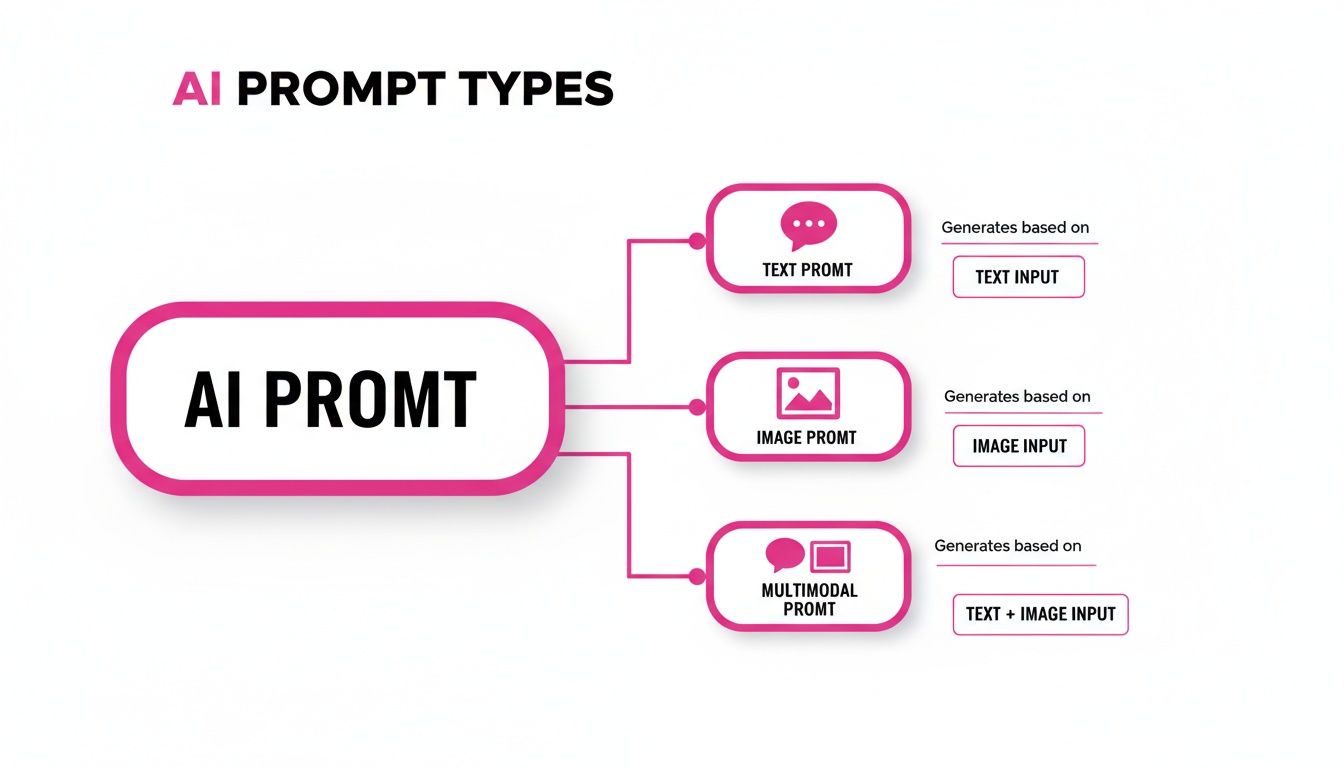
As you can see, while text is the most common way to prompt, mixing it with reference images (multimodal prompts) gives you even more creative power.
Putting It All Together: A Practical Example
Let’s watch this unfold by building a prompt layer by layer.
Simple Prompt: a robot
This is way too vague. The AI has no idea what you want. It might spit out a toy, a movie character, or an industrial arm.
Detailed Prompt: A photorealistic close-up of a friendly, vintage robot from the 1950s, made of chrome and brass, standing in a lush green forest during golden hour.
The difference is night and day. The detailed prompt nails down the subject (vintage robot), style (photorealistic), composition (close-up), materials (chrome and brass), setting (lush forest), and lighting (golden hour).
By providing this level of detail, you shift from being a passive requester to an active creator. You're directing the AI to produce exactly what’s in your head. For marketers, educators, and small business owners who need specific, high-quality visuals, this skill is everything.
Best Practices for Crafting Powerful Prompts
Knowing what a prompt is and writing one that actually gets you the image you want are two very different things. Getting from a fuzzy idea in your head to a stunning visual isn’t about making a wish; it's about giving a detailed creative brief to a highly skilled, incredibly literal artist.
The trick is to build your prompt in layers. Don’t just ask for "a picture of a dog." Instead, give the AI the specific details it needs to bring your exact vision to life. This simple shift turns a vague request into a powerful command.
Start With Specificity And Context
Every great prompt is built on a foundation of clarity. The AI needs to know precisely what you want, who it’s for, and why. Vague inputs will always give you generic, forgettable outputs. You have to be descriptive right from the start.
- Be Specific: Instead of “a car,” try “a vintage red convertible sports car.”
- Provide Context: Don’t just say “a logo.” Ask for “a minimalist logo for a coffee shop, using earthy tones.”
- Define the Goal: Clearly state the purpose, like “an engaging hero image for a blog post about sustainable travel.”
This first layer of detail strips away the ambiguity and gives the AI a solid framework to work with. It's no surprise that techniques providing examples for consistent results now hold 34% of the prompt engineering market share—they’re perfect for producing visuals at scale without endless trial and error. To really sharpen your skills, especially for things like brand visibility, digging into resources on LLM prompt engineering is a great next step.
Define Style And Iterate For Perfection
Once the subject and context are locked in, it's time for the fun part: defining the artistic direction. This is how you control the mood, the aesthetic, and the entire feel of the image. Think of yourself as a photographer choosing a specific lens, a lighting setup, or a unique post-processing effect.
Use keywords that paint a picture of the visual style you’re after. This could include:
- Artistic Medium: Do you want a
photograph,oil painting,watercolor,3D render, or a cleanvector illustration? - Lighting: Use terms like
soft morning light,dramatic studio lighting, orgolden hourto completely change the mood. - Composition: Direct the "camera" with phrases like
close-up shot,wide-angle view, orfrom a low angle.
The best prompts are almost never created on the first attempt. The magic happens in the iteration. Start with a solid base, generate an image, see what the AI got right, and then refine your prompt with even more detail.
This isn't just theory; it has a real-world impact. A 2023 Forrester report found that personalized prompt engineering boosted e-commerce customer engagement by 35%. That's the power of creating specific, targeted visuals.
Let’s watch this process unfold:
- Initial Idea:
a golden retriever - Adding Specifics:
a golden retriever puppy playing in a field - Defining Style & Iterating:
A photorealistic image of a golden retriever puppy playing in a sunlit field of wildflowers, shot with a shallow depth of field, warm and joyful mood.
See how each layer gets you closer to a final, polished image? If you feel stuck or just want a creative nudge, our free AI image prompt generator is a great place to get some ideas flowing.
Comparing Prompting Techniques For Better AI Results
To get the most out of AI, it helps to know a few specific prompting methods. These aren't complicated tricks, but rather structured ways of communicating with the model to guide it toward a better, more predictable result.
| Technique | How It Works | Best For |
|---|---|---|
| Zero-Shot Prompting | You ask the AI to do something without giving it any prior examples. It's a direct command like, "Create a logo for a bookstore." | Simple, straightforward tasks where you trust the AI's general knowledge. |
| Few-Shot Prompting | You provide 2-3 examples within the prompt to show the AI the pattern or style you want it to follow before giving the final instruction. | Achieving a specific style, format, or tone consistently across multiple outputs. |
| Chain-of-Thought (CoT) | You ask the AI to "think step-by-step" or break down its reasoning process. This forces it to slow down and create a logical path to the answer. | Complex problems, multi-step image compositions, or troubleshooting a prompt that isn't working. |
| Negative Prompting | You explicitly tell the AI what to avoid. For example, adding --no text, ugly, deformed hands to an image prompt. | Removing unwanted elements, fixing common AI art issues, and refining the final image. |
Choosing the right technique depends entirely on your goal. For a quick, creative idea, zero-shot is fine. But for a consistent set of branded images, few-shot or negative prompting will give you far more control.
The Future of AI Interaction Beyond Manual Prompts
While getting good at writing the perfect instruction is a valuable skill right now, the way we talk to AI is already evolving. The whole conversation is becoming more natural, more focused on the big picture. We're slowly shifting away from being meticulous prompt engineers and becoming clear communicators of what we ultimately want to achieve.
Instead of typing out a long, complicated prompt with dozens of parameters, you'll soon just describe your desired outcome. Imagine telling an AI, “I need a set of social media images for a new coffee blend,” and the system figures out the optimized, detailed prompts on its own, working quietly in the background. This change is knocking down the steep learning curve of manual engineering, making advanced AI truly accessible to everyone.
The Shift from Engineering to Goal-Setting
This isn't some far-off future; it's already happening. The initial explosion in "prompt engineer" jobs tells a fascinating story. Searches on Indeed for the role shot up from just 2 per million in early 2023 to 144 per million after ChatGPT took off.
But by late 2023, those numbers began to level out as the AI models themselves got much better at understanding what we actually mean. Today, automated tools are expected to slash prompt creation time by up to 60%, which points directly to smarter, self-optimizing systems. You can read more about this trend and why some believe prompt engineering jobs may be obsolete by 2025.
This evolution is a huge win for creative freedom. It empowers people who aren't technical experts to get professional-grade results without needing to master a complex new skill. The real value is no longer just in knowing how to write a prompt, but in having a clear vision for what you want to create.
The future of prompting isn't about memorizing keywords or complex syntax. It’s about having a natural, collaborative conversation with an AI that understands your ultimate goal and helps you get there.
What This Means for You
For anyone creating content, this move toward intuitive AI is a game-changer. The focus is shifting from the mechanics of the prompt to the quality of the idea behind it.
- For Marketers: You can spend your time nailing down campaign strategy instead of getting lost in the weeds of crafting the perfect image description.
- For Educators: You can generate custom learning materials just by describing the lesson's objective.
- For Small Businesses: You can create on-brand visuals without needing a dedicated designer or an in-house prompt wizard.
Communicating with AI is becoming as natural as brainstorming with a creative partner. We dive deeper into this new era of creativity in our article on AI image generation trends for 2025.
A Few Common Questions About AI Prompts
Even as you get more comfortable directing AI, a few questions tend to pop up again and again. Getting the hang of these core ideas is the key to understanding why a thoughtful, well-crafted prompt makes all the difference between a mediocre result and a masterpiece.
Let's clear up some of the most common points of confusion.
What's the Difference Between a Prompt and a Query?
It’s easy to mix these two up, but they represent two totally different ways of interacting with technology.
A query is a straightforward request for information that already exists. Think of it like asking Google, "what is the capital of France?" The system just fetches a fact from its massive database and gives it to you. Simple.
A prompt, on the other hand, is a creative brief. It's a set of instructions you give a generative AI to create something entirely new that has never existed before. It’s the difference between asking a librarian where to find a book on Mount Everest and commissioning an artist to paint a brand-new masterpiece of it.
For example:
- Query: "highest mountain in the world"
- Prompt: "Create a photorealistic image of a lone hiker reaching the summit of Mount Everest at sunrise, conveying a sense of triumph and awe."
One pulls a known fact; the other sparks a creative act.
What Actually Makes a Prompt "Good"?
A "good" prompt is one that successfully translates the vision in your head into clear instructions the AI can actually follow. It’s specific, it’s loaded with helpful context, and it leaves very little up to the AI’s imagination. The quality of your prompt is directly tied to the quality of the image you get back.
A truly effective prompt usually includes a few key ingredients:
- Clarity: It uses simple, direct language. No room for misinterpretation.
- Specificity: It gets into the nitty-gritty—the subject, style, colors, lighting, even the camera angle.
- Context: It gives the AI a sense of the mood or purpose. What feeling are you trying to evoke?
- Constraints: It often includes negative prompts, telling the AI what not to do (e.g.,
no text, no blurry backgrounds).
The best prompts are almost never perfect on the first try. They’re born from iteration. You start with an idea, see what the AI creates, and then tweak and refine your prompt with more detail until the output matches exactly what you pictured.
A weak prompt like "a picture of a car" is a total gamble. But a good prompt like "A side-profile photograph of a sleek, black electric sports car on a wet city street at night, with neon lights reflecting off its glossy paint" gets you exactly where you want to go.
Do I Need to Become a Prompt Engineer to Use AI?
Not anymore. While it definitely helps to know what makes a prompt work, the idea that you need to become a master prompt engineer is quickly becoming a thing of the past.
In the early days of AI image generation, you really did have to wrestle with highly technical, complex instructions to get anything decent. But today’s AI platforms are built to do the heavy lifting for you.
Modern tools are designed to understand your goals, not just your literal words. You can describe what you want in natural language, and the system is smart enough to build the perfectly optimized prompt behind the scenes. In fact, a 2023 McKinsey survey found that only 7% of organizations were hiring dedicated prompt engineers, which shows a massive shift toward more intuitive, user-friendly tools.
The focus has moved from manual, technical engineering to simply being clear about your creative vision. For marketers, educators, and entrepreneurs, this is a huge deal. You can focus on your big-picture strategy and let the AI handle the technical details. It puts powerful creative tools in the hands of anyone, no matter their technical skill level.
Stop wrestling with manual prompt engineering. Bulk Image Generation lets you describe your goals in simple language and produces hundreds of professional, on-brand images in seconds. Try it for free and see how easy it is to scale your creative workflow.