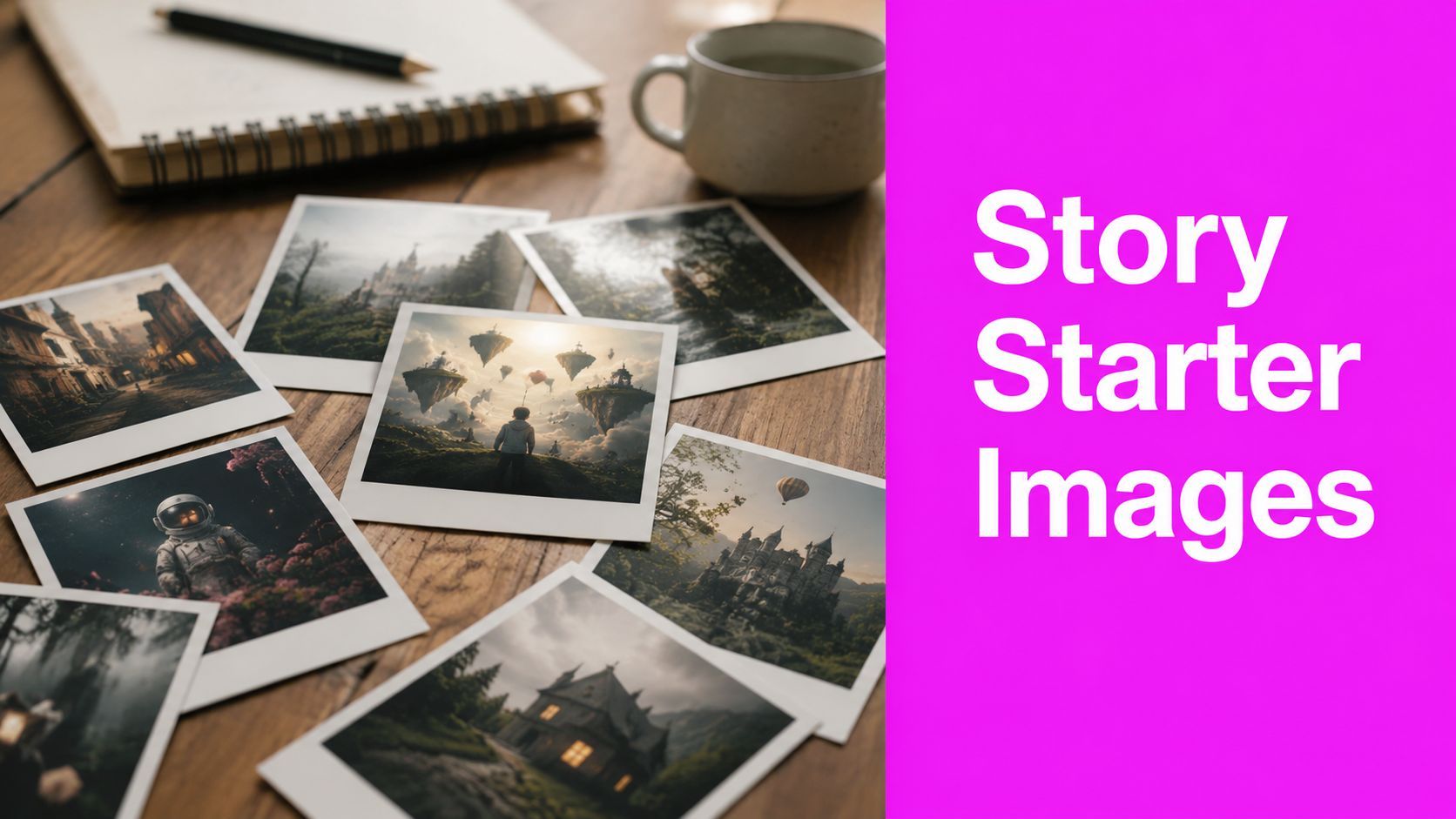
Story Starter Images: A Guide to Sparking Creativity

Ryan Bennett • June 17, 2026
Unlock endless creative ideas with story starter images. Learn how to find, create, and use visual prompts for education, marketing, and writing projects.
You open a document for your class, your campaign, or your next post. The cursor blinks. The page stays empty. You know you need an idea, but what you really need is a starting point that doesn't ask you to invent everything at once.
That's where story starter images help. A single visual can replace pressure with direction. Instead of asking, “What should I write?” you start asking better questions: Who is this person? Why is the door open? What happened just before this moment? What happens next?
I use them the same way in teaching and in creative planning. In a classroom, they help reluctant writers get moving. In marketing, they help teams build hooks, captions, campaign angles, and short-form narratives without forcing every brainstorm to begin from zero. If you write fiction, they can also sharpen genre thinking. For example, if you want to study visual tension and mood, this guide to developing terrifying novels shows how prompts can push an idea toward dread instead of generic suspense.
If you want to generate starting points quickly, a tool like this free AI image prompt generator can help you turn a vague concept into something visual enough to react to. That reaction matters. Many individuals don't have a creativity problem. They have a starting problem.
The End of the Blank Page
Why the blank page feels so hard
A blank page asks for too much at once. You need a setting, a character, a conflict, a tone, and a reason to care. Even confident writers stall when they have to make all of those decisions before writing the first sentence.
Story starter images lower that barrier. They give you some of the decisions for free. A scene already exists. A mood is already implied. The writer or viewer can spend less energy inventing from nothing and more energy interpreting what's there.
A good prompt image doesn't finish the story. It gives you enough to begin.
That's why these visuals work for more than creative writing. A teacher can use one image to start a narrative lesson. A social media manager can use one image to test several campaign angles. A small business owner can use one scene to brainstorm product storytelling, seasonal content, or customer scenarios.
What changes when you start with a visual
Think about two common situations.
In one, a student gets the instruction “Write a story about an adventure.” The task is broad. Some students enjoy that freedom. Many freeze.
In the other, the student sees a picture of a child in rain boots holding a map beside a flooded park bench. Now the mind has something to grip. The student can infer location, weather, mood, and possible conflict. The writing starts faster because the thinking starts faster.
The same thing happens in marketing. “Write a post about our brand” is abstract. “Write three captions for an image of a baker carrying a ruined birthday cake through a dark parking lot in the rain” is specific enough to reveal tone, audience, and point of view.
When people say they've run out of ideas, they often mean they've run out of entry points. Story starter images create those entry points.
What Exactly Are Story Starter Images
A story starter image is a visual prompt designed to spark narrative thinking. It isn't just an illustration. It's more like an opening shot in a film or the first paragraph of a novel. It introduces enough context to trigger curiosity, then leaves space for the audience to complete the rest.

The simplest way to define them
If a normal image says, “Look at this,” a story starter image says, “What's happening here?”
That difference matters. A product photo may show an object clearly. A story starter image introduces tension, implication, or unanswered action. A lantern left on a staircase. A backpack on a playground at dusk. A chef staring at an empty plate while smoke rises behind them. The scene invites interpretation.
You can think of it as a key for a locked door. The image doesn't build the whole room behind the door. It just turns the handle.
Why they work so well
People remember stories better than isolated facts. A 2024 Quarterly Journal of Economics study found that the impact of statistics on beliefs faded by 73% over one day, while the impact of a story faded by only 32%. The study explains that stories create distinctive context and details that improve recall.
That finding helps explain why story starter images are powerful. The image itself may be static, but if it pushes the viewer into story mode, it gives the brain context, sequence, and implied meaning. That makes the idea easier to remember and easier to discuss later.
For younger learners, playful visual material can do this beautifully. If you're looking for an example of imagination-first visual engagement, this piece on how to engage kids with space colouring shows how visual prompts can invite children to build worlds rather than just fill space.
Practical rule: the best story starter images answer “where” and “who,” but leave “why” unresolved.
That unresolved part is the engine. It's what makes someone want to write, speak, caption, teach, or post.
Powerful Use Cases Across Industries
Some tools stay in one lane. Story starter images don't. They work in classrooms, content studios, and solo creative routines because they solve the same core problem in each place. They create a usable beginning.

In education
A teacher puts an image on the board. It shows a bicycle lying in tall grass beside an open gate. The students don't need a lecture to begin. They can name the setting, guess the time of day, infer what just happened, and decide who belongs in the scene.
Classroom guidance from Storyboard That supports this approach. Story starter images work best when they're intentionally ambiguous but still clear enough to support inference. Teachers often ask students to identify characters, setting, and implied action, because those cues help writers move from observation to plot.
That matters for reluctant writers and multilingual learners. A picture gives them shared material to talk about before they write. They aren't staring into abstraction.
In marketing
A marketer needs five social posts, two email hooks, and one blog angle for a seasonal campaign. Starting from a spreadsheet of features often leads to flat copy. Starting from a scene creates voice.
A coffee brand, for example, might use an image of a commuter standing alone at sunrise with a spilled paper cup and a train just leaving the station. That one visual can produce multiple narrative angles:
- Missed moment: The morning went wrong. What saves it?
- Routine reset: Start over with something better.
- Micro-drama: Every product sits inside a human moment.
If you want more examples of practical visual workflows for local brands, this article on AI images for small businesses shows how business owners can turn image concepts into usable content assets.
For individual creators
Writers, hobbyists, and journaling fans use story starter images as a daily creative trigger. You don't need a full plot. You need a spark. One image can produce a poem, a character sketch, a dialogue scene, or a short mystery setup.
Use one image in three ways. Write what happened before it, what happens during it, and what happens after it.
That simple routine trains flexibility. It also stops you from treating creativity as a single perfect idea. Instead, you learn to generate possibilities.
How to Create Effective Story Starter Images
The strongest story starter images usually contain three things: a clear subject, a readable setting, and an unresolved action. If one of those is missing, the prompt gets weaker. If all three are present, the image starts doing narrative work immediately.

What to include in the image
Start with the subject. This is the focal point the viewer notices first. It can be a person, an object, or an animal, but it needs to be specific enough to anchor the scene.
Then build the setting. A forest path, cluttered office, subway platform, school hallway, or rooftop greenhouse all give different story signals. Setting shapes genre faster than generally expected.
Finally, add unresolved action. This is the hinge that creates curiosity. A hand reaching toward an alarm. A suitcase left open in snow. A text message glowing on a cracked screen while someone looks away.
Here's a quick test:
- Too complete: A smiling family poses at dinner. There's not much to solve.
- Too vague: A blur of colors and shapes. There's not enough to infer.
- Just right: A child under a table clutching a birthday crown while adults argue in the next room.
How to generate them with consistency
For scalable creation, Apple's education workflow recommends treating story prompts as structured inputs. The guidance is to specify a central object, a setting, and one unresolved action, then vary style and angle across batches so the prompts stay coherent while producing different story paths, as described in Apple Education's resource on visual storytelling workflows.
That gives you a reliable prompt pattern:
-
Central object or subject
“A red umbrella,” “an exhausted florist,” “a locked arcade machine.” -
Setting
“In an empty school gym,” “at a roadside diner at night,” “inside a messy rehearsal room.” -
Unresolved action
“Just before opening a hidden note,” “while hearing footsteps upstairs,” “after noticing one shoe missing.”
Then vary the style. Try sketch, editorial illustration, cinematic still, collage, children's book art, or comic panel. Style changes how easy the scene is to read and how strongly it suggests age, mood, and genre.
Don't ask an image generator for “a creative writing prompt.” Ask for a subject, a place, and a tension point.
That shift turns random art into a repeatable creative system.
Classroom Activities and Lesson Ideas
Teachers often ask the same practical question. Which image should I use for this group? That's the right question, because the same visual can be either helpful or overwhelming depending on the learner.
A teaching challenge noted in this discussion of picture prompts and scaffolding is that one image can serve very different goals. It can support simple sentence building for beginners or push advanced writers into complex narrative work. The key is matching image complexity and support to the task.
Three adaptable lesson formats
Sentence from a scene
Best for early writers, language learners, or students who need confidence before longer drafting.
Show one image with a strong focal subject and obvious setting. Ask students to complete frames such as:
- I see...
- The person is...
- They might be...
- This happened because...
Use images with fewer moving parts. One person, one place, one visible clue.
Character and conflict
This works well in middle grades. Students need more than naming objects, but they still benefit from structure.
Have them answer:
- Who is the main character?
- What does this character want?
- What is stopping them?
- What might happen next?
A useful image here includes a readable emotional cue and one unresolved detail, such as a broken trophy, torn letter, or half-open door.
Point of view shift
Older students and advanced writers can handle a richer scene and a less guided task.
Give the same image to the whole class, then assign different perspectives:
- the main character
- a hidden observer
- a future narrator looking back
- an object in the scene
This turns one image into multiple narrative voices without needing a new prompt.
AI prompt templates for story starter images
If you want to generate fresh materials, these templates help. You can also browse these prompt ideas for AI image generators when you need examples to adapt for a lesson or workshop.
| Goal | Prompt Template |
|---|---|
| Early sentence writing | “Create a simple, clear illustration of one child in a park holding an unusual object, with a readable background and gentle emotional tone.” |
| Narrative beginning | “Create a cinematic scene of one character in a specific setting just after discovering something unexpected, with one unresolved detail.” |
| Dialogue practice | “Create an image of two people reacting differently to the same event in a public place, with body language that suggests conflict.” |
| Point of view writing | “Create a scene with one central event and multiple background characters, so writers can choose different narrators.” |
| Marketing content ideation | “Create an editorial-style image of a customer in a real-life problem moment connected to [product category], with visible tension but no explicit resolution.” |
How to decide if an image fits
Use a quick filter before class:
- Check cognitive load: If students need several minutes just to identify what they're seeing, simplify the image.
- Look for one mystery: If there's no open question, the writing may stay descriptive instead of narrative.
- Match support to skill: Younger learners need frames and vocabulary. Older learners need constraints that still leave room for voice.
Good image selection is quiet teaching. Students feel like they're responding, but you've already shaped the path into the writing.
Best Practices for Quality Legality and Access
If you plan to use story starter images regularly, quality control matters as much as creativity. Without a system, your prompts become repetitive, your audience stops noticing them, and the images start feeling like decoration instead of triggers.
A challenge noted by Teach Starter's picture prompt resource is avoiding novelty fatigue and cliché when prompts are used at scale. For marketers and businesses, that means building repeatable workflows that keep prompts fresh, localized, and valuable for ideation.
Keep the image library fresh
Clichés show up fast. The mysterious key. The lonely road. The cracked mirror. These can still work, but not if every prompt relies on the same symbols.
Try rotating your prompt library by category instead of by random mood:
- Everyday tension: missed bus, broken cake, spilled coffee, unread message
- Place-based prompts: laundromat, rooftop, hallway, parking lot, greenhouse
- Object-first prompts: glove, notebook, flashlight, receipt, bouquet
- Audience-specific scenes: classroom, clinic, bakery, office, home studio
This helps both teachers and marketers. You stay specific, but you don't become predictable.
Fresh prompts usually come from ordinary moments with one unusual detail.
Handle legal use carefully
If you use generated or sourced images for public work, don't assume every image is automatically safe for every use. Check the platform's usage terms, especially for commercial projects, client work, ads, downloadable classroom materials, or print products.
A practical review process can be simple:
- Confirm usage rights: Know whether the image can be used commercially, publicly, or in derivative work.
- Track origin: Save where the image came from, who generated it, and under what terms.
- Review recognizable elements: Watch for logos, branded environments, or likeness issues if realism is involved.
This isn't about slowing creativity down. It's about protecting the work after you've invested time into building with it.
Make them accessible
Accessibility often gets skipped because visual prompts feel self-explanatory. They aren't. If a student, colleague, or customer uses a screen reader, they need enough description to access the activity.
Write alt text that describes the visible scene and preserves the prompt value. Don't solve the story in the alt text. Support access without removing interpretation.
For example:
- Weak alt text: “Interesting image for writing prompt”
- Better alt text: “A teenager stands alone in a school hallway holding a wet umbrella while lockers behind them hang open”
That version gives context, subject, and mood. It doesn't tell the viewer what the story means.
The best story starter images do more than look appealing. They invite response, hold up under reuse, and stay usable across audiences, formats, and abilities.
If you want to build a larger library of story starter images without writing every prompt from scratch, Bulk Image Generation can help you turn broad creative goals into batches of usable visuals. That's useful for teachers preparing prompt sets, marketers testing campaign angles, and creators who want consistent variety instead of one-off inspiration.