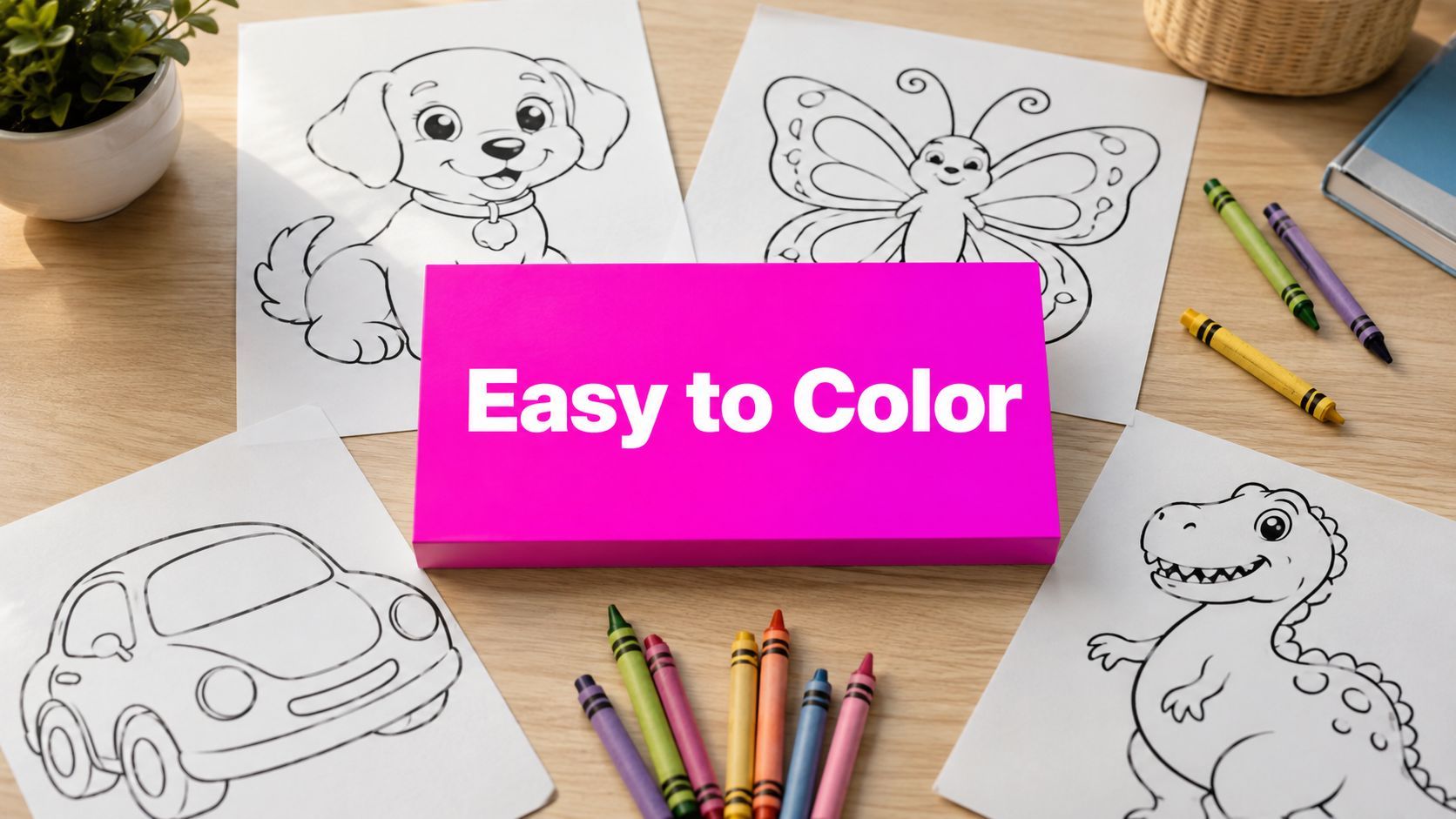
7 Easy to Color Coloring Pages Sources

Ryan Bennett • August 30, 2026
Find easy to color coloring pages for kids, classrooms, and home use, with print tips, customization ideas, and AI creation guidance.
A parent may need a quiet-time activity before dinner, while an educator may need a printable packet before the next lesson. In both cases, the wrong page creates friction. Tiny sections frustrate beginners, crowded artwork overwhelms children who need visual simplicity, and a poorly formatted download can waste valuable preparation time.
The best easy to color coloring pages use open shapes, bold outlines, limited visual clutter, and a clear match between the child's ability and the activity's purpose. Start by identifying the intended age or skill level, then choose a reliable source, check the print format, and customize only what improves usability. This roundup includes free libraries, education-focused worksheets, personalized early-learning pages, and an AI option for creating coordinated sets.
1. Coloring Pages
When you need a coordinated packet rather than a single sheet, Bulk Image Generation's Coloring Pages tool is built for the production problem. You can describe a theme in plain language, such as “large farm animals with bold black outlines, open regions, minimal background detail, and a print-friendly page layout,” then create a collection without manually refining every prompt.
The platform is powered by Flux 1.1 and integrated with OpenAI's GPT-Image-1. Its coloring-page workflow can generate up to 100 unique visuals in under 20 seconds, according to the product information supplied for this comparison. That makes it useful for educators preparing themed activities, creators developing activity books, and parents who want pages based on a child's interests.
Best workflow for a coordinated set
Choose the learning or activity goal first. For example, a preschool packet might use one large object per page, while a vocabulary set could repeat the same visual style across animals, foods, or classroom objects. Ready-made templates and use-case presets for education, activity books, print-on-demand, kids' crafts, and game assets help reduce setup time.
The batch editor can support background removal, resizing, enhancement, and other post-production work. Free companion tools, including a free AI image prompt generator, can help beginners describe the intended subject, detail level, and composition more clearly.
Practical rule: Ask for fewer regions, thick outlines, high contrast, and a simple background. Then inspect the actual page at print size before sharing it with children.
The trade-off is quality control. Human review still matters for clean line art, consistent character details, margins, resolution, and possible vectorization needs. If you plan to sell or distribute the pages commercially, review the relevant licensing and attribution requirements for your use case. For publishing guidance, BarkerBooks' coloring-book publishing guide offers additional context.
2. Crayola Free Coloring Pages
Crayola's free coloring pages are a practical first stop when a parent or teacher needs a familiar, family-friendly activity with little preparation. The library includes categories such as animals, vehicles, seasons, educational subjects, and color-by-number pages. Many designs use clean outlines and broad fill areas, which can work well for young children and first-time colorers.
The main strength is speed. You can browse, choose a theme, and print without creating an account for basic use. That matters during a classroom transition or a short quiet-time window, when a complicated download process can defeat the purpose of the activity.

Use it for quick themed practice
Crayola is especially useful when the coloring activity should reinforce a familiar topic. An animal page can accompany a read-aloud, a seasonal design can serve as a calm arrival task, and an educational page can provide a low-pressure follow-up to a lesson.
Its Custom Page Creator also supports simple personalization. A teacher might create a page connected to a child's name or a classroom theme, while a parent could choose a subject that encourages the child to engage.
The main limitation is that some categories include branded or character-based content. That may be appealing at home, but an educator who wants a neutral worksheet should preview the page before adding it to a packet.
- For beginners: Select the largest shapes with the least background detail.
- For classrooms: Preview character content and confirm it supports the lesson.
- For home use: Let the child choose between a few themes rather than browsing an entire library.
3. SuperColoring
SuperColoring suits adults who want broad choice and educators who need to search across many subjects. Its catalog includes free printable pages across categories such as letters, numbers, animals, and holidays, with many beginner-friendly designs using bold outlines and straightforward shapes.
That breadth is both its advantage and its challenge. A teacher looking for a simple letter page can find a useful match, but the size and variety of the catalog may require more screening than a tightly curated preschool site. Style and complexity can vary, so don't assume that every result meets the same definition of easy.

Turn a large catalog into a focused activity
Search by the child's immediate purpose. For letter recognition, look for pages where the target letter remains visually dominant. For a science unit, choose a single animal or object instead of a scene filled with background elements. For a holiday center, select a design with open regions that children can complete without constant adult assistance.
SuperColoring also offers creation tools, including an AI Coloring Page Generator, Photo-to-Coloring-Page tool, and Poster Maker. These can help an educator simplify a familiar image or create a custom visual for a classroom topic. If you need a separate creation workflow, Bulk Image Generation's image generator can support custom page development from plain-language descriptions.
A useful approach is to download one candidate and test it with the intended group before building a packet. Check whether the smallest regions invite careful coloring or create unnecessary frustration. Also inspect the line clarity after printing, since a page that looks simple on screen may feel different on paper.
4. Twisty Noodle
Twisty Noodle is a strong choice for early-learning sheets that combine coloring with a small amount of text practice. Its pages cover familiar preschool themes, including letters, numbers, animals, and holidays, and many use simple line art with large shapes.
The site's personalization feature gives it a classroom advantage. You can add short text, choose from available fonts, and create a page with a child's name, a sight word, or a brief prompt. That turns a general coloring sheet into a more purposeful literacy activity without requiring design software.

Match the page to the child's task
Use a name-based page for letter recognition, a sight-word page for visual familiarity, or a themed page as a calm extension after a story. Keep the text short. The coloring should remain the accessible part of the activity, not become secondary to a demanding writing task.
Twisty Noodle also includes worksheets and mini-books connected to preschool themes. That makes it useful when an educator wants to move from a single coloring page into a small learning sequence.
Some designs are extremely minimal, which is helpful for children who need a low-clutter page but may feel too plain for children ready for more visual choice. Review several options before printing, then group them by complexity.
- Choose minimal pages for children who are building pencil control.
- Add one short word when the goal includes early literacy.
- Use related worksheets when coloring should lead into another classroom skill.
5. Just Color Kids by JustColor
Just Color Kids by JustColor separates children's content from the site's adult coloring material, making it easier to search for age-appropriate themes. The Kids Zone includes characters, animals, simple scenes, and beginner mandalas, with many pages offering clear outlines and larger areas for young colorers.
This source works well when the child needs choice but still benefits from a children-focused collection. The “Most Popular” area can help a parent find familiar starting points, while seasonal additions give educators material for holiday centers or themed displays.

Use a progression instead of a random selection
Begin with a page containing one central object and broad regions. Once the child is comfortable, introduce a simple scene or a beginner mandala with more repeated areas. The point isn't to make every page harder. It's to offer an appropriate next step without turning coloring into a test.
The print-ready PDF format also supports straightforward preparation. A parent can print a favorite page for a quiet activity, while an educator can save a small selection for a choice station. Before distributing pages, check whether a design includes branded or franchise-related subjects and review the site's usage notes for classroom or commercial plans.
For custom artwork beyond the existing library, Bulk Image Generation's AI art generator can help create a related visual style. That option is most useful when you need several pages around a specific classroom theme rather than a single popular subject.
6. BigActivities
BigActivities is designed around simple, classroom-friendly printables and early-learning practice. Its coloring pages use bold outlines and large shapes, while related resources include handwriting practice, connect-the-dots activities, and simple mazes.
That combination makes the site useful for a skill-building station. A child might color an object, trace a related word, and then complete a basic dot-to-dot activity. The pages can support a predictable classroom routine without requiring an elaborate lesson plan.

Build a low-preparation skill station
Choose one page based on the current objective, not just the season. A holiday design may work for a celebration, but an animal, letter, or number page may better support a learning center. The site's seasonal collections include themes such as Back to School, Fall, Halloween, and Thanksgiving, so educators can connect visual interest with the calendar when appropriate.
The lightweight page style is also practical for school copiers. Simple outlines tend to remain readable when printed in batches, although you should still test the first copy before producing a full set.
The interface is basic and doesn't offer the same modern filtering depth as larger libraries. That trade-off can be helpful for users who want a no-frills route to a printable, but it means educators may need to browse more manually. Keep a small folder of tested pages organized by skill, season, and complexity for faster reuse.
7. Education.com Preschool Coloring Worksheets
Education.com's preschool coloring worksheets is best suited to educators and homeschoolers who want coloring connected to early academic skills. Its preschool-oriented resources include letters, numbers, animals, simple scenes, and cut-and-color activities, with filters that help users search by grade or skill.
The education-first structure makes packet building more deliberate. Instead of choosing a page solely because it looks appealing, you can select a coloring worksheet that supports literacy, numeracy, fine-motor practice, or a related classroom topic.
Plan a short, skill-based packet
Start with the learning goal, then choose pages with a consistent level of visual demand. For example, a packet about letter recognition should avoid switching from a large single-letter design to a crowded scene unless that change is intentional. Cut-and-color activities can add a craft element, but they require more supervision and preparation than a standard coloring sheet.
Education.com offers a mix of free and premium resources. Some content requires a Premium membership, and free access may be limited for particular downloads. Check the page availability before promising a complete packet to a class or family.
The consistent formatting is useful for teachers who need resources that look coherent when printed together. Even so, preview each worksheet at its final print size. Confirm that the outline is clear, the page has enough white space, and the activity matches the child's current ability rather than just the listed grade level.
7-Site Comparison: Easy-to-Color Coloring Pages
| Item | Implementation Complexity | Resource Requirements | Expected Outcomes | Ideal Use Cases | Key Advantages |
|---|---|---|---|---|---|
| Bulk Image Generation, Coloring Pages | Low, one‑click pipeline; minimal setup | Subscription or cloud credits, internet, optional post‑print edits | High‑volume, print‑ready line art; consistent collections (may need human QA) | Publishers, print‑on‑demand, rapid book or classroom pack production | Extreme speed/scale, batch post‑production, templates and presets |
| Crayola, Free Coloring Pages | Very low, browse and download | Internet, printer/paper | Clean, beginner‑friendly outlines ready for immediate printing | Parents, classrooms, quick activities | Trusted brand, kid‑safe content, easy downloads |
| SuperColoring | Low, browse + optional creation tools | Internet, optional account for tools | Vast variety of simple pages; quality varies by contributor | Educators/creators needing many options or custom pages | Massive library, AI/photo tools, free access to core features |
| Twisty Noodle | Very low, select and customize on page | Internet, printer; optional customization inputs | Simple, bold sheets with custom text options for class use | Early learners, teachers needing personalized worksheets | Fast personalization, education‑oriented resources, simple navigation |
| Just Color Kids (JustColor) | Very low, browse and download PDFs | Internet, printer | Curated kid‑appropriate pages and seasonal additions | Parents and teachers seeking child‑focused, print‑ready pages | Dedicated kids zone, print‑ready PDFs, frequent updates |
| BigActivities | Very low, browse and print | Internet, printer/copier | Classroom‑friendly sheets with complementary early‑learning activities | Preschool/kindergarten teachers building skill packets | Early‑education focus, simple printing, related activity types |
| Education.com, Preschool Worksheets | Low, filtered search and download; some premium features | Internet, printer; possible Premium subscription | Skill‑aligned, consistent worksheets suitable for packets | Educators and homeschoolers building curriculum‑aligned materials | Grade/skill filters, consistent formatting, classroom alignment |
Make Every Printable Easier to Use
Choosing a source is only half the job. A page can come from a trusted library and still be a poor fit if the shapes are too small, the background is crowded, or the activity asks for skills the child hasn't developed yet. Start with the visual demand, then connect it to the purpose.
For beginners, choose large, open shapes, bold outlines, and minimal background detail. For children practicing letters or numbers, make sure the target symbol remains easy to see. For a classroom craft, select a page with enough open space for coloring, cutting, folding, or writing without forcing several tasks into a cramped layout.
Preview every page at its intended print size. Use standard paper settings, check that margins aren't cutting off the artwork, and print a test sheet before producing a full packet. A page that looks clean on a large monitor may lose line clarity or usable space after printing.
Before printing: Test one page with the actual paper, printer, coloring tools, and learner group you plan to use.
Personalization should serve the activity. Add a child's name, a sight word, a short vocabulary prompt, or one question when that addition supports the lesson. Don't add text just because the tool allows it. Extra instructions can make a simple page feel busy, especially for children who need low-cognitive-load layouts.
Accessibility deserves the same practical attention. Children and adults with fine-motor, visual, or cognitive challenges may benefit from thicker outlines, fewer regions, high-contrast line art, and balanced layouts. The Disability Equality Education coloring-page resource illustrates why inclusive resources should be considered as a distinct planning need, not treated as an afterthought.
For adult users, “easy” can mean a fast finish, marker compatibility, or reduced hand fatigue rather than a page intended for young children. Trend coverage from Book Illustration AI describes bold-and-easy formats with large open regions and marker-oriented use cases. In practice, review line weight, region size, paper choice, and the risk of bleed-through before selecting a page for markers.
AI tools can help you create coordinated designs by specifying the subject, bold outline style, low-detail composition, intended age group, and page format. Review every generated image for clean lines, consistent complexity, safe margins, and print readiness. If you plan to share or sell the material, review licensing before distribution.
Bulk Image Generation helps parents, educators, and creators produce coordinated easy-to-color coloring pages in bulk from plain-language prompts. Visit Bulk Image Generation to create custom collections, prepare print-ready assets, and refine a complete activity workflow.