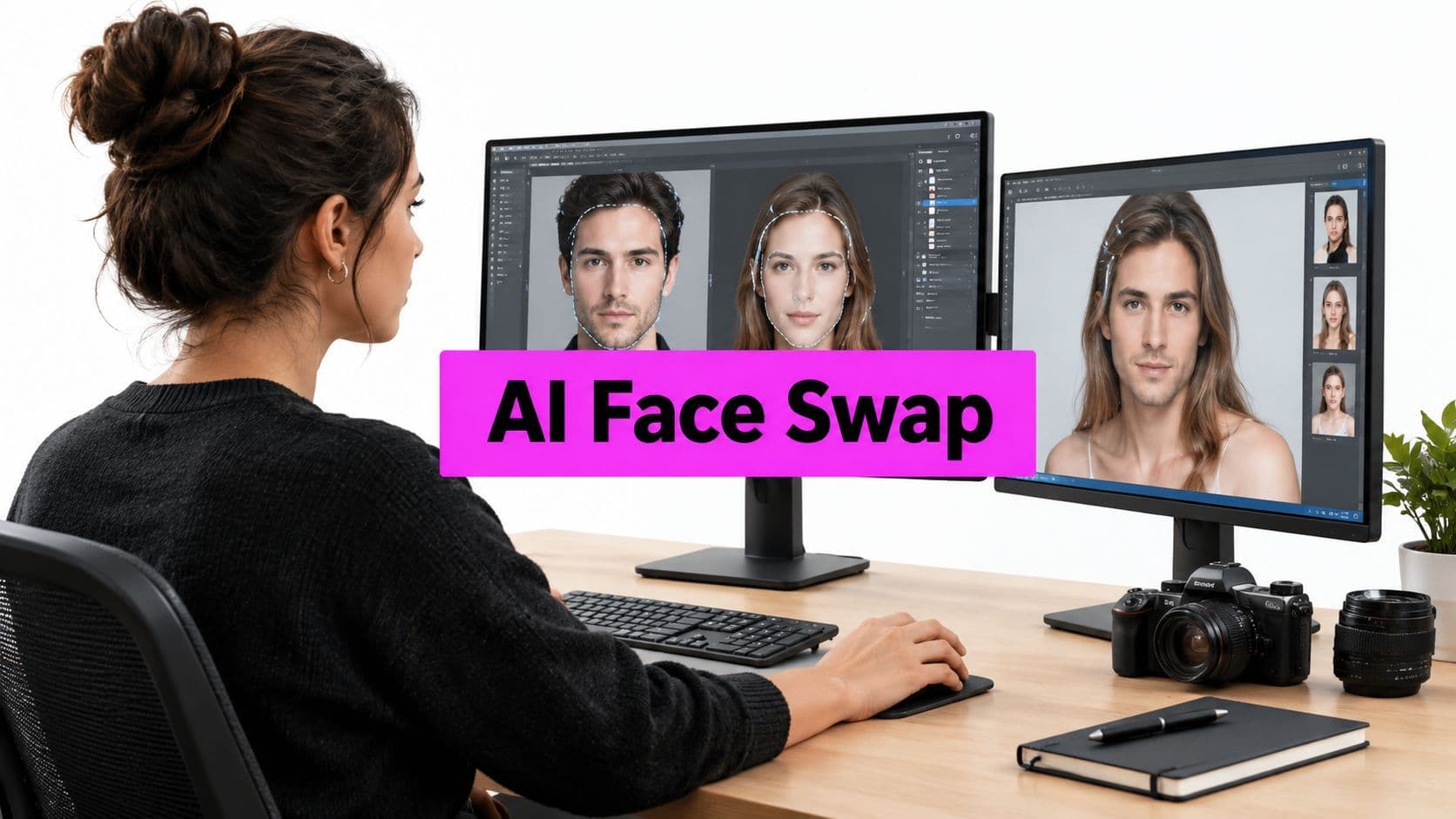
AI Face Swap: Ethics, Tech, and Best Tools

Ryan Bennett • October 5, 2026
Discover how AI face swap technology works, the top tools for 2026, and why ethics are essential when using this powerful feature.
AI face swap uses deep learning to map one person's facial features onto another in an image or video, creating realistic results in seconds. The modern AI face-swap era is widely traced to late 2017, when public face-swapping tools turned a specialist technique into a mainstream synthetic-media issue.
You may already have seen the result while scrolling through social media. A face looks convincing at first glance, yet the eyes seem slightly misaligned, the skin texture feels too smooth, or the expression doesn't quite belong to the person in the image. For creators, marketers, educators, and hobbyists, the same technology can also turn a time-consuming editing task into a repeatable workflow.
That mix of convenience and risk makes AI face swap difficult to evaluate. The mechanism that helps a filmmaker test a character design can also be used to impersonate someone during an identity check. Understanding both sides requires more than asking whether a result looks realistic. You need to know how the system works, where it leaves evidence, and what safeguards responsible tools should provide.
What AI Face Swap Actually Means for Your Images
Suppose you have a group photograph and want to place a consenting person's face into several creative scenes. Traditional editing would require careful masking, retouching, color matching, and repeated adjustments. An AI face swap automates much of that work by identifying facial structure, learning visual patterns, and reconstructing the selected face so it fits the new image.
The underlying idea is still digital manipulation, but the workflow differs from older manual techniques. Instead of moving pixels by hand, a neural network estimates how features such as the eyes, nose, mouth, jawline, and skin texture should appear under the target image's lighting and angle. The system then creates a composite that aims to preserve the surrounding expression, pose, and background.
Why modern tools feel easier
Earlier face replacement often depended on a skilled editor. A non-expert could produce an obvious cutout, but a believable result demanded patience and technical judgment. Consumer AI tools lowered that barrier by combining face detection, alignment, blending, and enhancement in a single interface.
That doesn't mean every result is reliable. A face swap can struggle with hair crossing the face, heavy shadows, unusual camera angles, motion blur, hands covering facial features, or a source image with poor resolution. A clean-looking result also doesn't prove that the edit is harmless or that the person shown agreed to it.
Practical rule: Treat a face swap as a creative edit only when you have permission to use the person's likeness and a clear reason to disclose the manipulation.
For a beginner, the useful mental model is simple. The source image supplies the identity features, the target image supplies the scene and often the pose, and the AI tries to make both sets of information appear to belong together. That combination explains why the tool is valuable for approved entertainment, design, and educational projects, while also explaining why unauthorized use can create serious harm.
How Face-Swap Technology Works Step by Step
Think of a face-swap model as a cook who has studied many recipes. It doesn't memorize one finished dish. It learns recurring relationships between ingredients, proportions, textures, and presentation. In the same way, a deep-learning system studies facial examples and learns patterns such as eye spacing, jaw shape, expression, and skin detail.
1. Detection finds the ingredients
The system first locates a face in the source and target images. It identifies the visible facial area and separates it from the rest of the scene. If detection fails because the face is too small, turned away, obscured, or poorly lit, every later stage inherits that mistake.
2. Alignment sets the plate
Next, the tool maps facial landmarks. It compares points around the eyes, nose, mouth, cheeks, and jaw so the source face can fit the target position. Alignment helps the system understand that a tilted head needs a different placement from a straight-on portrait.
3. Feature mapping transfers identity
The model extracts identity-related features from the source face. Convolutional neural networks are useful here because they can recognize visual patterns at different levels, from edges and contours to more complex facial arrangements. The system doesn't paste a rectangular photograph over another face. It generates or reconstructs facial information to fit the target context.
4. Blending combines face and scene
The replacement face must match the target's lighting, color, expression, and perspective. Blending softens boundaries around the cheeks, forehead, and chin, while the surrounding image remains available as context. A mismatch in shadows or skin tone often creates the uncanny appearance viewers notice.
5. Refinement checks the finish
The final pass may improve sharpness, smooth transitions, and restore details that became weak during the swap. Compression, resizing, motion, and complex backgrounds can still reduce quality. The system's goal is visual coherence, not proof that the image is authentic.
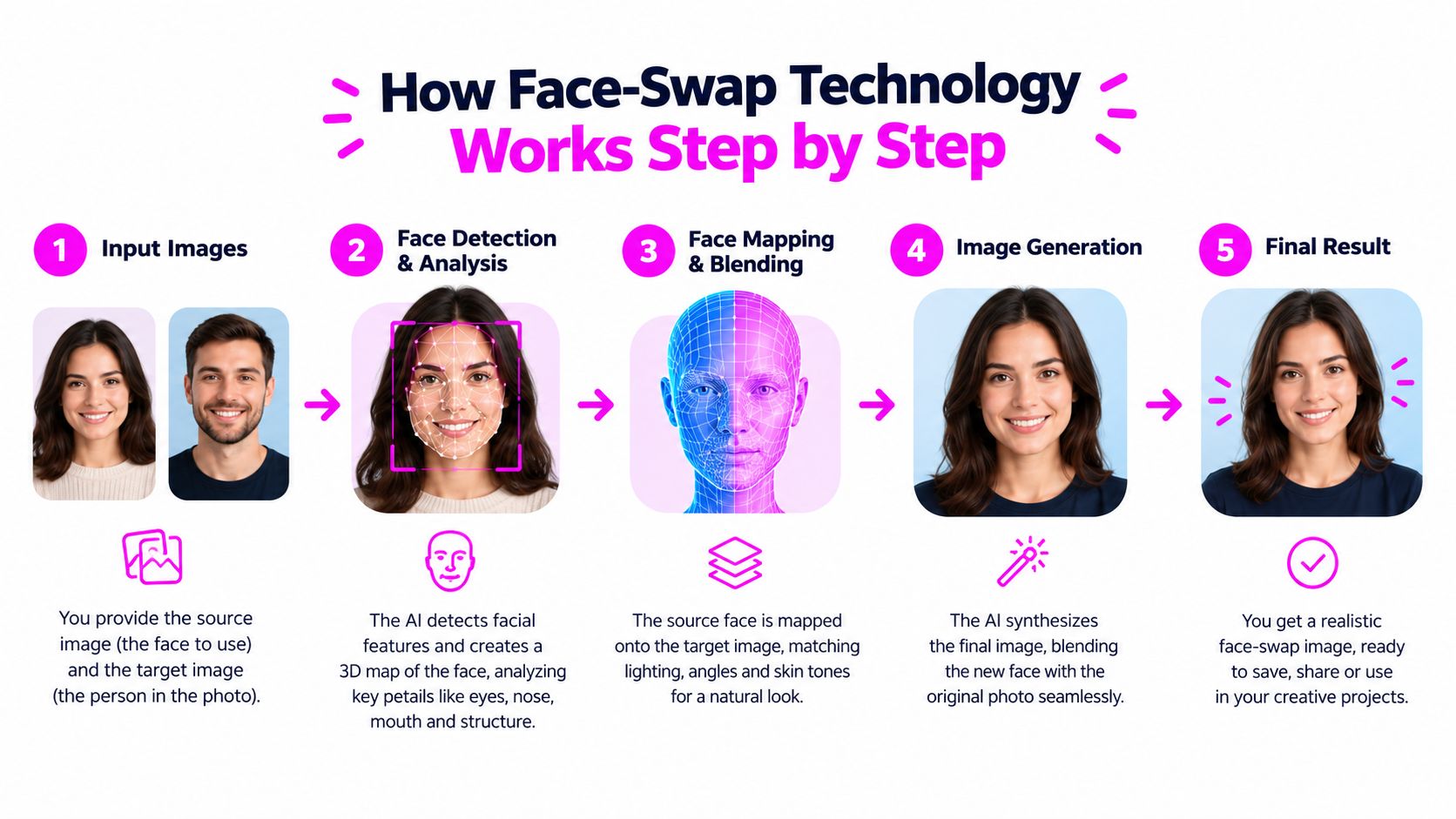
This process also clarifies why a convincing swap can fail under close inspection. The model may preserve identity well but produce artifacts around the mouth. It may blend the skin successfully while mishandling a watermark or background edge. Beginners who want a practical walkthrough can use this face replacement guide for beginners to understand the preparation and editing decisions behind a clean result.
The Evolution of AI Face Swap From Deepfakes to Mainstream Tools
The public history of AI face swap began with controversy. In late 2017, a Reddit user posting under the handle “deepfake” released falsified videos using face-swapping techniques. That moment is widely treated as the public starting point of the deepfake phenomenon, while open-source autoencoder workflows spread through 2017 and 2018 and moved face replacement from research and professional compositing into publicly available software. These milestones are summarized in an academic technical timeline of face-swap development (academic summary of the deepfake and face-swap timeline).
The technology didn't emerge in isolation. Consumer augmented-reality filters had already made facial manipulation familiar to ordinary users by 2015 and 2016. That preparation mattered because people had already become comfortable with digital masks, altered features, and playful visual transformations before more realistic identity replacement appeared.
From novelty to mass-market capability
The 2018 Chinese app Zao showed how quickly the concept could enter mainstream awareness. An industry overview reports that the app drew hundreds of millions of downloads within a short period, demonstrating the reach a consumer face-swap product could achieve in a national market (history and market context for face-swapping technology).
By 2021 and 2022, real-time GPU swapping tutorials and ecosystems such as DeepFaceLive were proliferating. That shift changed the practical experience from editing a finished video to generating a swap during live or near-live use. Current market commentary places face-swapping tools at more than 1 million face swaps daily and estimates a $2.71 billion industry, with a projection of $10.2 billion by 2032, according to the same market overview.
The pattern is clear. Face swap moved through research, open-source experimentation, viral consumer applications, and creator workflows in a short period. Its speed of adoption explains why technical safeguards and public understanding have struggled to catch up with the convenience of the tools.
Legitimate Uses Versus Identity Verification Risks
The ethical question is not just whether face swapping is good or bad. The same operation can support a clearly authorized creative task or help someone impersonate another person. The difference usually comes from consent, context, intent, and whether another system treats the altered face as evidence of identity.
| Use Case Category | Examples | Risk Level | Regulatory Attention |
|---|---|---|---|
| Creative production | Film tests, approved character concepts, visual effects | Lower when likeness rights and consent are documented | Moderate |
| Social entertainment | Memes, private jokes, filters, and clearly labeled posts | Lower when participants agree and viewers aren't misled | Growing |
| Marketing personalization | Campaign variations using authorized talent or synthetic characters | Moderate, especially when disclosure is unclear | Growing |
| Gaming and education | Avatars, classroom demonstrations, and fictional scenarios | Lower when the use is transparent | Moderate |
| Authentication bypass | Presenting a swapped face to defeat an identity check | High | High |
| Credential fraud | Using manipulated media to support false account access or applications | High | High |
| Identity theft | Impersonating a real person for financial, social, or professional gain | High | High |
Why verification changes the stakes
A playful image usually asks the viewer to enjoy a transformation. An identity-verification system asks whether a face belongs to a particular person. That second situation involves access, trust, and potentially sensitive personal information, so an apparently realistic output can become an attack tool.
The risk is not theoretical. A report on AI face-swap threats says attacks against identity-verification systems surged 300% in a single year (analysis of AI face-swap attacks on identity verification). The figure highlights why a platform may require consent checks, restrict certain workflows, or add review steps even when many users arrive with innocent creative intentions.
For your own project, ask one decisive question: Could someone mistake this altered face for proof of who a person is? If the answer is yes, entertainment standards aren't enough. You need explicit permission, transparent labeling, and a workflow that doesn't encourage the content to function as authentication evidence.
Why Face Swaps Leave Detectable Digital Fingerprints
A face swap isn't always confined neatly to the face. A 2025 region-aware study found that swapping can change background statistics and weaken watermark signals outside the facial area, with effects that vary across watermark strength and model family (study of non-local effects and watermark degradation in face swapping).
That finding has a practical consequence for creators and reviewers. Placing a provenance mark in the corner of an image doesn't guarantee that the editing process will leave it untouched. Some architectures confine edits more effectively and preserve background watermark signals more reliably, but globally trained pipelines can affect areas that users assume are independent of the face.
What forensic reviewers measure
Visual realism is only one part of evaluation. Forensic systems increasingly examine two separate questions:
- Identity preservation: ArcFace cosine similarity is commonly used to assess whether the output still represents the intended identity.
- Artifact detectability: DeepfakeBench-style scoring evaluates how readily detection algorithms identify traces associated with face swapping.
These measures can point in different directions. A model might preserve identity strongly while leaving detectable blending artifacts. Another might produce a visually plausible result but weaken identity consistency. A benchmark summary reports that stronger artifacts are generally flagged more often and that a training-free watermarking method achieved about 98% detection accuracy across JPEG compression, resizing, and seven face-swap models (benchmark summary on identity preservation, artifacts, and watermark detection).
This doesn't make detection perfect. Compression, cropping, platform processing, and new model architectures can change what a forensic system sees. If you need to inspect image provenance, compare files carefully and use a workflow that preserves original assets. Tools such as using Simple Unmark for clean text may help with text cleanup, but removing a mark isn't the same as proving authenticity. For a related quality-control task, teams can also review how to identify duplicate images before approving a batch.
Using Batch Editor for Safe Face-Swap Workflows
A professional batch workflow should make the ethical decision before it makes the edit. Start by collecting the source images, identifying whose likeness will appear, and recording consent for the intended context. If the person hasn't agreed to the use, don't treat a convenient upload field as permission.
A safer operating sequence
-
Prepare authorized assets. Keep the original files, document the permitted campaign or project, and separate approved faces from unreviewed material. This reduces accidental use of the wrong person's image.
-
Select the replacement area. Use the editor to identify faces consistently across the image set. Batch processing is useful when the same approved source face must appear across product scenes, social posts, or branded variations.
-
Apply a disclosure decision. Decide whether the finished images need an AI-generated label, a campaign note, or an internal record. A transparent label is especially important when viewers could interpret the image as a real event or genuine endorsement.
-
Review the output. Inspect facial edges, eyes, teeth, lighting, hair intersections, background details, and any visible watermark. Automated consistency doesn't replace human approval.
-
Export with records intact. Retain the original and edited versions, the consent record, and the intended publication context. These records help teams respond if a subject questions the use or a platform requests clarification.
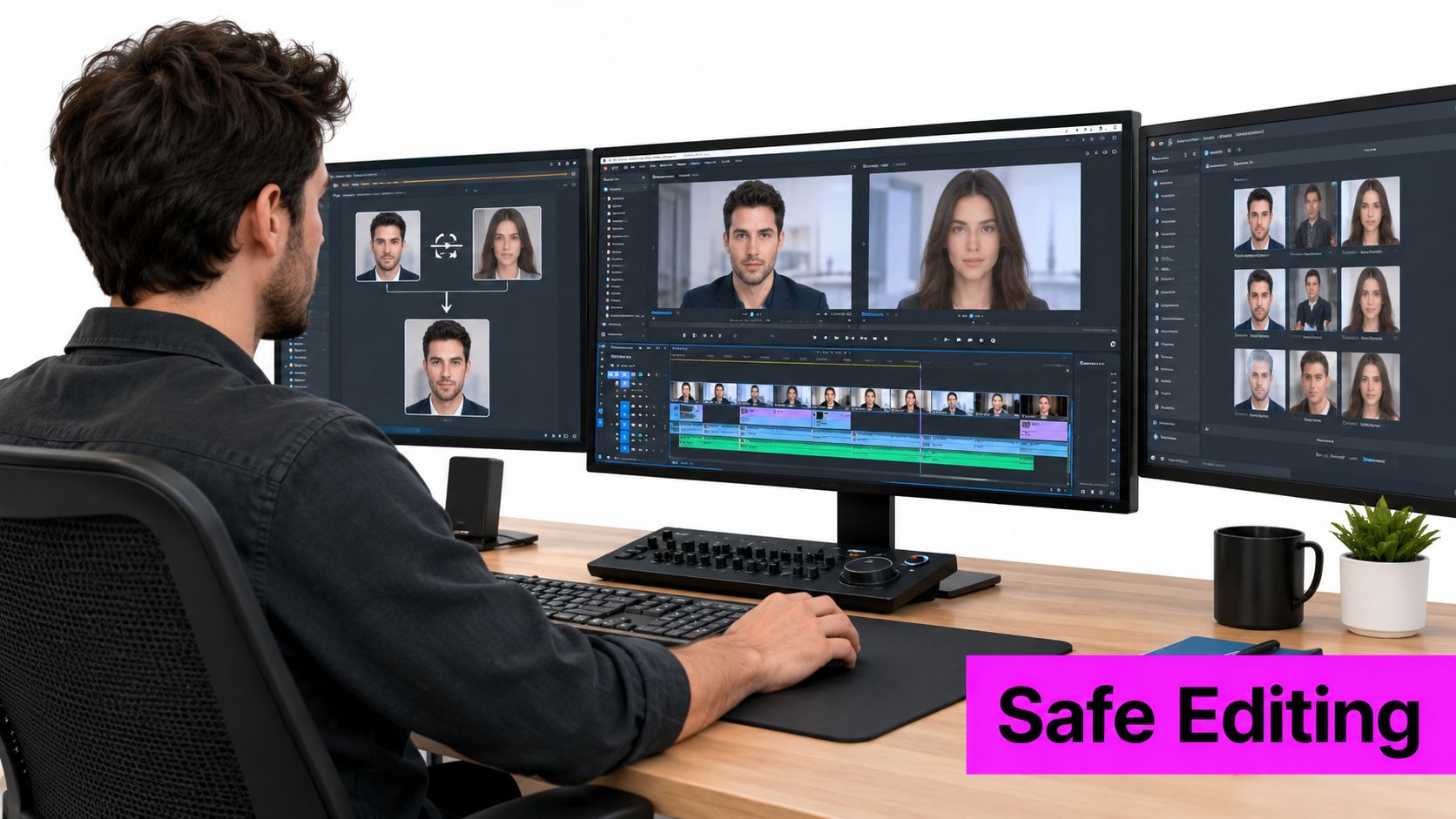
The Batch Editor in Bulk Image Generation supports batch face replacement alongside tasks such as background removal, resizing, and enhancement. Its workflow is suited to marketers creating authorized campaign variations, educators preparing fictional or clearly labeled teaching materials, and small businesses adapting approved brand imagery. The platform combines Flux 1.1 with OpenAI's GPT-Image-1 for bulk image creation, while the editor reduces repetitive post-production work.
You can compare the practical stages in this guide to swapping faces. For a wider view of creator workflows, this overview of AI-powered tools for creators can help you evaluate how face replacement fits alongside image generation, resizing, and campaign production.
Workflow principle: Batch processing should multiply an approved decision, not multiply an unreviewed one.
The Real Challenge Balancing Creativity With Responsibility
Face-swapping tools aren't automatically safe because the user has a creative goal. A social filter and an authentication attack can rely on related technical operations, even though their consequences differ sharply. Treating the entire category as either harmless entertainment or malicious deepfake production hides the decisions that matter most.
Blanket restrictions can block legitimate film, education, accessibility, and design work without eliminating determined misuse. Unregulated access creates a different problem, because automated tools can make unauthorized manipulation easier to repeat and distribute. The useful answer sits between those extremes.
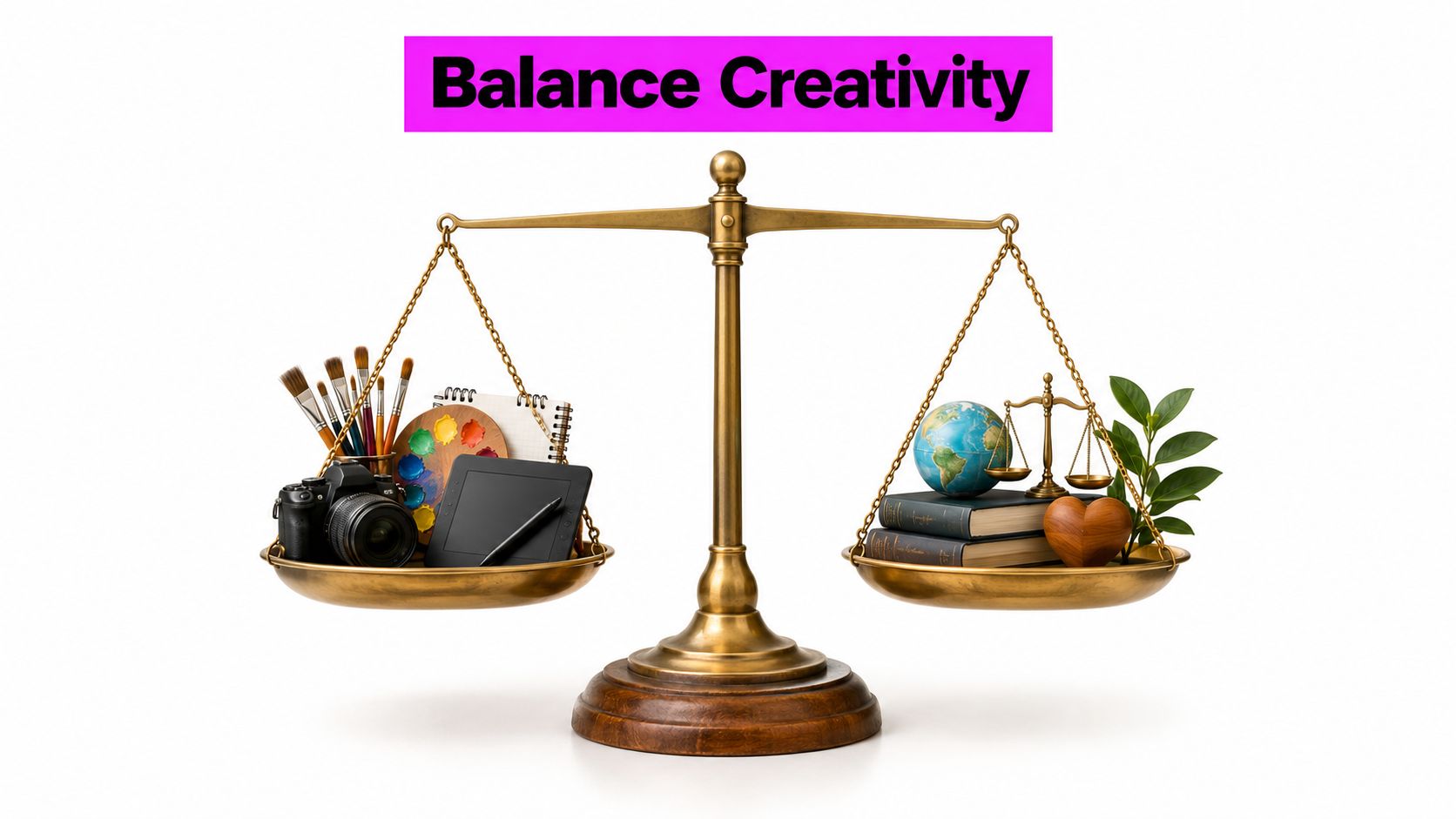
Four layers of responsible adoption
Technical safeguards can include consent prompts, abuse reporting, provenance signals, restricted access to sensitive workflows, and detection checks. These controls won't solve every misuse case, but they can add friction where the potential harm is greatest.
User education matters because many people still judge authenticity by appearance alone. A training session should explain that a polished image can be synthetic, that watermarks may be affected beyond the face, and that identity verification requires stronger evidence than a single video frame.
Platform accountability means providers should explain data handling, define prohibited uses, respond to reports, and make safeguards visible. Users can't make informed decisions when a tool hides whether it stores uploads or how it handles biometric material.
Adaptive policy gives organizations room to distinguish fictional art from impersonation. Rules should respond to changing capabilities without assuming that every face edit carries the same risk.
Creativity benefits from clear boundaries. A team that asks for consent, labels synthetic content, and separates creative assets from authentication workflows can use the technology without pretending that technical sophistication removes social responsibility.
Making Responsible Choices With AI Face-Swap Tools
A responsible project begins before the upload. Confirm that every identifiable person has agreed to the face replacement, define where the image will appear, and decide whether the audience might mistake it for an authentic photograph or video. If the project involves access, identity, money, or a real person's reputation, use a more cautious review process or avoid face swapping altogether.
A practical selection checklist
- Consent controls: Check whether the workflow helps you document permission and distinguish approved assets from unreviewed uploads.
- Data handling: Read how the service stores, processes, and deletes images, particularly when files contain recognizable faces.
- Quality review: Look for previews and controls that let you inspect alignment, lighting, edges, expressions, and background changes.
- Transparency options: Prefer tools that support labels, provenance records, or other ways to tell viewers that an image was altered.
- Abuse response: Review the provider's reporting and removal process before publishing sensitive material.
- Project fit: Use a guide to the best face-swap workflows to compare practical requirements, but make your final choice based on consent, data practices, and risk, not visual realism alone.
Detection tools can identify patterns, but they aren't a substitute for permission. Likewise, a watermark can support provenance without guaranteeing that an image has remained untouched. The safest habit is to combine technical checks with human judgment and a clear record of who authorized the edit.
Before publishing: Ask whether the subject consented, whether the audience could be misled, and whether the image could be reused as identity evidence.
The industry is developing stronger detection methods, clearer disclosure practices, and more adaptable governance. Users influence that direction through the tools they select and the workflows they normalize. Choose face-swapping for approved creative purposes, keep the process transparent, and never let convenience turn another person's identity into an unreviewed asset.
Bulk Image Generation provides bulk image creation and a Batch Editor for authorized face swaps, background removal, resizing, and enhancement. Use it to prepare consistent creative variations with human review and consent records, then explore the workflow at Bulk Image Generation.