Create and Sell AI Coloring Books From Scratch

Ryan Bennett • September 28, 2026
Your complete guide to creating and selling AI coloring books. Learn to generate unique art, find profitable niches, and build a passive income stream today.
AI coloring books are a fantastic side hustle that lets just about anyone create and sell unique designs, no art degree required. This guide is your roadmap—we're going to walk through the entire process, from dreaming up your first images to building a real passive income stream.
The secret? It's all about turning simple text prompts into profitable products.
The Booming AI Coloring Book Market
The world of coloring isn't just for kids anymore. It has absolutely exploded into a massive industry for adults looking for a way to de-stress and tap into their creative side. At the same time, AI art tools have become so accessible that they've completely leveled the playing field for aspiring creators.
This intersection has created the perfect storm—an opportunity for entrepreneurs to launch their own AI coloring books with almost no startup costs or heavy lifting. You don't need to spend years mastering illustration software anymore. All you need is a great idea and the right prompts.
This new model completely sidesteps the traditional publishing headaches and offers some serious advantages:
- Minimal Startup Costs: Forget expensive design software or hiring illustrators. Your main investment is a subscription to an AI art generator.
- High-Profit Margins: With digital downloads or print-on-demand services, you're not managing any inventory, which means much higher potential returns.
- Endless Niche Potential: The AI can generate art for any theme you can dream up, from intricate mandalas to hyper-specific professional humor.
Understanding The Market Opportunity
The scale of this trend is pretty staggering. The global coloring book market was worth over $3.2 billion in 2023 and is projected to grow by nearly 9.8% every year through 2028.
Inside this massive market, smart creators are already carving out profitable niches. For instance, searches for a 'mandala coloring book for adults' can hit 100,000 per month. Even profession-themed books like 'nurse coloring book' pull in over 30,000 combined searches. The data shows a clear, hungry audience ready to buy. You can discover more insights about the coloring book market to see the full potential.
To give you a better idea, here's a quick look at the key advantages of launching your own AI coloring book venture.
AI Coloring Book Business At A Glance
| Attribute | Description | Example |
|---|---|---|
| Low Barrier to Entry | No artistic skills or expensive software needed. | A writer can create a "Literary Gardens" coloring book without knowing how to draw. |
| High Scalability | AI can generate hundreds of unique pages quickly. | Create a 10-book series on "Mythical Creatures" in a matter of days, not months. |
| Niche Domination | Target ultra-specific interests that big publishers ignore. | "Coloring for Urban Beekeepers" or "Vintage Sewing Machine Patterns." |
| Passive Income | Sell digital downloads or use print-on-demand for hands-off fulfillment. | List your PDF on Etsy and earn money while you sleep. |
This model allows for incredible creative freedom and a direct path to a paying audience.
This isn’t just a fleeting trend; it’s a sustainable business model. By identifying an underserved audience—like fans of 'cyberpunk botanicals' or 'vintage fairytale kitchens'—you can build a loyal customer base and a significant passive income stream.
The key is to be different. While the market is getting flooded with generic animal or fantasy books, real success lies in specificity. Think about communities with passionate members: dog breed enthusiasts, classic car lovers, or fans of niche architectural styles.
By catering to these specific interests, your AI coloring books become more than just a product; they become a must-have item for a dedicated audience. This targeted approach is what turns a simple creative project into a profitable business.
Finding Your Niche in the Coloring Book Gold Rush
Before you even think about generating your first image, we need to talk strategy. The absolute key to making money with AI coloring books isn't just creating beautiful pages—it's finding a profitable niche. Anyone can make a generic "animal" or "fantasy" book, but those get buried in a sea of sameness.
The real magic happens when you get specific. Really specific.
Instead of just "animals," what about "Kittens in Parisian Cafes"? Instead of a broad "fantasy" theme, how about "Gothic Lolita Fairies in Haunted Gardens"? See the difference? These aren't just themes; they're hooks. They grab the attention of passionate buyers who are scrolling through endless options, looking for something that speaks directly to them.
This is your first and most important job: move from a vague idea to a laser-focused concept that feels like it was made for one specific person. That’s how you find your audience.
Don't Guess, Validate Your Idea
A brilliant idea is just a hobby until you know people will actually pay for it. This is where a little bit of detective work pays off big time. You don't need a marketing degree, just a few free tools and a bit of curiosity.
First, brainstorm a list of themes you're genuinely interested in. Your own passion is a great starting point because you'll understand the audience better than anyone. Got your list? Now, let's see if it has legs.
- The Amazon Autocomplete Trick: Head over to Amazon and start typing your ideas into the search bar. Don't hit enter. Pay close attention to what Amazon suggests. If you type "gothic coloring book," and it suggests "gothic fairytale" or "gothic architecture," you've just struck gold. Those are real terms people are actively searching for.
- Scout the Etsy Marketplace: Etsy is a hotspot for all things creative and niche. Search for your theme and see what pops up. Look for products with "Bestseller" tags, a healthy number of reviews, and multiple sellers in that space. A bit of competition is a good sign—it proves there's a market with hungry buyers.
- Peek at the Search Numbers: For a more data-driven approach, you can use tools like Google Keyword Planner or paid options like Ahrefs. Finding out that "kawaii pastel goth coloring book" gets 500 searches a month, while the broader "goth coloring book" gets 10,000, helps you gauge the size of your potential pond.
This quick research phase is what separates the pros from the hobbyists. It turns your creative whim into a business decision backed by actual data.
Who Are You Really Making This For?
Okay, you've got a validated niche. Now, who is the person on the other end, holding the coloring pencils? An AI coloring book for a 5-year-old is worlds apart from one designed for an adult looking to de-stress after a long day. Nailing down your "ideal customer avatar" will guide every single choice you make, from the complexity of your line art to the words you use on your sales page.
Ask yourself these questions to get a clear picture:
- Age & Skill Level: Are we talking about a toddler who needs chunky, bold lines and simple shapes? Or an experienced colorist who wants a challenge with tons of tiny, intricate details?
- The "Why" Behind the Buy: What's their motivation? Is this for stress relief? A creative outlet? A screen-free activity for their kids? A way to geek out over a hobby they adore?
- Their Vibe & Style: What aesthetic are they drawn to? Cute and whimsical? Dark and moody? Minimalist and geometric?
Let’s walk through an example. Say your niche is "Vintage Fairytale Kitchens." Your ideal customer is likely an adult who loves the cottagecore aesthetic, feels a sense of nostalgia for classic stories, and finds joy in detailed, cozy scenes. Your images would need to be intricate, filled with tiny things to color like herb bundles, patterned teacups, and antique spice jars. The words you’d use to sell it? "Charming," "whimsical," and "a relaxing escape."
Now, flip that. A book on "Construction Site Dinosaurs" is for a completely different person. Here, you're targeting parents of preschoolers. The artwork needs thick, simple outlines and big, easy-to-color shapes. The T-Rex in a hard hat should be cute, not scary. Your marketing would be all about "fun," "educational," and "hours of screen-free play."
When you know your audience this well, you create something that feels like it was made just for them. That’s how you build a real brand and turn a one-time buyer into a fan who can't wait to see what you release next.
Generating Stunning Line Art With AI Prompts
Alright, you've nailed down your niche. Now for the fun part: actually making the art. This is where you play director, turning simple text commands into the beautiful, intricate line art that will become your coloring book. When you're working with AI art generators like Midjourney or Leonardo.AI, it's not about being a traditional artist; it's about giving crystal-clear instructions. And that all happens through your prompts.
The final quality of your AI coloring books hinges almost entirely on how well you write those prompts. If you're vague, you'll get muddy, unusable messes. But if you get specific and pack your prompts with the right keywords, you'll get the clean, professional pages that people are excited to buy and color.
AI has completely changed the game for digital creators. Generative AI is on track to be a $5 billion industry by the end of 2025, and a huge slice of that is in art and design. This tech smashes the barrier to entry, letting anyone sell creative products worldwide with great margins and zero physical inventory.
The Anatomy Of A Perfect Coloring Page Prompt
Think of your prompt as a recipe. Every ingredient shapes the final result. For coloring pages, some ingredients are absolutely essential to get the AI to create something people can actually color.
Here are the non-negotiable keywords that need to be in pretty much every prompt you write:
coloring pageorcoloring book page: This is the big one. It's the primary instruction that tells the AI you need an outline-based illustration.line artoroutline drawing: These terms back up the first command, pushing the AI away from painterly styles or shading and toward clean, distinct lines.black and white: You have to be explicit here. This command stops the AI from adding any color or gradients, which would obviously defeat the purpose of a coloring page.clean outlinesorbold outlines: Think of these as quality control. They help you avoid the thin, sketchy lines AI can sometimes produce, giving you a much more polished and professional final image.
The process is pretty straightforward. You've done the hard work of finding your audience and theme; now it's all about translating that idea into a language the AI understands.
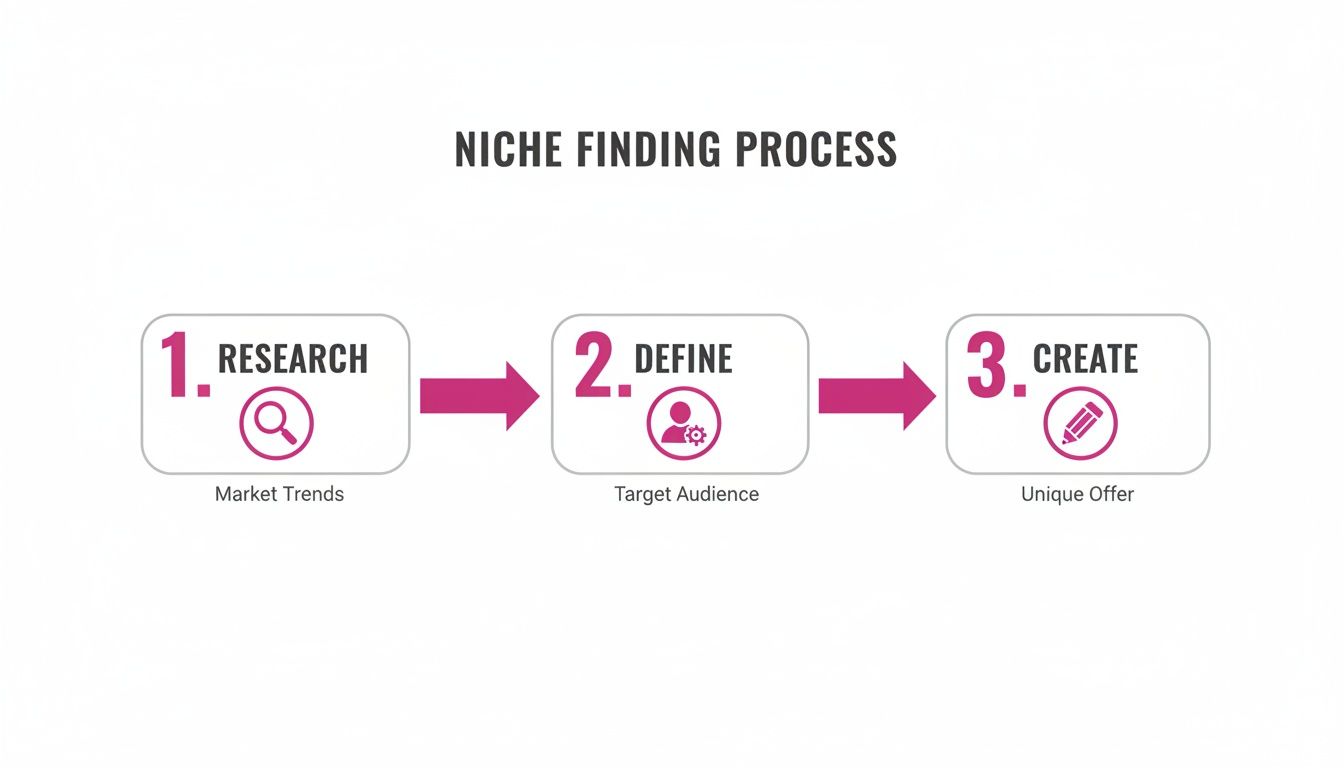
As you can see, once the research is done, your prompt-writing skill is what brings your unique offer to life.
A well-crafted prompt bridges the gap between your idea and a high-quality, sellable coloring page. Let's look at the key components that make a prompt work.
| Effective Prompt Components For Coloring Pages |
| :--- | :--- | :--- |
| Component | Purpose | Example Keyword |
| Core Command | Tells the AI the fundamental format required. | coloring page |
| Style Reinforcement | Specifies the visual style, ensuring it's an outline. | line art |
| Color Constraint | Prevents unwanted colors or shading. | black and white |
| Line Quality | Defines the thickness and clarity of the lines. | bold outlines |
| Subject | Describes the main focus of the image. | whimsical dragon |
| Setting/Background | Adds context and detail to the scene. | in a cozy library |
| Artistic Style | Influences the overall aesthetic (e.g., fantasy, vintage). | fairytale style |
Combining these elements gives you precise control over the final output, ensuring every page fits your vision.
Battle-Tested Prompt Formulas For Any Style
Once you get the hang of the core keywords, building prompts for any style becomes second nature. The basic formula is simple: [Subject] + [Style/Theme] + [Essential Keywords].
Let's see how this plays out in a few popular niches:
Example 1: Whimsical Creatures
A cute baby dragon sleeping on a pile of books, whimsical fantasy style, coloring book page for kids, thick bold outlines, clean line art, black and white.
Example 2: Intricate Geometric Patterns
Intricate mandala with floral and cosmic elements, Zentangle style, adult coloring page, fine details, clean symmetrical lines, black and white.
Example 3: Cozy Cottagecore Scenes
A charming kitchen in a fairytale cottage, filled with plants and baking supplies, cozy and detailed, coloring book page, clean line art, black and white.
Pro Tip: If your AI tool supports "negative prompts," use them! Sometimes the AI will sneak in gray shading no matter what you do. Adding
--no grey, shading, colorcan force it to stick to pure black and white. This simple trick can save you a ton of cleanup work later.
Feeling a bit of writer's block? You can use a free AI image prompt generator to kickstart some ideas and get pre-formatted prompts you can tweak for your niche.
Generating In Bulk For A Cohesive Book
Making one cool image is one thing. Making a full coloring book with 25 to 50 pages that all look like they belong together is another challenge entirely. If you generate them one by one, you'll almost certainly end up with a mismatched collection of styles.
The secret to a professional-looking book is consistency, and the best way to achieve that is through bulk generation.
This means you create a base prompt and then use variables to automatically generate dozens of variations. For instance, if your theme is "Enchanted Forest Animals," your base prompt could be:
[ANIMAL] in an enchanted forest, whimsical coloring page, detailed background, clean line art, black and white.
Then, you'd simply feed the AI a list of animals to swap into the [ANIMAL] placeholder—fox, bear, owl, deer, and so on. This method guarantees that every single page shares the same aesthetic DNA, from the line weight to the background details. It's a massive time-saver and the single most effective way to produce a polished, cohesive book.
If you want more inspiration, check out these different drawing prompts using AI to generate stunning art in any style and see how you can adapt them for coloring pages.
Getting Your Artwork Ready for Print and Digital Sales
Okay, you’ve generated a mountain of images. That’s a huge win, but let's be real—the raw output from an AI is almost never customer-ready. This next part, post-production, is where the magic really happens. It’s how you transform a folder of cool but flawed images into a polished, professional coloring book.
This is the step that separates the amateurs from the pros whose books get those glowing five-star reviews.
The whole point here is to make your artwork look sharp and inviting, whether someone is printing it out or coloring on an iPad. We’ll walk through the essential cleanup work that tackles the common weirdness of AI art. Then, we'll get everything formatted into a book that’s ready to sell. Nail this, and you’ll build a reputation for quality that brings customers back.
Think of this stage as your quality control checkpoint. Even the best AI tools can leave behind little imperfections like faint gray backgrounds or fuzzy lines. Fixing these is what elevates your product from "just another AI coloring book" to something genuinely well-crafted.
Polishing Your AI-Generated Line Art
Before you can even think about laying out the book, every single image needs a little TLC. AI-generated line art, in particular, often has subtle flaws that might not jump out at first but can absolutely ruin the coloring experience for a customer. The usual suspects? Gray artifacts and low resolution.
Here’s what you need to do for every image:
- Upscale for Print Quality: Most AI generators spit out images at 72 DPI (dots per inch). That looks perfectly fine on a screen, but it will print out looking blurry and pixelated. You have to upscale every image to 300 DPI, which is the non-negotiable standard for professional printing. Tools like Gigapixel AI are fantastic, but free online upscalers can also get the job done.
- Kill the Gray Artifacts: A lot of AI tools sneak in faint gray shading or backgrounds, even when you explicitly ask for "black and white." This makes the final print look muddy and cheap. You can easily fix this in software like Photoshop or a free alternative like Photopea by adjusting the levels or curves to force any gray pixels into pure white.
- Clean Up the Weird Stuff: Let's face it, AI can be strange. You’ll find bizarrely merged lines, people with seven fingers, or random background shapes that make no sense. These are classic AI quirks. Spending a minute with an eraser tool to clean up these little errors makes an enormous difference in perceived quality.
A huge complaint from buyers of AI coloring books is the lack of cleanup. One frustrated reviewer said, "Many [pages] have scores of extra toes or fingers... Others have half-baked background elements that make no sense at all." Taking a few minutes to fix these things will instantly put your book head and shoulders above the competition.
The good news is that you can streamline this. Once you figure out your process, you can often batch-process your images to adjust levels and upscale them all in one go, which is a massive time-saver.
Assembling a Book People Will Actually Love
With your images all cleaned up and looking sharp, it’s time to actually build the book. This isn’t just about dragging and dropping pictures into a file; it’s about designing an experience. User-friendly tools like Canva or Affinity Publisher are perfect for this, and you don’t need a graphic design degree to use them.
First, get your document set up right. The most common size for a physical coloring book on a platform like Amazon KDP is 8.5 x 11 inches. Make sure you account for page margins—a 0.5-inch margin on all sides is a safe bet—so nothing important gets chopped off during printing.
Now for the most critical layout decision you’ll make: a single-sided design. This means you put each coloring page on the right-hand page and leave the back of that page blank (or maybe add a simple pattern or your logo). This tiny detail is a game-changer for anyone who uses markers, as it completely prevents ink from bleeding through and ruining the next illustration. It’s a detail constantly praised in positive reviews and shows you actually care about the user’s experience. Properly formatting your book is just as crucial as the art itself. For more great advice on creating visuals that sell, check out our guide on how to create stunning digital product images using AI generators.
Finally, think about the little touches. Add a "This Book Belongs To" page at the start, maybe a color test page, and a thank you note or a call-to-action at the end. These small additions create a complete, professional package that feels thoughtful and valuable, turning a simple collection of images into a product customers will be excited to buy and use.
How To Publish And Sell Your Coloring Book
Okay, you've done the hard work. Your illustrations are polished, the pages are in order, and you have a finished manuscript. Now it’s time to shift gears from creator to entrepreneur. This is the final, crucial step where you get your AI coloring books into the hands of eager customers and start building a real business. It all comes down to a few key things: knowing your rights, picking the right marketplace, and creating product listings that actually convert.
First, Make Sure You Can Actually Sell Your Art
Before you even think about uploading a single file, you need to be absolutely certain you have the right to monetize your creations. This is a step so many new sellers skip, and it can land you in hot water. Every AI art generator operates under its own Terms of Service, and that document dictates your commercial usage rights.
Most of the big names, like Midjourney (on a paid plan) or Leonardo.AI, grant you full ownership and commercial rights for the images you generate. But you have to read the fine print. Some free tools might slap restrictions on commercial use, so always, always verify before you build your business on their platform.
Choosing Your Sales Platform
Where you decide to sell your coloring book fundamentally defines your business model. The two giants in this space offer completely different paths, each with its own pros and cons. The choice really hinges on whether you want to sell physical books or digital files.
Here’s a quick breakdown of the main options:
- Amazon KDP (Kindle Direct Publishing): This is the king of print-on-demand (POD) physical books. A customer places an order, and Amazon handles everything—printing, binding, and shipping it right to their door. You never touch a single piece of inventory. The huge upside here is tapping into Amazon's colossal customer base.
- Etsy: This is the go-to marketplace for digital downloads. On Etsy, you list your coloring book as a PDF file. Customers buy it, download it instantly, and can start printing pages at home right away. This model usually means higher profit margins since you have zero printing costs, and it's perfect for customers who want that instant gratification.
Key Takeaway: It really comes down to what your customer wants. Amazon KDP is for people who love the feel of a traditional, professionally bound book arriving in the mail. Etsy is for the DIY crowd that values the flexibility and speed of printing pages themselves. Honestly, many of the most successful sellers do both.
Crafting A Listing That Sells
Think of your product listing as your digital storefront. A weak description or terrible photos will kill your sales, no matter how amazing your coloring book is. You need to write copy that grabs attention and show off your product in a way that makes people want to click "buy."
First up, your title and description need to be loaded with keywords. Put yourself in your customer's shoes. What words would they be typing into the search bar? Be sure to include phrases like "adult coloring book," "stress relief activity," or "whimsical fantasy designs," plus any keywords specific to your niche (like "gothic fairytale" or "cottagecore scenes").
Next, create mockups that look incredible. Don't just slap a flat image of the cover on your listing. Use mockup templates to show your coloring pages in a real-world context—picture them on a coffee table with colored pencils scattered around, displayed on a tablet screen, or even partially colored in. This helps customers visualize themselves actually using and enjoying your book. If you want a deep dive on this, our guide on how to make money on Etsy has some fantastic strategies for creating listings that truly stand out.
Finally, you have to price it right. Do some digging and see what similar coloring books in your niche are selling for. For digital downloads on Etsy, a price point somewhere between $2.99 and $7.99 is a pretty standard range. For physical books on Amazon KDP, you’ll typically see prices from $7.99 to $12.99, depending on the page count and complexity. For a really detailed breakdown, check out this comprehensive guide to launching and selling POD products that covers everything from market research to promotion.
Navigating the world of AI art for the first time can feel like you've got a million questions buzzing around. What's legal? What's not? Which tools actually work for this? Am I going to sink a bunch of time into this for nothing? It's totally normal. Everyone starts there.
Getting these big questions answered upfront is key. It helps you dodge the common traps that trip up new creators and lets you move forward with a clear head. Let’s cut through the noise and get you some straight answers.
Can I Legally Sell Art Made With AI?
This is the big one, and the answer is a confident yes, you can—but with a huge string attached. Your right to sell AI-generated art is entirely dictated by the terms of service of the AI tool you're using. You don't just automatically own everything you create.
Most of the major AI art platforms have clear policies on this:
- Midjourney: If you're on a paid plan, they grant you full ownership and commercial rights. That means you're good to go for selling your creations in a coloring book.
- Leonardo.AI: Much like Midjourney, their paid subscriptions typically give you the green light for commercial use, making it a solid choice for anyone looking to monetize.
- Free or Open-Source Tools: This is where you have to be careful. Some free tools come with creative commons licenses or other restrictions that might block you from selling your art. You absolutely must read the fine print before you build a business around a free platform.
The bottom line is simple: check the license. Your commercial rights aren't a given; they're a permission slip from the platform. Spending five minutes reading their terms now can save you a world of legal pain later.
What Are The Best AI Tools For Line Art?
Look, there are a ton of AI art generators out there, but not all of them are built for what we need. Many are tuned for photorealism or painterly styles, which are completely wrong for a coloring book. You need a tool that excels at illustration and actually understands what "clean line art" means.
From my experience and what I've seen in the community, two platforms are consistently ahead of the pack for this specific job:
- Midjourney: It’s widely considered one of the best for creating stylized, artistic illustrations. Its model is fantastic at taking creative prompts and spitting out clean, consistent line art that’s practically begging to be colored in.
- Leonardo.AI: This one offers a bit more fine-tuned control and a library of different models, some of which are specifically trained for illustrative work. This makes it another top-tier option for generating detailed, high-quality outlines for your pages.
My advice? Play around with both. See which one clicks with the visual style you're trying to create for your book.
How Much Can I Realistically Earn?
Let's be real: this is not a get-rich-quick scheme. The earning potential for AI coloring books is all over the map and comes down to your own effort and strategy. Your success depends on the niche you pick, the quality of your art, how you market it, and where you sell it.
Some creators are pulling in a few hundred dollars a month, which is a fantastic side hustle. But others who treat it like a real business—researching hot niches, launching multiple high-quality books, and marketing them effectively—have scaled up to $5,000 a month or even more. Your income will directly reflect how well you can find an audience that's hungry for something specific and deliver a product that blows them away.
Do I Need Any Artistic Skills To Succeed?
Nope. Not a single one. This is one of the most incredible things about making AI coloring books. Your most important skill isn't drawing; it's communication. Your success will ride on how well you can write clear, descriptive prompts that tell the AI exactly what to create.
Think of yourself as a creative director, not an artist. You have the vision—the theme, the niche, the style. The AI is just the highly-skilled (and very fast) intern executing that vision for you. Mastering the art of the prompt is your new job, and it's a skill anyone can pick up and get better at with a little practice.
Before diving into the full tutorial, it's helpful to have a clear understanding of the key questions many aspiring creators have. This table provides quick, direct answers to the most common queries.
| Frequently Asked Questions |
|---|
| Can I legally sell art made with AI? We'll clarify the commercial rights of popular AI tools and what to look for in their terms of service to ensure you can sell your work without issues. |
| What are the best AI tools for line art? Discover the top platforms like Midjourney and Leonardo.AI, with a focus on which one excels at generating the clean, black-and-white illustrations needed for coloring pages. |
| How much can I realistically earn? We'll break down the earning potential based on factors like niche selection, marketing efforts, and platform choice, giving you a transparent look at what's possible. |
| Do I need any artistic skills to succeed? This guide confirms you don't. Your key skill is crafting effective prompts. We'll show you exactly how to master this to produce incredible results. |
With these foundational questions answered, you're better equipped to tackle the practical steps of creating and selling your own AI-powered coloring book.
Ready to stop prompting one image at a time and start creating entire collections with ease? Bulk Image Generation lets you produce up to 100 unique, high-quality images in seconds, perfect for building your next bestselling coloring book. Streamline your entire workflow at Bulk Image Generation.