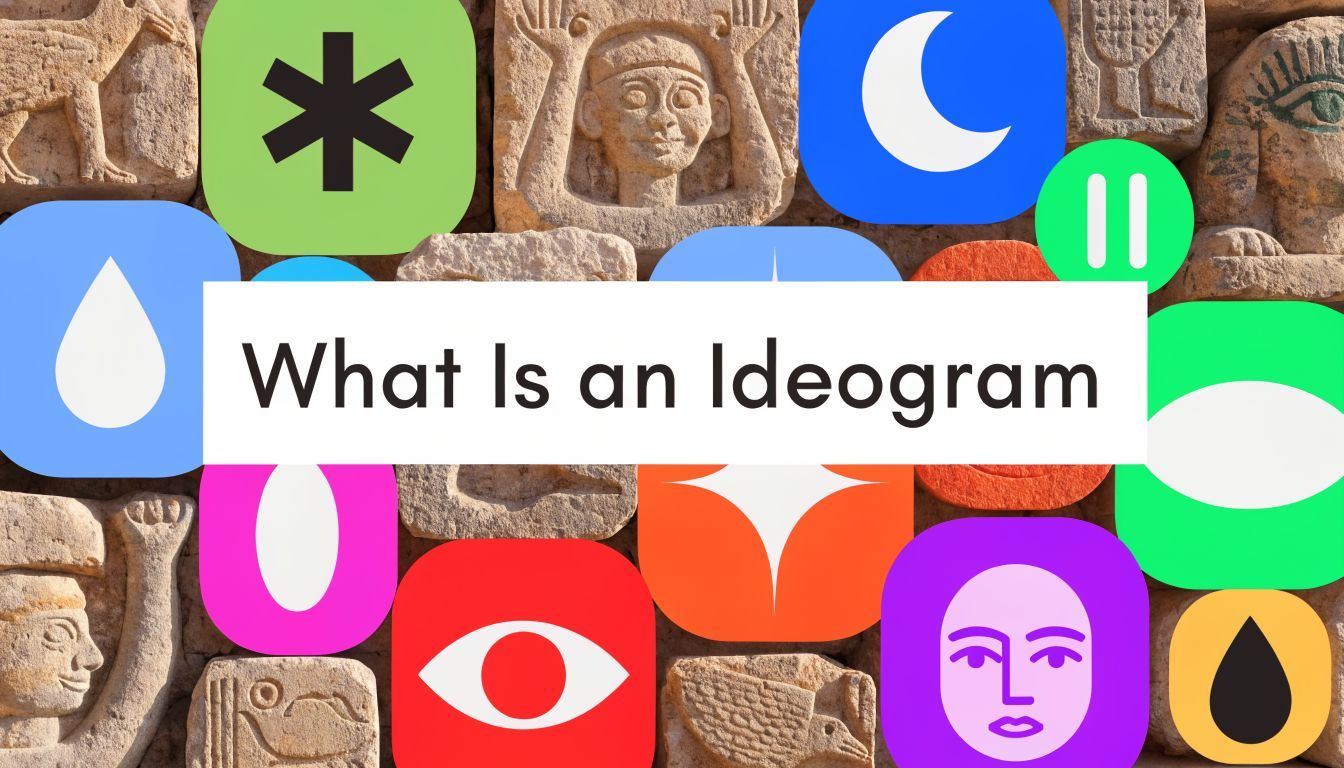
What Is a Ideogram? A Guide for Modern Creators

Ryan Bennett • April 28, 2026
What is a ideogram and how can you use it? Learn the definition, see examples from history to emojis, and discover how to create them at scale with AI.
You’re in an airport in a country whose language you can’t read. You still know where the bathroom is, where baggage claim is, and which button means “play” on your phone. You’re not reading words at that moment. You’re reading ideas.
Beyond Words How Ideas Travel the World
A teacher once told me that the fastest way to see the limits of language is to watch people rush through a transit hub. Nobody pauses to parse full sentences when they’re late, distracted, carrying bags, or helping children. They look for shapes, arrows, colors, and symbols.
That’s where the idea of an ideogram starts to make sense.
Words are powerful, but they’re tied to language. If a sign says “Exit,” it works only for people who know that word. If a sign uses a running figure and a door shape, the message travels farther. It doesn’t ask the viewer to translate first. It asks them to recognize.
Why this matters in busy environments
Marketers and educators run into the same problem, even if they’re not designing airports. A lesson slide, app screen, ad creative, worksheet, or product package has only a moment to communicate. People don’t study visuals line by line. They scan.
That’s why visual communication often works best when it behaves like shorthand.
- In public spaces: people need direction fast.
- In classrooms: learners benefit from cues they can grasp at a glance.
- In marketing: audiences scroll quickly and decide even faster.
- In digital products: icons reduce friction when space is limited.
The strongest symbols don’t need a paragraph beside them.
An ideogram solves a very old problem. How do you express an idea so that meaning survives even when spoken language changes?
That question is ancient, but it’s also current. Every creator making icons, thumbnails, logos, interface elements, or educational graphics is still answering it. The tools are newer now. The challenge isn’t.
When people search what is a ideogram, they’re often expecting a dictionary definition. What they usually need is something simpler. They need to see that ideograms are already all around them. They’re part of the hidden visual system that helps modern life move.
The Power of a Single Image
A single symbol can do in a second what a sentence sometimes cannot. You see it, and the meaning arrives before you start forming words in your head. That speed is the true power behind an ideogram.
An ideogram is a graphic symbol that communicates an idea directly. In plain language, it helps the viewer grasp meaning without first sounding out a word. For marketers, educators, and creators, that distinction matters because attention is short and screen space is limited. The faster a visual carries meaning, the more useful it becomes.

A quick analogy that clears up the confusion
These terms are easy to mix up because they all deal with symbols. A simple way to separate them is to treat them as three different jobs.
- A pictogram shows a thing.
- An ideogram signals an idea.
- A logogram stands for a word or part of a word.
A drawing of a cigarette is just an object. Put a red slash over it, and the symbol now communicates a rule: no smoking. The picture is still there, but the meaning has shifted from “this is a cigarette” to “smoking is prohibited here.” That shift is where many readers finally see what an ideogram does.
Ideogram vs pictogram vs logogram
| Symbol Type | What It Represents | Example |
|---|---|---|
| Ideogram | An idea or concept | No smoking sign, numerals like 1 |
| Pictogram | A physical object or direct action | Simple drawing of a sun |
| Logogram | A word or language unit | & for “and”, Chinese character 山 |
Context matters here. The same mark can behave differently depending on how it is used. That is why symbol systems can feel slippery at first. A creator does not just choose a shape. They choose the kind of meaning that shape needs to carry.
Why ideograms feel fast
Ideograms work like visual compression. They pack meaning into a form the eye can recognize quickly, much like a file icon on your desktop tells you what kind of content is inside before you open it.
That speed matters in practice. A mobile app icon has only a few pixels to explain itself. A classroom worksheet may need to help learners across reading levels or languages. A social post has a fraction of a second to communicate before the thumb keeps scrolling.
Researchers who study visual and written systems often describe symbols like these as efficient because they reduce the amount of verbal decoding required at the moment of recognition. In everyday terms, the viewer spends less effort translating and more effort understanding.
Practical rule: if people have to pause and decode the symbol, the design is too detailed, too literal, or too tied to language.
The concept offers significant utility for modern content teams. An ideogram is not decoration. It is compressed communication. Once you see symbols that way, you can design visuals that travel faster across ads, slides, thumbnails, product interfaces, and educational materials.
That matters even more now because AI image tools can generate visual assets at scale. Speed alone is not enough. If the underlying symbol is unclear, AI will mass-produce confusion faster. If the symbol is clear, AI can help you produce a consistent visual language across dozens or hundreds of assets. That is the ancient idea behind ideograms, applied to modern content production.
A Visual Language Through Time
The story of ideograms begins in early writing systems, where symbols carried meaning before writing became fully tied to speech. Before alphabets could spell out every sound, people needed marks that could hold an idea, track goods, label places, and record events.

From early marks to shared meaning
Early systems such as Sumerian cuneiform and Egyptian hieroglyphs included signs that began close to pictures. Over time, those marks became less like drawings and more like agreed symbols. The shift is easy to miss, but it matters. A mark stops acting like a sketch of an object and starts acting like a compact container for meaning.
That change is similar to what happens in brand design. A first draft may look literal, with lots of detail. After repeated use, the strongest version usually gets simpler. It keeps just enough form to trigger the right idea quickly.
Writing systems followed a similar path. Repetition trained communities to read a symbol as meaning first, drawing second. That is one reason ideograms matter historically. They show how humans learned to compress thought into visual units that could be recognized, reused, and remembered.
Symbols you no longer notice as symbols
Some modern symbols feel so normal that they no longer look designed at all.
- Arabic numerals such as 1, 2, and 3 function as fast visual carriers of quantity.
- The ampersand (&) condenses a word into a single mark.
- Mathematical symbols such as + and = turn operations and relationships into compact visual forms.
These marks work like highly refined interface icons. You do not study them each time you see them. You recognize them, apply the meaning, and move on.
That is the long arc from early ideograms to modern visual systems. Humans kept the symbols that traveled well across distance, repetition, and context. Marketers, educators, and creators still follow the same rule now, especially when AI can generate hundreds of assets in minutes. If the core symbol is clear, scale helps. If the core symbol is muddy, scale spreads confusion faster.
The history here is not just about ancient writing. It explains why simple visual forms remain so effective in digital communication.
Ideograms You Use Every Day
Individuals commonly already read ideograms fluently. They just don’t call them that.
A restroom figure on a door, a pedestrian crossing symbol, a power icon, a heart reaction, a battery warning, a recycle mark, a location pin, a mute button. These aren’t random visual fragments. They’re compact messages built for instant recognition.

In streets, screens, and classrooms
Look at a typical day and you’ll see ideograms in three major places.
Public navigation
Traffic signs, elevator icons, baggage symbols, hazard marks, and restroom signs all lean on visual meaning. They have to work quickly, often for people under stress or in motion.
Digital interfaces
App icons and interface controls use visual shorthand constantly. A triangle means play. Two vertical bars mean pause. A gear means settings. A bell means notifications. These aren’t full sentences. They’re compressed instructions.
Learning materials
Teachers use stars, check marks, arrows, flags, clocks, books, and color-coded symbols to organize lessons visually. Younger learners and multilingual learners often benefit when these symbols support the text rather than replace it.
Why brands use them too
A strong brand symbol often behaves like an ideogram, even if it also functions as a logo. It condenses a company into a recognizable mark that people can spot before they read the brand name.
That doesn’t mean every logo is an ideogram in a strict linguistic sense. But many logos borrow the same principle. They aim for recognition first, explanation second.
Consider what happens in a crowded feed. A viewer may notice the shape of a mark long before reading the caption. That’s why symbol-led branding can be so powerful for social media, packaging, signage, and mobile interfaces.
If a visual has to work at thumbnail size, ideogram thinking helps.
A useful test
Ask four questions when you see a symbol:
- Can I understand it quickly
- Would it still work without text nearby
- Would it stay legible when small
- Does it point to an object, a word, or a broader idea
That last question matters most. A leaf drawing may be a pictogram. A recycle symbol points beyond the object and into a concept. A branded swoosh may not name a product directly, but it can signal identity, movement, and recognition through repeated association.
Once you start noticing that distinction, your visual world changes. Icons stop being decoration. They become strategy.
Designing Effective Modern Ideograms
Good ideograms don’t happen by accident. They’re designed to survive speed, distraction, small sizes, and mixed audiences. That’s why the best ones look obvious only after someone has solved the hard part.
Start with the idea, not the art style
The first mistake many creators make is choosing a visual style too early. They ask whether the icon should look playful, premium, minimal, flat, glossy, or hand-drawn before they’ve defined the message.
Start with the concept in one plain sentence. “This symbol should mean approved.” “This mark should signal growth.” “This classroom icon should indicate quiet reading time.”
Once the meaning is clear, test whether the symbol can carry that idea without supporting text.
Four design principles that hold up
Simplicity
Remove details until only the essential signal remains. If tiny lines disappear at mobile size, they weren’t doing useful work.
Recognizability
Use forms people have likely seen before, unless novelty is the goal. Reinvention often hurts clarity.
Scalability
A symbol has to work on a slide, a worksheet, a phone screen, and sometimes a sign. Check it large and small.
Cultural awareness
Some gestures, objects, and metaphors don’t travel well. A hand sign that feels obvious in one market may confuse or offend in another.
Design check: if you need to explain the symbol before someone understands it, revise the symbol.
Common mistakes to avoid
- Too much detail: tiny embellishments create noise.
- Mixed metaphors: combining several ideas into one icon weakens recognition.
- Overreliance on text: if the symbol only works with a label, it may not be doing enough.
- Trend-first design: fashionable icon styles age quickly.
For small businesses choosing between a symbol-led mark and a name-led mark, these important logo style considerations for SMEs are worth reviewing. They help clarify when a visual symbol strengthens brand recall and when a wordmark may be the better strategic choice.
Briefing a designer or AI tool well
You’ll get better results if your prompt or brief focuses on the message, audience, and constraints.
For example:
- “Create a simple icon for growth using upward motion, minimal geometry, and strong readability at small sizes.”
- “Design a classroom symbol for group discussion that feels friendly and clear for young learners.”
- “Generate a logo concept based on trust and momentum, avoiding literal arrows.”
If you’re exploring options quickly, an AI logo generator can help you pressure-test directions before refining a final system. The key is to judge the output by clarity, not by novelty alone.
Scaling Ideogram Creation with AI
A marketing team launches one campaign and suddenly needs the same idea to appear in ten places. The website needs a clean icon. Social posts need faster, bolder versions. Email banners need simplified variants. A lesson pack or onboarding guide may need the same symbol set adapted for print, mobile, and slides. That is where ideogram thinking becomes operational.
Understanding ideograms gives you the logic for meaning. AI helps you produce that meaning as a repeatable visual system.

Why AI fits this job well
An ideogram works like a visual shorthand. Once you know the core idea you want to express, AI can generate multiple forms of that same idea quickly. Instead of sketching every option by hand, you guide the system, compare patterns, and keep the versions that communicate fastest.
That matters for teams building at volume. Marketers often need one symbol language across ads, landing pages, lead magnets, and product UI. Educators may need matching cues across worksheets, posters, slide decks, and printable activities. AI speeds up the variation stage, which can reduce post-production time when you are producing template-based visuals or testing concept families.
AI is especially useful for:
- Consistent icon sets for apps, courses, or learning materials
- Campaign variations designed for different audiences and channels
- Fast concept testing before a design direction is finalized
- Repeatable templates for social graphics, explainers, or classroom assets
The advantage is scale with control. You are not asking for random images. You are building a small visual vocabulary that can be reused across dozens of assets.
Better prompts create better symbols
AI follows direction closely. Generic input usually leads to generic symbols.
A prompt such as “make an icon” gives the model almost no design strategy to work with. A stronger prompt names the idea, the level of abstraction, the usage context, and the visual constraints. If you want help turning rough concepts into clearer instructions, this free AI image prompt generator for visual concept prompts can help structure the brief.
Here is the difference:
- Weak prompt: “growth icon”
- Better prompt: “minimal ideogram for growth, abstract upward movement, clean lines, suitable for app UI and classroom worksheet”
- Better still: “set of six ideograms for growth, progress, review, collaboration, time, and achievement, unified geometric style, strong readability at small sizes”
A useful rule is simple. Ask for a symbol system, not a single attractive image.
Ideograms across media, not just static graphics
This approach also improves motion work. A stable symbol library gives videos and animations a coherent visual grammar, so the viewer keeps recognizing the same ideas from frame to frame. In practice, that means fewer visual resets and clearer communication.
Teams building short explainers, product demos, or social clips through AI video creator workflows often get stronger results when they start with ideograms first. The symbols become the recurring cues for transitions, overlays, scene markers, and calls to action.
That is the modern shift. Ideograms began as a way to carry meaning across language barriers. AI turns them into production-ready assets that can be generated, adapted, and deployed at the speed digital publishing now demands.
From Ancient Symbols to AI-Powered Assets
An ideogram is simple to define and easy to underestimate. It’s a visual symbol that carries an idea. But that small definition opens into something much larger. It explains how humans have communicated across language gaps for thousands of years, and it explains why the best modern visuals still feel immediate.
For creators, marketers, and educators, this isn’t abstract theory. It shapes everyday work. A strong symbol can guide, reassure, instruct, organize, and persuade faster than a paragraph can. That’s why ideogram thinking improves icons, logos, teaching materials, campaign assets, and interface design.
The old lesson is still the useful one. Meaning travels farther when form is clear.
AI doesn’t replace that principle. It amplifies it. Once you know what kind of symbol you’re trying to create, modern image tools make it easier to generate variations, build visual systems, and scale production across channels. The craft has shifted from drawing every mark by hand to directing a symbol language with intention.
If you want a broader view of where this is heading, the latest AI image generation trends for creators offer a helpful look at how visual production is changing.
The next time you ask what is a ideogram, the shortest answer is this: it’s an idea made visible. The more useful answer is this: it’s one of the most practical tools you have for communicating clearly in a crowded, global, AI-assisted visual world.
If you want to turn that understanding into production, Bulk Image Generation is built for creators who need lots of visuals fast. You can generate professional-quality images in bulk, explore symbol-driven concepts, and streamline editing for campaigns, teaching materials, branding, and social content without getting stuck in manual prompt work.