How to Create Stunning Mirror Image Art with AI

Ryan Bennett • August 28, 2026
Learn how to create mirror image art with AI. Step-by-step tutorial with prompts, style tips, batch generation tricks, and real-world use cases.
You're staring at a blank canvas, an empty social feed, or a product mockup that feels technically correct but visually forgettable. A mirrored composition can solve that problem quickly, but flipping an image rarely produces polished mirror image art. The stronger approach starts with a deliberate axis, a controlled subject, and a batch workflow that gives you enough variations to compare instead of settling for the first acceptable result.
What Mirror Image Art Actually Is
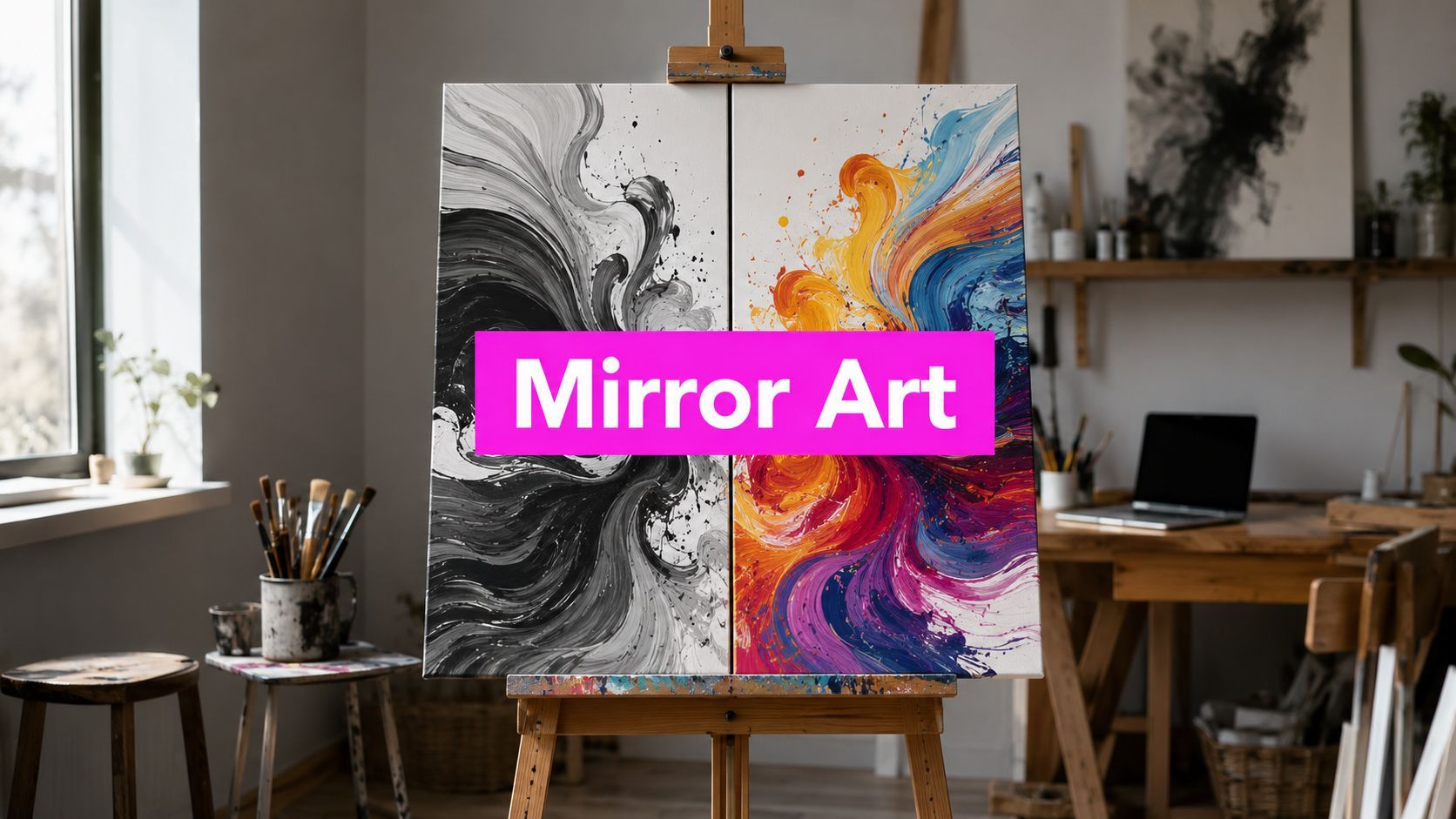
Mirror image art is a composition in which visual elements are duplicated and flipped along a defined axis. That axis can run vertically, horizontally, or through a rotational structure, creating a deliberate visual palindrome rather than an accidental resemblance.
The distinction matters. A kaleidoscope design usually repeats elements around a central point, often producing multiple wedges or radial segments. Rorschach-style imagery depends on interpretive ambiguity, where viewers search for recognizable forms in abstract stains. Mirror image art can create similar visual associations, but its defining feature is controlled reflection across a specific line.

Start with the axis, not the effect
For a vertical mirror, place the main subject so the left and right halves meet at a strong centerline. A face, bottle, flower, doorway, or architectural opening can act as the anchor. A horizontal mirror works differently, reflecting an upper scene into a lower field, which is useful for natural vistas, water, shadows, and decorative borders.
Rotational symmetry needs a central point rather than a single seam. It works well for mandalas, ornamental motifs, and coloring pages because the design distributes visual weight around the page.
By the end of a practical workflow, you should have a stack of consistent symmetrical visuals, not one isolated experiment. Those outputs might become social posts, printable coloring pages, product mockups, wallpapers, or brand assets.
Keep one mental model in front of you: one strong motif, one chosen axis, one repeatable prompt structure.
Why Symmetry Works in Visual Composition
Mirrors have served artists for thousands of years. The earliest manufactured mirrors were polished obsidian objects dating to around 6000 BCE in Anatolia, followed by polished copper mirrors in Mesopotamia around 4000 BCE and in Egypt around 3000 BCE. Glass mirrors existed in ancient Rome, but they became widely used much later, around 1500, when convex mirrors were produced in Germany and flat silvered mirrors were developed by Venetian glassmakers. The historical sequence is documented in this research on mirrors in art and science.
Artists didn't use reflective surfaces only to decorate a scene. Mirrors introduced questions about viewpoint, identity, depth, and the relationship between the viewer and the image. Jan van Eyck's The Arnolfini Portrait, painted in 1434, is widely cited as the earliest known painting to use a mirror-image device inside the composition. Art historians treat it as a turning point because the mirror became a tool for perspective, self-representation, and visual complexity, rather than just a symbolic object. The painting's role is discussed in this overview of major mirror paintings.

What the viewer notices first
Vertical bilateral symmetry is processed rapidly. Neuroaesthetics sources summarize research indicating that symmetry can be detected in under 0.05 seconds, with vertical symmetry detected faster than horizontal or rotational symmetry. That suggests a practical composition rule, place the mirrored focal axis where the viewer's eye lands first, then move secondary irregularities outside the most important centerline. See the summary of symmetry perception in art.
This doesn't mean every symmetrical image is automatically more beautiful. A controlled study found a strong implicit preference for symmetry independent of art expertise, while explicit preferences shifted with expertise. In another experiment, adults selected symmetrical images as more beautiful 74.17% of the time, compared with 52.35% for children, showing that context, development, and task shape the response. The findings are available in this study of symmetry preference and expertise.
For modern creators, the translation is straightforward:
- Bilateral balance gives a feed thumbnail an immediate anchor.
- Radial symmetry fills a product page or printable sheet with ornamental density.
- Near-symmetry adds tension, preventing a portrait or poster from feeling mechanically sterile.
Decorative references can help you study how repeated motifs behave on real surfaces. The Quote My Wall vinyl sticker collection is useful for examining how symmetrical patterns remain readable when they're applied across furniture and interiors.
Building Mirror Image Art in Bulk
A reliable batch starts with a prompt that separates subject, axis, lighting, and style. If you only write “beautiful symmetrical AI art,” the generator has too much freedom. It may create approximate balance, radial repetition, or a centered subject with unrelated details on each side.
Use this prompt anatomy:
- Subject: Name the object or character clearly.
- Axis cue: Specify “mirrored along the vertical axis,” “horizontal reflection,” or “rotational symmetry.”
- Lighting token: Choose a visual condition such as butterfly lighting, soft studio light, or a controlled gradient.
- Style anchor: Add the intended finish, such as editorial portraiture, botanical line art, or luxury product photography.
Copy-paste prompt examples
Editorial portrait of a woman with calm expression, centered composition, butterfly lighting, mirrored along the vertical axis, clean facial features, symmetrical shoulders, refined fashion photography, neutral backgroundElegant cat seated at the center, botanical leaves flanking both sides, central floral axis, vertical mirror symmetry, detailed line art, balanced negative space, coloring page design, black and whiteLuxury perfume bottle duplicated left and right around a precise vertical centerline, soft gradient backdrop, symmetrical studio lighting, polished glass, premium product photography, clean reflective surface
The important phrase is not “symmetrical.” Use an explicit instruction such as “precise bilateral symmetry” or “duplicated and flipped across the vertical axis” when you need a clean seam. If you want organic variation, use “near-symmetrical” or “balanced asymmetry” instead. Those phrases produce different creative outcomes, and mixing them inside one batch makes comparison harder.
Batch settings that keep results usable
In the Bulk Image Generation workflow, set the row count before refining the prompt. A consistent batch lets you compare composition, facial structure, seam quality, and background behavior without changing several variables at once. Lock the seed when you want controlled variations around a stable visual idea. Disable it when you need broader exploration.
Choose the aspect ratio before generation:
- 1:1 suits posters, square artwork, and profile graphics.
- 9:16 gives vertical symmetry enough room for stories and mobile screens.
- 4:5 works well for social feed compositions where the subject needs height without becoming too narrow.
Use a folder convention such as client_project_axis_style_batch. For example, jewelry_campaign_vertical_portrait_batch01 is more useful downstream than a folder full of unnamed exports. If you're preparing social assets, the bulk social media image generator can support a similar production mindset, but the key discipline remains the same, separate orientations and keep prompt versions traceable.
Choosing the Right Symmetry Axis
The axis changes the job the image performs. Vertical symmetry establishes a confident centerline. It suits posters, logos, frontal portraits, masks, architecture, and centered brand marks. Horizontal symmetry creates a sense of reflection, stillness, or surface balance. It's often effective for nature scenes, water, tabletop arrangements, and product scenes. Rotational symmetry distributes attention around a center and gives decorative designs more usable area.
| Content Type | Best Axis | Why It Works | Watch Out For |
|---|---|---|---|
| Posters | Vertical | Gives the headline, subject, or emblem a firm central structure | Can feel rigid if every detail is duplicated |
| Coloring pages | Rotational or quadrantal | Fills the page with repeatable ornamental space | Excessive detail can make coloring difficult |
| Product photography | Horizontal | Supports surface, reflection, and left-to-right scanning | Reflections can make the product look staged |
| Animal portraits | Near-vertical | Keeps the face recognizable while preserving organic character | A strict crop can cut ears or flatten the head |
| Landscapes | Horizontal | Turns water, sky, or terrain into a natural reflective field | A weak horizon creates an awkward seam |
| Logos and icons | Vertical | Makes the symbol easy to identify at a glance | Tiny inconsistencies become obvious |
A vertical axis is usually the safer choice when recognition matters. Research summarized in visual perception sources indicates that viewers detect vertical mirror symmetry especially quickly, while research on frieze patterns found that horizontal symmetry can exert stronger influence on perceived beauty in that particular context. The result isn't a universal ranking. The right axis depends on format, viewing distance, and whether you want instant detection, decorative balance, or emotional tension. See the research comparing vertical and horizontal mirror symmetry.
Use rotational symmetry for mandalas and ornamental worksheets, but don't force it onto a product image that needs a clear front-facing hierarchy. For practical prompt references across styles, browse these AI image generator prompt ideas and choose the axis before you write the final prompt.
Polishing Mirrored Images After Generation
Generation gets you close. Post-production determines whether the image looks intentional or like an uncorrected AI experiment. The most efficient sequence is background cleanup, face correction, then resizing, because each step removes a different source of friction.
Remove distracting context first
Use Background Remover when the mirrored image contains furniture, stray objects, or inconsistent scenery around the main subject. It earns its place most clearly in symmetrical product flat-lays, where a single unrelated prop can break the visual rhythm. Isolate the subject before changing the canvas, because cleanup is easier when the background isn't competing with the reflection.
Correct faces only when the seam demands it
A mirrored face can look uncanny when the two halves have mismatched eye direction, earrings, hair strands, or skin texture. Face Swap becomes useful when the viewer notices the face before noticing the artistic device. Don't use it automatically. A slightly irregular face may preserve personality, while a corrected face may make the portrait look polished but generic.

Resize for every destination
Resize after the composition is approved. A poster may need a print-ready square, a social post may need a taller crop, and a story needs a vertical frame. Export platform-specific versions instead of forcing one file into every placement. The bulk image resizer is useful when several approved variations need the same treatment.
The same principle applies to motion. If your mirrored concept becomes a reel or short clip, these mobile and desktop video flipping tips can help you check orientation and avoid reversing text or directional movement.
A bundled Fast Image Tools path saves time when the same upload needs all three treatments. Keep a master file untouched, then export corrected versions into clearly named folders.
Real Use Cases for Mirror Image Art
Mirror image art becomes more useful when it's tied to a deliverable. The axis isn't the product. It's the visual decision that helps the asset perform its specific job.
Etsy product flat-lay
Create a symmetrical arrangement of candles, jewelry, stationery, or ceramics around the featured product. Use Background Remover to strip away a messy room or table edge, then place the isolated product on a controlled background. The takeaway is immediate: build the reflection around the item customers need to recognize, not around decorative props.
KDP coloring book pages
Generate a quadrantal mandala or rotational botanical pattern in a batch, then review the pages for line clarity and open spaces. Bulk Image Generation is the heavy-lifting feature here because consistency across a series matters more than one impressive page. Same-day action: define a single line-art prompt, lock the style, and separate rejected pages before layout.
Jewelry brand Instagram carousel
Produce a set of vertical-mirror portraits where earrings, necklaces, or headpieces occupy the center seam. Face Swap can help correct a distracting mirrored expression when the face competes with the jewelry. The actionable choice is to keep the model treatment consistent while varying the accessory, background, or lighting.
Desktop wallpaper bundle
A horizontal-mirror image can turn mountains, clouds, coastlines, or forests into a calmer wide-format composition. Keep the center seam away from important text or icons if the wallpaper will sit behind a desktop interface. Start today by creating one image prompt and testing both a natural horizon reflection and a deliberately surreal one.
Notion header pattern
Rotational motifs can be tiled across a Notion header without demanding a single focal subject. Use a simple symbol, botanical shape, or geometric mark so the repeated pattern remains legible at small display sizes. The practical move is to generate a clean tile first, then test it against both light and dark page backgrounds.
One caution applies to all five uses. Symmetry can make an asset feel finished before it is distinctive. Contemporary-art discussions describe reflective surfaces as tools for self-reflection, selfies, and interactive installations, while other work shows that viewers can prefer an original asymmetrical composition to a mirrored alternative in some artistic contexts. That tension is useful. Use mirror image art for clarity, rhythm, or participation, then introduce selective irregularity when a perfect duplicate removes the personality.
Smart Habits for Better Mirror Image Art
The best mirrored visuals usually come from simple controls applied consistently:
- Pin the axis first: Decide whether the design is vertical, horizontal, or rotational before writing the prompt.
- Lead with the subject: Describe the main object and its placement before adding atmosphere or texture.
- Add asymmetry deliberately: Start with a clean reflection, then introduce one controlled irregular detail if the image feels sterile.
- Compare batches: Generate a consistent group and judge the seam, silhouette, negative space, and thumbnail readability side by side.
- Separate orientations: Keep vertical and horizontal outputs in different folders so you don't reuse a composition in the wrong format.
- Check grayscale: A grayscale review exposes weak contrast, muddy reflections, and an axis that doesn't attract attention.
- Keep a swipe file: Save successful prompts and outputs, including the axis, aspect ratio, lighting, and style language.
Avoid mirroring low-resolution source material. Don't skip background cleanup, and don't reuse the same prompt unchanged across orientations. A scenic view prompt needs different spatial instructions from a vertical portrait prompt, even when both use reflection.
Mirror image art works best with intent, not by default. Symmetry should clarify the idea, create a visual hook, or support a repeatable series. If it only makes the canvas look evenly filled, it's probably hiding a weak concept.
Bulk Image Generation helps you turn a single mirror-image concept into a consistent batch for social campaigns, coloring pages, product visuals, and branded design work. Visit Bulk Image Generation to generate variations, compare axes, and move approved images into post-production without rebuilding each asset from scratch.