12 Fresh Ideas for Pictures That Work in 2025

Ryan Bennett • November 24, 2025
Discover 12 powerful and actionable ideas for pictures to elevate your content. Get pro tips, prompt templates, and inspiration for your next project.
In a visually saturated environment, the right image does more than just capture attention; it communicates a message, evokes emotion, and solidifies a brand's identity. However, consistently finding or creating unique, high-quality, and on-brand visuals is a significant hurdle for marketers, creators, and business owners. Standard stock photos often feel impersonal and fail to resonate with audiences who value authenticity and creative flair. This guide directly addresses that challenge.
We have compiled a comprehensive list of 12 actionable ideas for pictures, moving beyond the generic to offer professional tips, compositional guidance, and practical applications. Each idea is designed to be adaptable, whether you're a digital marketer planning a campaign, an educator creating coloring pages, or a branding agency defining a client's visual language. To truly excel in any photographic style, understanding the fundamental principles is key; learn more about essential composition techniques for photography that can elevate your visual storytelling.
More importantly, this resource is built for efficiency. We provide ready-to-use AI prompts for each concept and explain how to leverage tools like Bulk Image Generation. This approach empowers you to scale your creative output, generating hundreds of unique, professional-grade images tailored to your specific needs in a fraction of the time. This isn't just a list of ideas; it's a blueprint for overcoming creative block and building a limitless library of stunning, customized visuals.
1. Golden Hour Photography
Golden hour refers to the brief period shortly after sunrise or before sunset when the sun is low in the sky, casting a warm, diffused, and almost magical light. This natural lighting is exceptionally flattering for subjects, minimizing harsh shadows and creating a soft, golden glow that adds depth and dimension. This makes it one of the most sought-after ideas for pictures, beloved by professionals and amateurs alike for its ability to produce stunning, dimensional images with a warm, inviting mood.
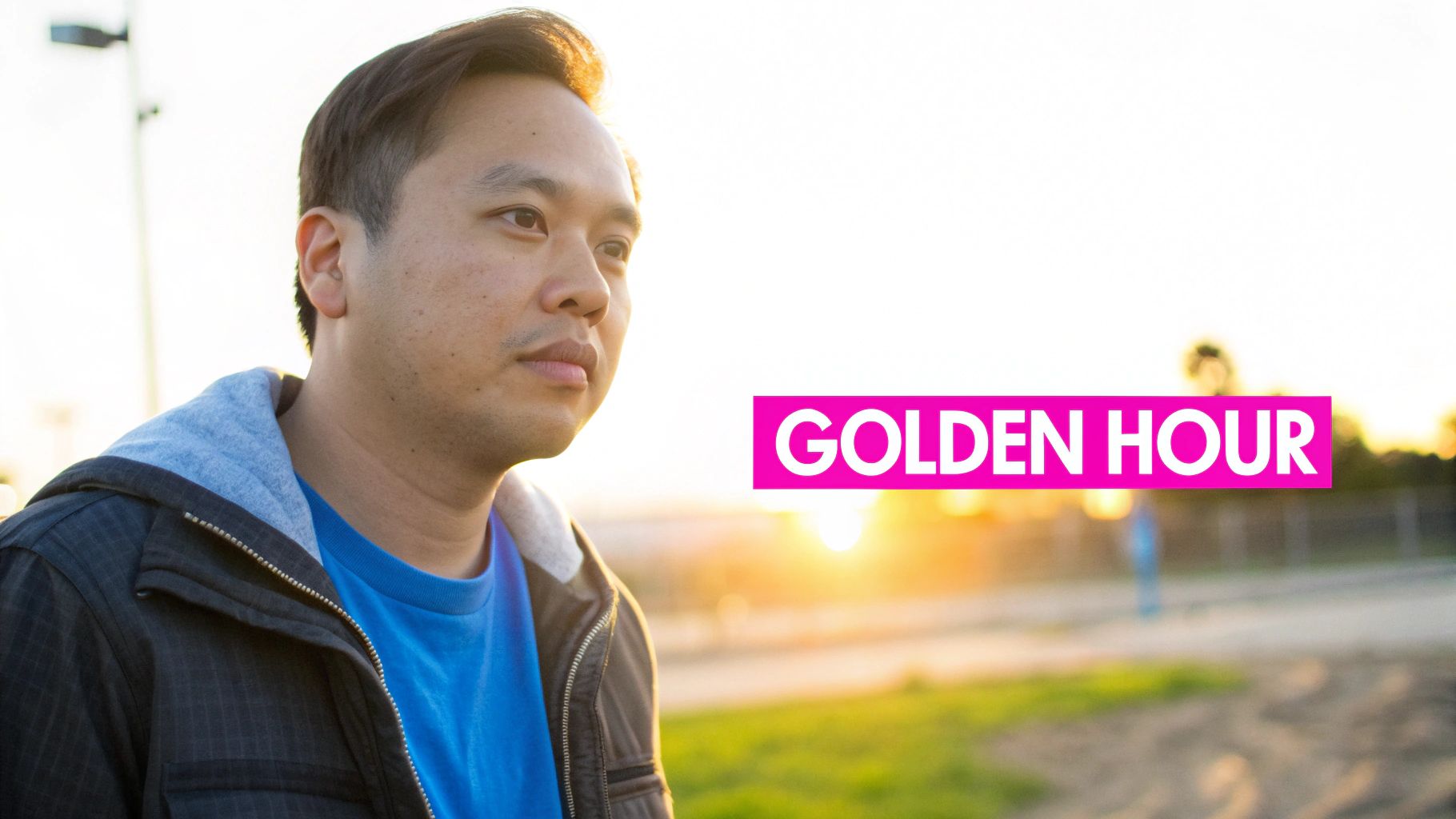
This technique is ideal for portrait photography, real estate listings, and lifestyle or branding content where a positive, serene, or premium feel is desired. The soft, directional light naturally sculpts faces and landscapes, creating beautiful highlights and gentle shadows without the need for complex artificial lighting setups.
How to Implement It
- Timing is Everything: Use an app like PhotoPills or The Photographer's Ephemeris to pinpoint the exact golden hour times for your specific location and date.
- Position Your Subject: Place your subject with the sun behind them (backlighting) to create a beautiful rim light or halo effect around their hair and shoulders. Alternatively, position them so the sun hits them from the side (sidelighting) to create dramatic, sculpting shadows.
- Adjust Exposure: Your camera's meter might get confused by the bright backlight. Use exposure compensation (+1 or +2) to ensure your subject is properly lit and you don't lose them in silhouette.
- Scout Ahead: Visit your location during the day to plan your compositions and see how the light will fall when it's lower in the sky.
For those looking to replicate this aesthetic with AI, you can find specific prompts and settings using an AI image prompt generator.
2. Flat Lay Photography
Flat lay photography is a popular composition technique where items are arranged on a flat surface and photographed from a bird's-eye view, directly above. This top-down perspective creates a clean, organized, and visually engaging story, making it one of the most effective ideas for pictures when showcasing multiple products or telling a narrative with objects. It is widely used by food bloggers, e-commerce brands, and social media influencers to create aesthetically pleasing and shareable content.

This style is perfect for product showcases, lifestyle content, food styling, and branding materials. By carefully curating the objects, colors, and textures, a flat lay can communicate a specific mood, theme, or brand identity. The organized grid-like format is particularly effective for social media feeds, as it is both eye-catching and easy for viewers to comprehend at a glance.
How to Implement It
- Choose a Background: Start with a clean, neutral background like a white poster board, a wooden table, or a marble slab to make your hero items pop.
- Create a Story: Arrange your main subject and supporting props to tell a cohesive story. For example, pair a laptop with a coffee cup and a notebook to evoke a "work-from-home" theme.
- Balance the Composition: Use the rule of odds by arranging items in groups of three or five. Leave intentional negative space between objects to prevent the layout from feeling cluttered and to guide the viewer's eye.
- Use Diffused Lighting: Position your setup near a large window to get soft, natural light. Avoid direct sunlight, which creates harsh shadows. If using artificial light, a softbox will help diffuse it evenly across the scene.
This technique is a cornerstone of modern branding, and you can explore more advanced concepts for creating similar visuals using AI with our tutorial on AI product photography.
3. Macro Photography
Macro photography is the art of capturing extreme close-ups of small subjects, revealing intricate details that are invisible to the naked eye. This technique typically involves magnifying the subject to a 1:1 ratio or greater, turning everyday objects like insects, flower petals, or water droplets into fascinating, abstract works of art. It’s an incredibly compelling idea for pictures because it offers a completely new perspective on the world, highlighting complex textures and patterns in stunning detail.
This style is perfect for product photography that needs to showcase fine craftsmanship, such as jewelry or textiles. It is also invaluable in educational content, scientific documentation, and nature photography. For digital marketers and brands, macro shots can create visually arresting content that stops users mid-scroll, emphasizing quality and attention to detail in a way standard photos cannot.
How to Implement It
- Stabilize Your Camera: Even the slightest movement is amplified at high magnifications. Use a sturdy tripod and a remote shutter release or your camera's self-timer to eliminate camera shake.
- Master Your Focus: Switch to manual focus for precise control. Since the depth of field is incredibly shallow, use a technique called focus stacking (taking multiple shots at different focus points and merging them in software) to get the entire subject sharp.
- Control Your Lighting: Use off-camera flashes or small LED lights positioned at a 45-degree angle to the subject. This will highlight textures and three-dimensional details without creating harsh, flat light.
- Prepare Your Subject: Clean your subject meticulously before shooting. Dust, smudges, or tiny fibers that are normally unseen will become glaring distractions in a macro photograph.
AI tools can simulate this detailed style effectively. For generating a variety of macro images, you can use an AI image prompt generator to create prompts that specify the subject, lighting, and level of detail.
4. Long Exposure Photography
Long exposure photography is a technique that involves using a slow shutter speed to capture the cumulative effect of time and movement within a single frame. By leaving the camera's shutter open for seconds, or even minutes, any moving elements like water, clouds, or car lights blur into smooth, ethereal streaks, while stationary objects remain tack-sharp. This contrast between motion and stillness is what gives these ideas for pictures their surreal, dreamlike quality, transforming ordinary scenes into captivating works of art.
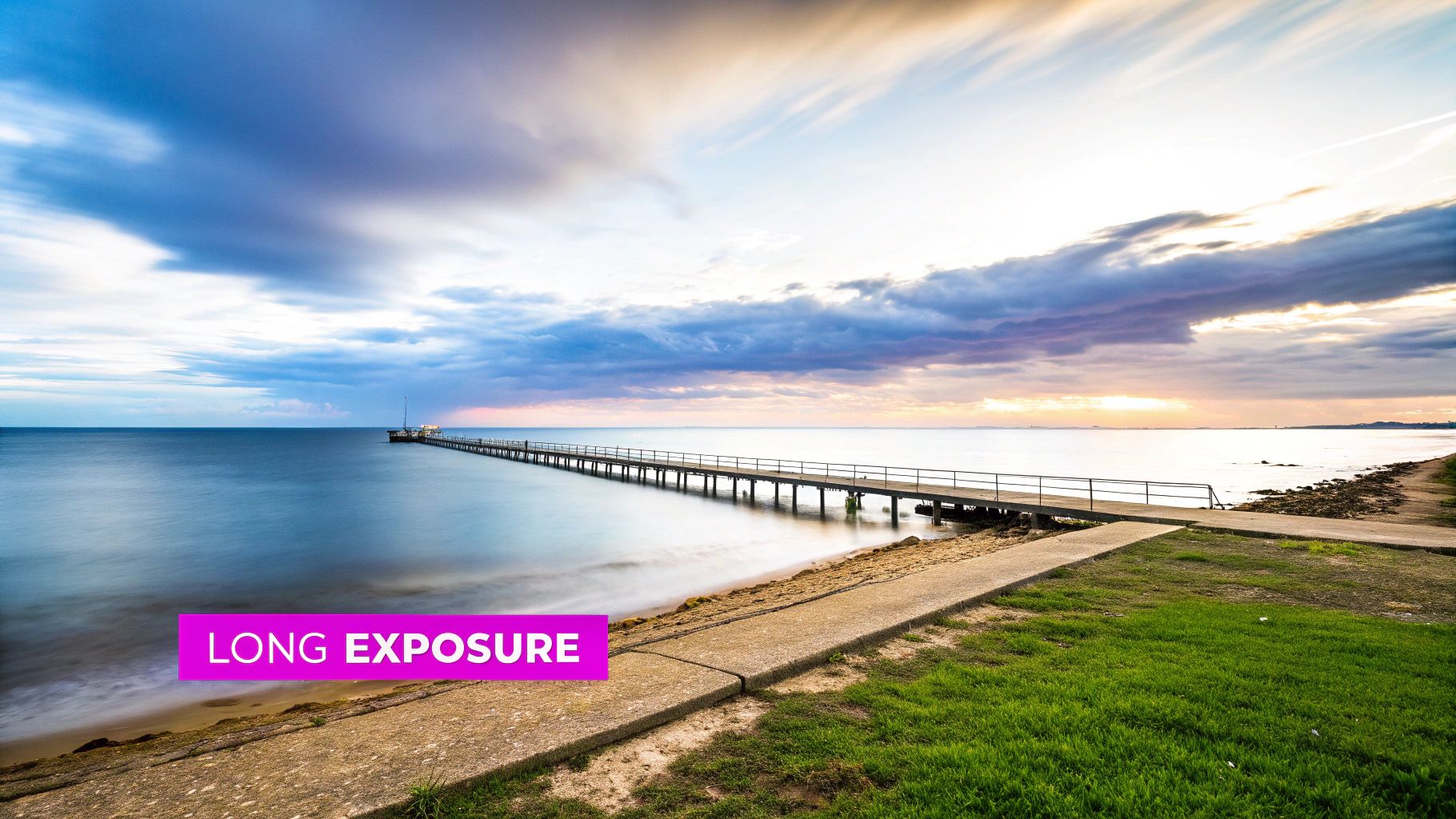
This method is perfect for landscape, cityscape, and astrophotography, where conveying a sense of peace, dynamism, or the passage of time is key. For brands, it can create high-impact, premium visuals that stand out. Think of silky smooth waterfalls in travel promotions or vibrant light trails representing data flow for a tech company. The technique adds a layer of sophistication and visual intrigue that is hard to achieve otherwise.
How to Implement It
- Stabilize Your Camera: A sturdy tripod is non-negotiable to keep the camera perfectly still. Use a remote shutter release or your camera's self-timer to avoid any shake from pressing the shutter button.
- Use an ND Filter: During the day, a Neutral Density (ND) filter is essential. It acts like sunglasses for your lens, reducing the amount of light entering the camera and allowing you to use a slow shutter speed without overexposing the image.
- Master Manual Mode: Set your ISO to its lowest native value (e.g., 100) and choose a narrow aperture (like f/8 to f/16) for a deep depth of field. Your shutter speed will be the variable you adjust to get the right exposure and desired motion blur effect.
- Start Small: Begin with exposures of 2-5 seconds for moving water or clouds to get a feel for the effect before attempting more complex, minute-long shots.
For those looking to replicate this aesthetic with AI, you can find specific prompts and settings using an AI image prompt generator.
5. Portrait Photography with Shallow Depth of Field
Shallow depth of field is a classic portrait technique that involves using a wide lens aperture (like f/1.8 or f/2.8) to isolate a sharp subject against a beautifully soft, blurred background. This effect, often called "bokeh," directs the viewer's attention squarely onto the person in the frame, minimizing distracting background elements. This makes it one of the most effective ideas for pictures when you want to create a professional, polished, and intimate portrait with a strong sense of dimension.
This method is the standard for professional headshots, fashion editorials, and wedding photography because it elevates the subject, making them the undeniable focal point. It adds a layer of sophistication and artistic quality, transforming a simple snapshot into a compelling portrait. The separation between subject and background creates a three-dimensional feel that is visually appealing and highly engaging.
How to Implement It
- Select a Wide Aperture: Set your camera or lens to its widest available aperture, such as f/1.4, f/1.8, or f/2.8, to achieve the shallowest depth of field.
- Use the Right Lens: Prime lenses, especially those with focal lengths like 85mm or 135mm, are ideal for this technique as they offer wide apertures and flattering compression for portraits.
- Create Distance: Physically move your subject further away from the background. The greater the distance between your subject and the background, the more blurred the background will become.
- Focus on the Eyes: For portraits, your critical focus point should almost always be on the subject's eyes. In very shallow shots, focus on the eye closest to the camera to ensure the most important feature is perfectly sharp.
For marketers and brands, using an AI image prompt generator can help create stunning portraits with perfect bokeh for campaigns without a photoshoot.
6. Black and White Photography
Black and white photography strips away all color, compelling the viewer to focus on the fundamental elements of an image: contrast, tone, texture, and composition. This classic approach distills a scene to its essence, creating timeless, dramatic, and emotionally impactful visuals. By removing the distraction of color, this technique emphasizes form, light, and shadow, making it a powerful choice among ideas for pictures that aim for depth and artistic expression.
This style is exceptionally versatile, excelling in portraiture to reveal a subject’s character, in architectural shots to highlight lines and shapes, and in street photography to capture raw, unfiltered moments. It lends a sophisticated and classic feel to fine art, editorial content, and branding materials, conveying a sense of gravity, elegance, or nostalgia that color sometimes cannot.
How to Implement It
- Look for Contrast: The best black and white images have a full range of tones, from deep blacks to bright whites. Train your eye to see scenes in terms of light and shadow, not color.
- Emphasize Texture and Pattern: Without color, textures like rough wood, wrinkled fabric, or weathered stone become much more prominent. Use lighting to enhance these details and create compelling compositions.
- Shoot in RAW: Always capture images in RAW format if possible. This retains all the image data, giving you maximum flexibility to adjust exposure, contrast, and tones when converting to black and white in post-processing.
- Master Post-Processing: Use editing tools to fine-tune your image. Increase contrast, dodge (lighten) and burn (darken) specific areas to guide the viewer’s eye, and adjust the black and white mix to control how individual colors are converted to grayscale.
For those creating monochromatic images with AI, you can refine your outputs with an AI image prompt generator.
7. Silhouette Photography
Silhouette photography is a powerful compositional technique where the subject is intentionally underexposed against a much brighter background. This contrast renders the subject as a dark, graphic outline, stripping away detail and texture to emphasize its shape and form. This method creates dramatic, high-impact images filled with mystery and emotion, making it a fantastic idea for pictures that need to tell a story through shape alone.
This style is perfect for travel photography, wedding portraits, and conceptual art where the mood is more important than the subject's specific details. It simplifies a scene, drawing the viewer's attention to the outline and the context provided by the bright background, whether it's a vibrant sunset, a city skyline, or a bright window. The resulting image feels both timeless and evocative.
How to Implement It
- Backlight Your Subject: Position your subject directly in front of a strong light source, like the setting sun or a bright sky. The key is to have the light behind the subject, not on it.
- Expose for the Background: Set your camera's exposure based on the brightest part of the scene (the background). This will automatically plunge your subject into shadow, creating the desired silhouette effect.
- Choose a Recognizable Shape: Since you lose all detail, select subjects with a clear and interesting profile. A person in profile, a distinctive tree, or an animal with a well-known shape works best.
- Keep it Clean: Avoid cluttered backgrounds or overlapping subjects, as this can make the silhouette confusing and messy. A simple, bold shape against a clean background is most effective.
8. Aerial and Drone Photography
Aerial photography captures images from an elevated perspective using drones, helicopters, or other aircraft, offering a unique bird's-eye view. This approach reveals patterns, scales, and compositions that are completely invisible from the ground, revolutionizing how we see landscapes, cities, and events. It provides a grand, contextual understanding of a scene, making it one of the most dynamic ideas for pictures for those seeking a dramatic and modern aesthetic.
This technique is invaluable for real estate marketing, travel content, event coverage, and architectural visualization. The high-angle perspective can showcase the full scope of a property, highlight the layout of a landscape, or capture the energy of a large gathering in a single, compelling shot. It instantly adds a high-production-value feel to any project, whether for a commercial or a social media post.
How to Implement It
- Check Regulations: Before flying a drone, always check local and national regulations. Many areas require permits or licenses, and there are strict no-fly zones, especially near airports and government buildings.
- Plan Your Flight: Use mapping tools like Google Earth to scout locations and plan your flight path in advance. This helps you identify key points of interest and anticipate potential obstacles.
- Monitor Weather: Wind is a drone's biggest enemy. Always check the weather forecast, paying close attention to wind speed and gusts, to ensure a safe and stable flight for clear photos.
- Shoot During Ideal Light: Golden hour and blue hour are fantastic times for aerial shots, as the low-angle light adds texture and dimension to the landscape below. Midday sun can create flat, uninteresting images.
9. Street Photography
Street photography is the art of capturing candid, unposed moments of everyday life in public spaces. It focuses on the human element within urban environments, telling stories through authentic interactions, fleeting expressions, and compelling compositions. Unlike staged photoshoots, this technique thrives on spontaneity and observation, making it one of the most powerful ideas for pictures that document genuine human experience and culture.
This approach is perfect for documentary projects, social media content that feels authentic and raw, and branding campaigns aiming for a grounded, relatable aesthetic. By capturing real life as it happens, street photography creates a powerful connection with the viewer, offering a window into the soul of a city and its people without artificial setups.
How to Implement It
- Anticipate the Moment: Don't just look for what is happening, but what is about to happen. Pay attention to light, shadows, and how people interact with their environment to predict where a compelling scene might unfold.
- Use a Prime Lens: A fixed focal length lens (like a 35mm or 50mm) encourages you to move your feet to frame the shot, making you a more engaged and deliberate photographer.
- Shoot from the Hip: Practice taking photos without raising the camera to your eye. This allows for more candid shots and helps you capture fleeting moments without drawing attention to yourself.
- Be Respectful and Aware: Understand local laws regarding public photography. While you can often shoot freely in public spaces, always be respectful. A simple smile or nod can go a long way, and be prepared to delete a photo if someone objects.
For brands and marketers looking to generate images with this candid, urban feel, you can find specific prompts and settings using an AI image prompt generator.
10. Texture and Detail Photography
Texture and detail photography focuses on capturing the intricate surfaces, patterns, and fine details of a subject to evoke a tactile sensation. This approach zooms in on elements like the grain of wood, the weave of fabric, or the rough surface of stone, transforming mundane objects into visually compelling and often abstract compositions. This is one of the more artistic ideas for pictures, allowing you to highlight craftsmanship, age, or natural beauty in a way that viewers can almost feel.
This technique is exceptionally powerful for product photography, where you need to convey the quality of materials. It's also effective in fine art, architectural photography, and branding content that aims to communicate a sense of authenticity, ruggedness, or luxury. By filling the frame with a pattern or texture, you create an image that is engaging and adds a layer of sensory depth to your visual storytelling.
How to Implement It
- Use Raking Light: Position your light source at a low angle (sidelighting) to the subject. This technique, known as raking light, creates dramatic highlights and shadows that accentuate every bump, ridge, and detail of the texture.
- Fill the Frame: Get close to your subject and eliminate any distracting background elements. The goal is to make the texture the sole focus, creating a powerful, abstract image that draws the viewer in.
- Use a Macro Lens: For extremely fine details, a macro lens is invaluable. It allows you to get incredibly close to the subject and capture details that are not visible to the naked eye.
- Shoot in RAW: Capturing images in RAW format gives you maximum flexibility in post-production to adjust clarity, contrast, and sharpness, which helps bring out the finest details of the texture.
To explore this concept further, especially for creating digital assets and backgrounds, you can discover more about using an AI texture generator.
11. Action and Sports Photography
Action and sports photography is the art of capturing subjects in dynamic motion, freezing peak moments to convey energy, speed, and intensity. This challenging genre requires technical precision and perfect timing to translate athletic feats and high-speed events into compelling still images. It is one of the most powerful ideas for pictures when the goal is to communicate excitement, power, and peak performance, making it a staple for sports journalism, brand endorsements, and advertising.
This technique is essential for editorial coverage of sporting events, marketing campaigns for athletic apparel or equipment, and content for professional sports teams and athletes. By freezing a critical moment, such as a game-winning goal or the explosive start of a race, these images tell a story of dedication, effort, and triumph that resonates deeply with audiences and creates a strong emotional connection.
How to Implement It
- Use a Fast Shutter Speed: To freeze motion without blur, use a shutter speed of at least 1/1000s or faster, depending on the speed of your subject. This is the most critical setting for sharp action shots.
- Enable Continuous Autofocus: Set your camera to continuous autofocus mode (AF-C or AI Servo) with tracking enabled. This allows the camera to constantly readjust focus on a moving subject, increasing your chances of a sharp image.
- Shoot in Burst Mode: Use your camera's high-speed continuous shooting mode to capture a rapid sequence of frames. This maximizes your odds of catching the perfect, decisive moment of peak action.
- Anticipate the Moment: Study the sport or activity you are shooting. Understanding the game's flow and athletes' movements will help you anticipate where the key action will happen, allowing you to be in the right place at the right time.
12. Reflections and Mirror Photography
Reflections and mirror photography is a creative compositional technique that uses reflective surfaces like water, mirrors, glass, or polished metal to create layered and compelling images. This approach adds depth, symmetry, and often a surreal quality by capturing both the subject and its reflection in a single frame. It’s one of the most versatile ideas for pictures because it can transform an ordinary scene into a complex, thought-provoking piece of art, inviting viewers to look closer and interpret the visual narrative.
This method is perfect for urban street photography, conceptual portraits, and landscape shots where you want to add an element of mystery or visual intrigue. By using reflections, you can create a natural frame, introduce powerful symmetry, or tell a story by showing two perspectives at once. For branding, it can convey sophistication, introspection, or a multi-faceted brand identity.
How to Implement It
- Find Your Surface: Look for still bodies of water like puddles after rain, lakes at dawn, or even storefront windows and modern architectural elements. The calmer the surface, the clearer the reflection will be.
- Play with Perspective: Get low to the ground for puddle shots to make the reflection more prominent and dramatic. Experiment with different angles to change how the subject and its reflection interact within the frame.
- Focus Carefully: Decide whether your primary focus is the subject or the reflection. For a sharp reflection, focus on the surface of the water or mirror. Using a smaller aperture (like f/8 or higher) can help keep both the subject and its reflection in focus.
- Embrace Imperfections: Don't be afraid of distorted or partial reflections. Ripples in water or imperfections in glass can add an abstract, painterly quality to your images, making them unique.
12 Photography Ideas Comparison
| Technique | Implementation complexity | Resource requirements | Expected outcomes | Ideal use cases | Key advantages |
|---|---|---|---|---|---|
| Golden Hour Photography | Low — time-sensitive planning | Minimal (camera, lens; optional reflector) | Warm, soft directional light with natural rim and long shadows | Portraits, landscapes, real estate, lifestyle | Cinematic, flattering results with little editing |
| Flat Lay Photography | Low–Medium — styling and composition | Minimal props, overhead setup or rig, diffused light | Organized bird's-eye compositions emphasizing products and patterns | E‑commerce, food, social media, lifestyle blogs | Highly shareable, showcases multiple items clearly |
| Macro Photography | High — precise focus and technique | Macro lens, tripod, lighting, focus‑stacking tools | Extreme close-up detail and abstract textures | Nature, product detail, scientific and commercial close-ups | Reveals hidden detail and unique perspectives |
| Long Exposure Photography | Medium–High — careful setup and experimentation | Sturdy tripod, ND filters, remote release | Motion blur, silky water, light trails, dreamlike scenes | Waterfalls, seascapes, nightscapes, light trails | Creates dramatic, ethereal motion effects |
| Portrait (Shallow DoF) | Medium — precise focusing critical | Fast prime lenses (50–135mm), sometimes reflector/ND | Subject isolation with creamy bokeh and dimensional separation | Headshots, fashion, weddings, editorial portraits | Professional, flattering subject emphasis |
| Black and White Photography | Low–Medium — relies on composition and tonal control | Any camera, RAW workflow, strong post‑processing tools | High-contrast, timeless images emphasizing form and texture | Documentary, fine art, editorial, portraiture | Emphasizes tonality and mood; timeless aesthetic |
| Silhouette Photography | Low — requires correct backlighting | Minimal; strong backlight (sun or artificial) | Dark subject outlines against bright backgrounds; graphic shapes | Sunsets, conceptual portraits, wedding and travel | Instant striking, graphic impact with simple setup |
| Aerial & Drone Photography | High — piloting, planning, regulations | Drone or aircraft, batteries, licensing, mapping tools | Bird's‑eye views revealing scale, patterns, and unique compositions | Real estate, landscape, commercial, film | Unique vantage points that transform perspective |
| Street Photography | Medium — timing, ethics, and adaptability | Minimal gear (prime lenses), mobility, legal awareness | Candid, documentary images capturing human moments | Urban storytelling, documentary, fine art | Authentic narrative; develops timing and observational skills |
| Texture & Detail Photography | Low–Medium — lighting and composition focused | Close/short tele lenses, raking light, tripod optional | Emphasized surfaces, patterns and tactile detail, often abstract | Product, architecture, fine art, editorial | Highlights overlooked beauty; strong abstract visuals |
| Action & Sports Photography | High — fast reflexes and technique | Fast camera bodies, high‑quality telephoto lenses, monopod | Frozen peak moments, dynamic, high‑impact frames | Sports, motorsport, adventure and wildlife action | Captures decisive, thrilling moments for commercial demand |
| Reflections & Mirror Photography | Medium — composition and timing sensitive | Any camera, scouting for reflective surfaces, careful framing | Layered, symmetrical or surreal images combining subject and reflection | Urban, conceptual, landscape, portraiture | Adds depth, symmetry and narrative complexity |
From Idea to Image: Your Next Creative Step
You've just explored a dozen powerful concepts, a comprehensive toolkit of ideas for pictures designed to elevate your visual content from ordinary to unforgettable. From the warm, evocative glow of Golden Hour Photography to the gritty, authentic narratives of Street Photography, each technique offers a unique language to communicate your message. We’ve moved beyond simple descriptions, equipping you with actionable prompt templates and composition notes for every style, whether you're capturing stunning Portraits with a shallow depth of field or revealing hidden worlds through Macro Photography.
The core takeaway is that a great image is rarely an accident. It is the result of intention, understanding, and the right tools. The concepts covered, such as using Silhouettes to create drama or Reflections to add depth, are foundational principles that separate amateur visuals from professional, high-impact content.
Bridging the Gap Between Concept and Creation
The challenge for many digital marketers, small business owners, and creators isn't a lack of ideas; it's the friction involved in bringing those ideas to life. Traditional photography for styles like Aerial shots or Long Exposure can require expensive equipment, specific locations, and a significant time investment. This is where the paradigm shifts.
Key Insight: Your ability to generate high-quality visuals is no longer limited by physical constraints. With AI, your primary asset is your creativity and your understanding of what makes a compelling image.
By mastering the art of the prompt, you can leverage Bulk Image Generation to translate these classic photographic styles into a limitless supply of digital assets. Think about the potential:
- For Marketers: Generate an entire quarter's worth of social media content featuring your product in various Flat Lay compositions, each tailored to a different seasonal theme.
- For Educators: Create hundreds of unique, high-contrast Black and White images or detailed Texture photographs to serve as coloring pages or visual aids for lessons.
- For Brands: Develop a complete brand identity kit with a consistent aesthetic, using concepts like Golden Hour lighting to ensure all your visuals feel cohesive and premium.
Your Path to Visual Mastery
The journey from inspiration to execution is now shorter than ever. The true value lies not just in knowing these ideas for pictures, but in actively applying them. Start by picking one or two concepts that resonate most with your brand or project. Experiment with the prompt templates provided, tweaking variables to see how they affect the final output. The more you practice translating a creative vision into a textual prompt, the more sophisticated and effective your results will become.
For those looking to deepen their foundational skills in composition, lighting, and camera work, or to explore advanced techniques beyond the digital realm, a structured learning environment can be invaluable. Exploring options like New Zealand photography courses can provide the hands-on experience and expert guidance needed to master the craft from the ground up, giving you an even stronger artistic foundation to inform your AI-driven creations. This combination of classic knowledge and modern technology is the key to becoming a truly versatile and effective visual creator.
Ultimately, the goal is to build a scalable, efficient workflow that consistently produces stunning, on-brand visuals. Let this collection of ideas be your launchpad. Don't just read it; use it as a hands-on manual to start creating today.
Ready to turn these concepts into a vast library of custom images? Bulk Image Generation is the tool designed to transform your creative prompts into hundreds of unique, high-resolution visuals in minutes. Stop creating one image at a time and start scaling your visual content effortlessly with Bulk Image Generation.