How to Create Collage: A Storytelling Guide

Ryan Bennett • November 3, 2025
Learn how to create collage from start to finish. Discover tips for finding images, choosing tools, and designing a compelling visual story.
So you're ready to dive into the world of digital collage. At its core, it's about blending multiple images into a single, compelling piece. You'll be selecting, arranging, and combining visuals to create something entirely new.
The real magic happens when you move beyond just slapping pictures together and start telling a story. It's about turning a collection of scattered images into a unified, artistic statement.
Where Visuals Tell the Story
Welcome to the world of collage, where your creativity is the only limit. This isn’t just about cutting and pasting; it’s a powerful way to tell a story without a single word. Thanks to modern digital tools, what was once a hands-on craft has become an incredibly accessible art form.
This guide will walk you through crafting a piece that feels uniquely yours, connecting you to a creative tradition that’s just as relevant today as it was centuries ago.
From Ancient Paper to Digital Pixels
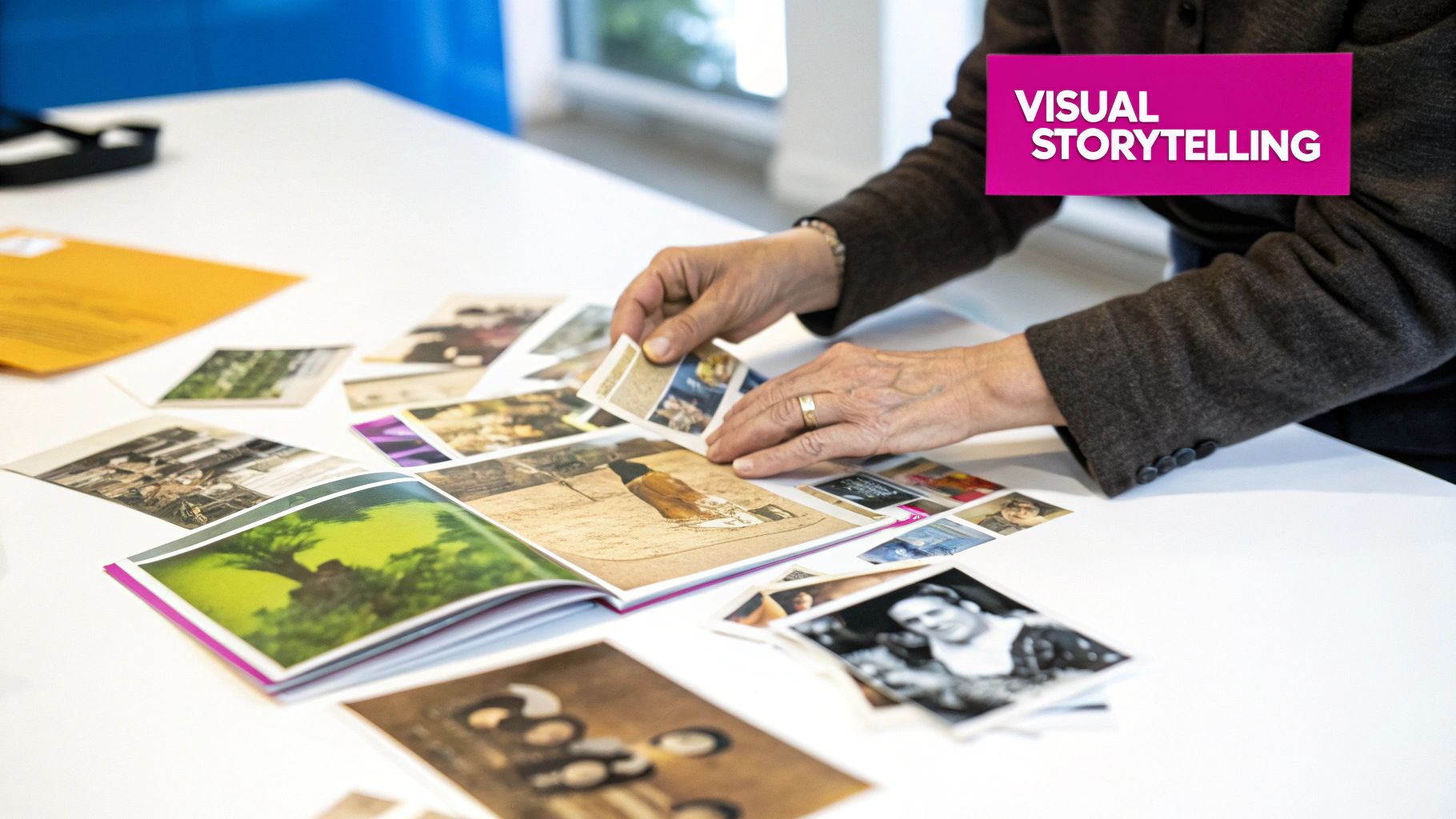
The art of collage has been around for a surprisingly long time. It dates all the way back to China around 200 BC, right after paper was invented. Fast forward to the 10th century, and Japanese calligraphers were using glued paper to add flair to their poetry. This rich history shows that collage has always been a medium for innovation.
Understanding its roots gives you a deeper appreciation for where it's headed.
Finding Your Creative Spark
Before you open a single app, take a moment to think about the story you want to tell. What’s the theme? The mood? If you're feeling stuck, brainstorming with tools like ChatGPT prompts for creative concepts can be a fantastic way to get the ideas flowing.
This expressive art form is more accessible than ever, and new tech is constantly pushing the boundaries. To see what's on the horizon, check out our guide on the latest https://bulkimagegeneration.com/blog/en/tutorials/ai-image-generation-trends-2025-a-new-era-of-creativity.
Gathering Your Visual Ingredients
Every killer collage starts with the right raw materials. This isn't just about grabbing a bunch of pictures; it's about going on a hunt for visuals that really nail your theme and tell a story. Think of yourself as a visual curator, pulling together the pieces that will make your final artwork sing.
Honestly, one of the best places to start is your own photo library. No stock photo can ever match the emotional weight of a personal picture. Dig through old family albums, travel snapshots, or even just interesting textures you’ve caught on your phone. Those authentic moments are what give a collage soul.
Defining Your Visual Language
Before you go on a downloading spree, it’s a good idea to set a few ground rules. This isn't about boxing yourself in—it's about creating harmony. Decide on a loose theme, like "urban nature" or "retro-futurism," or even just a specific color palette you love. A little direction up front keeps the final piece from feeling like a chaotic mess.
To guide your search, think about:
- Color Palette: Are you going for warm, earthy tones or cool, electric blues? A consistent palette is the fastest way to make different images feel like they belong together.
- Visual Theme: What’s the core idea? A collage about tranquility will need very different imagery than one capturing high-energy city life.
- Image Style: Are you into vintage black-and-white photos, vibrant illustrations, or clean, minimalist graphics?
Having this framework makes finding the right images so much easier and more focused. If you're hitting a wall trying to find visuals for a specific concept, you can always use a tool to get the creative juices flowing. You can learn more about crafting the perfect visual concepts with a free AI image prompt generator to spark some new ideas.
Prioritizing Quality for a Polished Result
While your creativity is the star of the show, the technical quality of your images is non-negotiable if you want a professional-looking result. Always, always source the highest-resolution images you can find. A blurry, pixelated photo will drag down your entire composition, especially if you ever want to print your artwork.
A high-resolution image ensures every line is crisp and every color pops, making your digital creation look just as stunning on paper as it does on screen. As a rule of thumb, aim for images that are at least 1500 pixels on their shortest side for web use and 300 DPI (dots per inch) for anything you plan to print.
Choosing Your Digital Canvas and Tools
So you've gathered your visual ingredients. Now it’s time to pick your digital workspace. The software you choose can completely change your creative flow, and finding one that matches your style and skill level is the key to making collage art without wanting to throw your computer out the window.
Don't get paralyzed trying to find the "perfect" tool. The best one is whatever feels the most intuitive to you.
For anyone who values speed and simplicity, web-based platforms like Canva and mobile apps are brilliant. They’re built around drag-and-drop interfaces and pre-made templates, letting you assemble a great-looking collage in just a few minutes. This makes them perfect for whipping up quick social media posts or personal projects where the goal is a fast, clean design.
Selecting Your Ideal Software
On the flip side, if you're the type who craves total control and advanced features, then desktop software is where you should be looking. Think Adobe Photoshop or its powerful free alternative, GIMP. These programs are packed with sophisticated tools for layering, masking, and color correction that grant you complete creative freedom.
Yes, they have a steeper learning curve, but they unlock a much higher ceiling for what's possible. You can literally manipulate every single pixel to get it just right.
Think about what you're trying to create:
- Quick & Social: Mobile apps like Bazaart or web tools like Fotor are your best friends.
- Creative & Custom: PicMonkey and Canva strike a great balance between easy-to-use templates and robust customization.
- Professional & Detailed: For intricate, high-level artwork, nothing beats the unmatched control of Adobe Photoshop.
This infographic can help you map out the first few steps of your creative journey, starting with locking down a theme.

As the visual guide shows, whether you already have a concept in mind or need to brainstorm, there's a clear path to gathering your images and getting started.
The sheer number of tools available can feel overwhelming, so I've put together a quick comparison to help you narrow down the options based on what you actually need.
Digital Collage Tool Comparison
This table breaks down some popular choices, highlighting what they're best for and how quickly you can get up and running.
| Tool | Best For | Learning Curve | Key Features |
|---|---|---|---|
| Canva | Beginners, social media, quick projects | Low | Drag-and-drop, huge template library, team collaboration |
| Adobe Photoshop | Professionals, intricate art, maximum control | High | Advanced layering, masking, filters, content-aware fill |
| GIMP | Hobbyists wanting power without the price tag | Medium-High | Open-source, extensive plugins, powerful editing tools |
| Bazaart | Mobile creators, on-the-go editing | Low | AI magic tools, background removal, photo blending |
| PicMonkey | Bloggers, small businesses, creative projects | Low-Medium | Templates, photo effects, cloud storage, branding kits |
There's no single "best" tool, just the best tool for a particular job. A social media manager might live in Canva, while a professional artist might never leave Photoshop.
Don’t be afraid to experiment. Most of these tools offer free trials or freemium versions. Spend an afternoon playing around with a few to see which one clicks. You'll know it when you feel it.
Ultimately, your digital canvas is just a means to an end. The real magic comes from your vision and the story you tell with your images. Pick the tool that empowers that vision, and you'll be on your way.
Designing a Compelling Composition
Alright, you’ve gathered your images and have your tools fired up. This is where the real fun begins—arranging your elements into something that actually works. It’s less about just plopping photos onto a canvas and more about telling a story and guiding the viewer’s eye through your creation. The best collages feel intentional, balanced, and full of life.
Before you start dragging and dropping, take a second to think about the vibe you're going for. Do you want a clean, grid-like design that feels organized and calm? Or are you leaning towards a more free-flowing, overlapping style that creates a sense of energy and movement? Every single piece you add should have a reason for being there.

This whole idea of mashing up different materials to make something new isn't recent, by the way. Modern collage art really took off in the early 20th century. Cubist pioneers like Georges Braque and Pablo Picasso started experimenting with it around 1912. Braque’s 'Fruit Dish and Glass' is a classic example—he used imitation wood-grain wallpaper to completely change the game, and it marked a huge shift in the art world.
Creating a Visual Hierarchy
Every great collage needs a focal point. This is the one dominant element that grabs your attention right away. It might be your biggest image, the brightest pop of color, or a shape that's just more complex than everything else. Once you have your anchor, you can start arranging the supporting images around it to create a clear visual flow.
Think about how you can use scale and positioning to build out that structure.
- Layering: Tuck less critical images partially behind your main one. This instantly creates a sense of depth and makes the composition feel more dynamic.
- Rotation: Even a slight tilt can break up the monotony of a rigid layout. It adds a little bit of unexpected energy.
- Scaling: Don't be afraid to mix up the sizes. A composition with varied image sizes is always going to be more interesting than one where everything is uniform.
Don’t be afraid of empty space. Negative space—the area around your images—is your best friend. It keeps your collage from feeling cluttered, gives the whole thing room to breathe, and makes your important elements stand out even more.
The principles for arranging digital pieces are surprisingly similar to hanging art on a wall. It’s all about balance, flow, and thoughtful placement. If you want to dive deeper into creating balanced layouts, check out these tips on arranging wall art like a pro. Getting a handle on these concepts will make your work stronger, both on-screen and off.
Adding the Final Polish to Your Artwork
You’ve arranged your composition, but you’re not quite at the finish line yet. Those last few touches are what really pull a collection of images together into a single, unified piece of art. This is where the magic happens—turning a good design into a great one.
A simple trick I’ve used for years is to apply a consistent filter or color adjustment across every element in the collage. It’s a surprisingly fast way to create a shared mood. A subtle sepia tone, for instance, can give a bunch of modern photos a cool, nostalgic vibe. On the other hand, bumping up the saturation just a bit can make a vibrant piece really sing.

Unifying with Texture and Tone
Adding texture is another one of my go-to methods for injecting some depth and character. I've found that a faint digital paper effect or a light grunge overlay can tie even the most mismatched elements together beautifully. If you’re ever stuck for unique patterns, an AI texture generator can be a goldmine of options to play around with.
This isn't just a niche hobby, either. The art world has taken serious notice, with auction sales for collage works growing by over 40% in just one decade. It's a testament to the medium's lasting appeal. You can read more about the rise of collage art and its market significance on stlpr.org.
The whole point of this finishing stage is to find harmony. Every little adjustment—from a slight color shift to a textured overlay—should serve one purpose: making all the individual parts feel like they truly belong together.
Finally, think about where your creation is going to live. Exporting your file the right way is crucial for making sure all your hard work doesn't go to waste.
- For Web & Social Media: Save your file as a JPEG or PNG at 72 DPI. A width somewhere between 1200-2000 pixels usually keeps things looking crisp on screens.
- For High-Quality Prints: Export as a high-resolution TIFF or PDF at 300 DPI. This is non-negotiable if you want your printed artwork to be sharp and detailed, without any fuzziness.
Knowing the destination before you export ensures your art looks stunning, no matter where it's displayed.
Common Questions About Collage Making
When you first dive into making collages, a few practical questions almost always come up. Getting these sorted out early on saves a ton of frustration and helps you build good habits from the start. Let's walk through a few of the big ones I see all the time.
Probably the most common technical hurdle is image quality. You want your finished piece to look sharp and intentional, not like a blurry, pixelated mess. The secret is to think about where your collage will live before you even start choosing images.
What Resolution Should My Images Be?
If your collage is destined for the web—say, for an Instagram post or your blog—using source images that are at least 1080 pixels wide is a solid rule of thumb. That’ll keep things looking crisp on most screens without creating massive file sizes.
But if you’re creating something you might want to print? High resolution is completely non-negotiable.
My advice: Always aim for 300 DPI (dots per inch) at the final size you plan to print. This is the industry standard for a reason—it prevents that dreaded pixelation and makes sure your artwork looks just as professional on paper as it did on your monitor. When in doubt, always start with the highest quality photos you can get your hands on.
How Do I Make My Collage Look Cohesive?
A great collage feels deliberate, not like a random jumble of pictures thrown together. The key is to find a unifying thread that ties all your elements together. This could be a consistent color palette, a recurring shape, or a shared theme that guides your image choices from the get-go.
A really quick way to pull everything together is to apply a single filter or a subtle color adjustment across all your images. It’s a simple trick, but it can instantly make a bunch of different elements feel like they belong in the same visual family, turning chaos into a cohesive composition.
Finally, let’s talk about the big one: image rights. This is where a lot of new creators get into trouble.
- Can I just use images I find on the internet? This is a minefield. The vast majority of images you'll find in a standard Google search are protected by copyright. Using them without the right permissions, especially for anything commercial, can land you in serious legal hot water.
- So, where can I find images I can actually use? The safest bet is to stick with your own photography or use royalty-free stock websites. Platforms like Unsplash and Pexels are fantastic resources. They offer huge libraries of high-quality images that are safe to use, so you can create freely while respecting the work of other artists.
Ready to bypass the tedious parts of collage creation and get straight to the art? Bulk Image Generation uses powerful AI to generate hundreds of unique visuals in seconds, perfectly styled for your project. Start creating faster today at https://bulkimagegeneration.com.