Digital Transformation for Small Businesses Guide

Ryan Bennett • October 3, 2025
Discover how digital transformation for small businesses drives growth. Our guide covers AI tools, core strategies, and building your roadmap for success.
Let's cut through the noise. For a small business, digital transformation is really just about upgrading your toolkit to work smarter, not harder. It's like swapping an old paper ledger for an app that tracks sales, inventory, and customer info all in one spot. It’s a practical move that solves real problems.
What Digital Transformation Really Means for Your Business

This isn't about becoming a tech giant overnight. Think of it more as a series of smart, manageable steps to weave modern technology into the very heart of your operations. The whole point is to make your business run smoother and deliver more value to your customers.
You’re simply moving away from manual, time-sucking tasks and toward more efficient, automated, and data-backed ways of doing things.
For a local bakery, this might just mean setting up an online ordering system that zips orders straight to the kitchen. For a freelance consultant, it could be using a Customer Relationship Management (CRM) tool to finally get a handle on client notes and project deadlines. The changes are down-to-earth and designed for immediate impact.
Why This Shift Is Critical Now
The pressure for small businesses to adapt isn't some far-off trend anymore; it's here and now. Customer expectations have completely changed. People want seamless online experiences, quick answers, and personalized service, whether they're buying from a massive corporation or their neighborhood shop. Sticking to old-school methods can leave you playing catch-up.
On top of that, the modern economy rewards efficiency. Businesses that can do more with less are the ones that are built to last. The global digital transformation market was valued at around $535 billion in 2022 and is expected to hit an incredible $3,375 billion by 2032. That kind of explosive growth tells you one thing: nearly everyone is already making this pivot. You can explore more market insights on digital transformation trends to see just how big this movement is.
At its heart, digital transformation for a small business is about building resilience. It’s about creating a business that is more agile, more customer-focused, and better equipped to handle whatever comes next.
The Tangible Benefits for Main Street
When you put a thoughtful digital strategy in place, you get clear advantages that strengthen your business from the inside out. This isn't just about new software; it's about new capabilities.
- Boosted Efficiency: Automating repetitive tasks like invoicing or appointment scheduling frees up precious time. Suddenly, you and your team can focus on the stuff that actually grows the business.
- Enhanced Customer Experience: Digital tools help you understand your customers on a deeper level. This allows you to offer personalized promotions, provide faster support, and create a much smoother journey from browsing to buying.
- New Growth Avenues: An online presence opens your doors to the world, not just your neighborhood. E-commerce platforms and digital marketing can connect you with customers you would have never been able to reach otherwise.
The Four Pillars of a Strong Digital Strategy

Trying to tackle "digital transformation" all at once can feel completely overwhelming. It's a huge concept. The trick is to break it down into manageable chunks. We can do that by focusing on four core pillars.
Think of these not as a rigid checklist, but as the foundations for building a smarter, more resilient business. You don't need to master them all overnight. The smart move is to figure out which pillar addresses your biggest headache right now and start there.
Key Pillars of Small Business Digital Transformation
Here’s a quick overview of how these pillars break down, what they focus on, and a simple first step you could take for each one.
| Pillar | Focus Area | Example First Step |
|---|---|---|
| Customer Experience | Making every interaction with your business smooth and positive. | Set up a simple CRM to track customer conversations and preferences. |
| Operations | Improving the behind-the-scenes processes that run your business. | Use invoicing software to automate billing and payment reminders. |
| Team Empowerment | Giving your employees the tools and skills to do their best work. | Adopt a cloud-based tool like Google Workspace for easier collaboration. |
| Business Model Evolution | Creating new ways to make money and deliver value to customers. | Launch a basic e-commerce store to sell products online. |
Each of these pillars supports the others, creating a strong framework for sustainable growth in a digital-first world.
1. Elevating The Customer Experience
This pillar is all about one thing: making it incredibly easy and enjoyable for people to do business with you. In a world jammed with options, a great customer experience is what turns a one-time buyer into a loyal fan. The goal is to use technology to meet—and even anticipate—what your customers need at every step.
A fantastic starting point is a simple Customer Relationship Management (CRM) system. Instead of relying on scattered notes or just your memory, a CRM gives you a single place to see every customer interaction, purchase, and preference. This is how you start personalizing your service and making people feel seen.
Here are a few other practical ideas:
- Set up an online booking system: A local salon could let clients book appointments 24/7, which means fewer phone calls and no more double-booking nightmares.
- Add live chat support: An online shop can answer questions instantly, which often makes the difference between a lost sale and a happy customer.
- Personalize marketing emails: Use what you know about a customer to send them relevant offers, like a friendly reminder with a discount on an item they were looking at.
2. Streamlining Your Operations
This is all the behind-the-scenes work that makes your business run smoothly. Think of it as tuning up your engine. Streamlining operations means using digital tools to automate boring, repetitive tasks, cut down on manual errors, and just generally make things more efficient. All that time you get back can be poured directly into growing the business.
Look at the daily admin work that eats up your week. So much of it can be automated. For example, using a tool for automated invoicing gets you paid faster and frees you from chasing down late payments. Project management software gives your team a clear, central view of who's doing what, preventing important tasks from slipping through the cracks.
Digital transformation for small businesses isn’t just about buying shiny new software. It’s about fundamentally changing how work gets done so your team can focus on what really matters.
Once you have a handle on your internal strategy, you'll need to think about promotion. For a solid foundation, check out this essential guide to marketing for small business that breaks down the fundamentals.
3. Empowering Your Team
Your team is your single greatest asset. Digital tools are there to amplify their talent, not replace it. This pillar is about giving your employees the tech they need to collaborate seamlessly and perform at their best, whether they're in the same office or miles apart.
Cloud-based collaboration tools are the bedrock here. Platforms like Google Workspace or Microsoft 365 let everyone edit documents in real-time, share files without messy email chains, and stay connected. It breaks down those frustrating information silos and gets everyone on the same page.
Just as important is investing in digital skills. Helping your team get comfortable with new software doesn't just make them more productive—it shows you’re invested in their growth, which is a huge morale booster.
4. Evolving Your Business Model
The final pillar is the most forward-thinking. It’s about using technology to unlock completely new ways to make money or change how you deliver value. This is where digital transformation for small businesses goes from simply improving what you already do to inventing what you could do next.
For a classic brick-and-mortar shop, this might mean finally launching an e-commerce store to reach customers across the country. For a consultant who trades hours for dollars, it could be creating a subscription-based online course that generates income even when they're not actively working.
A powerful, modern example is using AI to create product images. This can slash the costs and complexity of getting a product online. You can explore how to use AI images for small businesses to generate incredible visuals without needing an expensive photographer. Suddenly, growth opportunities that seemed out of reach are right at your fingertips.
Building Your Digital Transformation Roadmap
Let’s be honest, turning the big idea of "going digital" into a concrete plan is where most small businesses get stuck. A digital transformation roadmap isn't some complex document only a consultant can write; it's your game plan. It’s a simple, practical guide that maps out where you are now, where you’re trying to go, and the exact steps to get there.
Think of it like planning a road trip. You wouldn't just jump in the car and start driving aimlessly. You'd check your tires, pick a destination, and map out the best route. A digital roadmap applies that same logic to your business, making sure every bit of time and money you invest actually pushes you forward.
This visual guide breaks down the core steps for creating a roadmap that works.
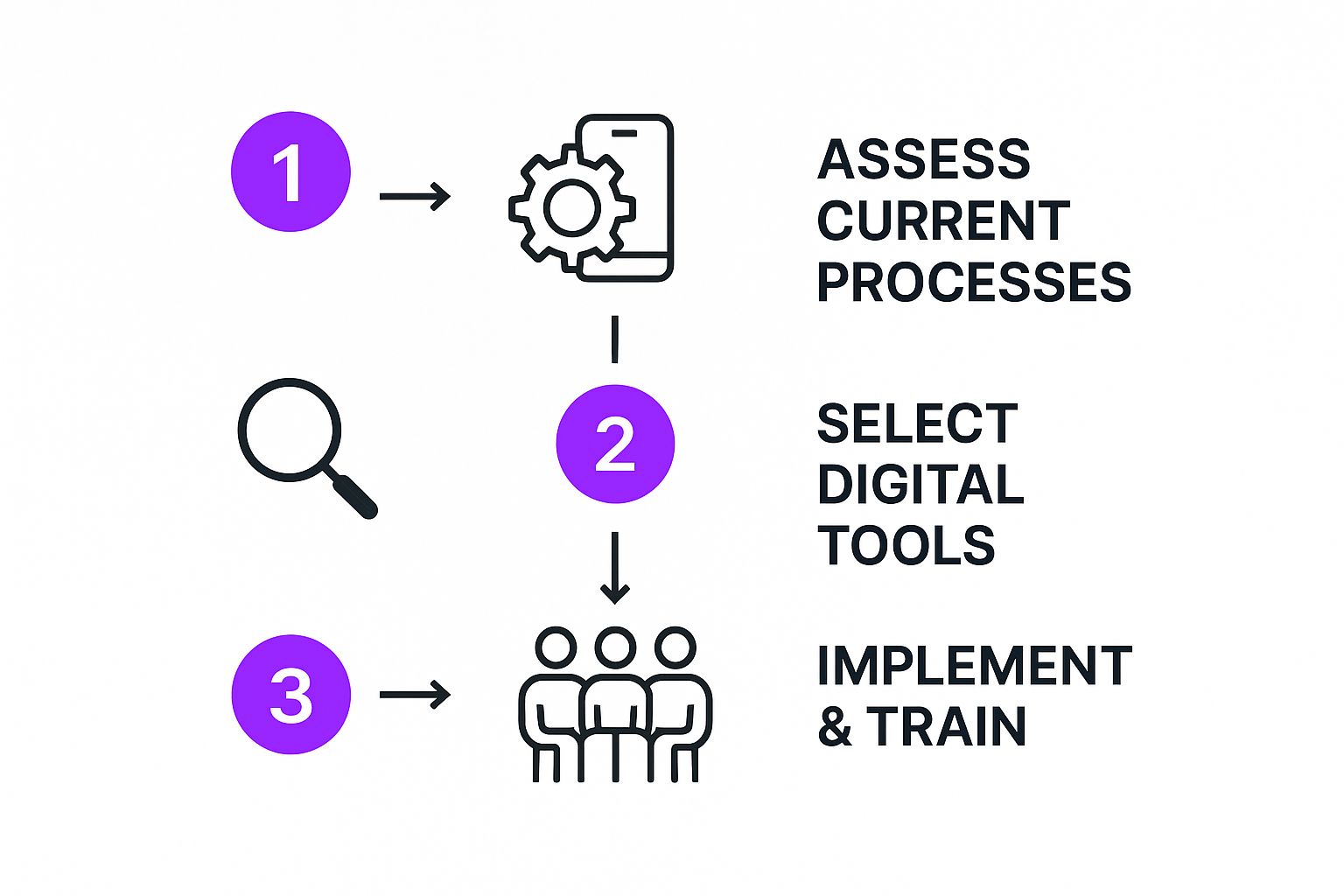
As you can see, it’s a logical flow: start with what you know, decide what to fix, find the right tools, and then get your team on board.
Step 1: Assess Your Current Position
Before you can chart a course for the future, you need a brutally honest look at where you stand today. This first step is all about finding your biggest operational headaches and time-sinks. Where are things getting stuck? What repetitive tasks are burning out your team?
Let's imagine a local bakery. The owner might realize that taking custom cake orders by phone is a mess—it leads to mistakes and eats up an hour every single day. That’s a real pain point, and you can't solve a problem until you've clearly identified it.
Step 2: Define Clear and Measurable Goals
Once you've pinpointed the problems, you have to define what winning looks like. Vague goals like "be more efficient" are impossible to act on. You need specific, measurable targets that are directly tied to the headaches you found.
For our bakery owner, a great goal isn't just "save time." It's: "Reduce time spent on manual order entry by 90% within three months." Now that's a goal. It's clear, you can measure it, and it has a deadline. It turns a general frustration into a tangible finish line.
Step 3: Prioritize Your Projects
You're going to uncover a lot of areas for improvement, but you can't boil the ocean. The trick is to prioritize projects based on their impact versus the effort required. Look for the "quick wins"—those changes that will give you the most bang for your buck without causing a massive disruption.
The bakery might be looking at a new inventory system and an online ordering form. The online form directly solves the biggest daily headache (those manual orders) and makes customers happier. That makes it the clear priority. Focus on one or two high-impact projects first to build some momentum.
A successful digital transformation roadmap doesn't try to do everything at once. It strategically sequences projects to deliver immediate value, which builds confidence and funds the next stage of your journey.
Step 4: Select the Right Tools
With your goals clearly defined, now you can start looking for the right tech. The market is flooded with tools, but your specific needs will help you cut through the noise. The best tool isn't the fanciest or most expensive one—it's the one that solves your problem, period.
The bakery owner just needs to cut down on order entry time. A simple, user-friendly online form builder or a basic e-commerce plugin is all they need. The key is to avoid getting sold on a massive, complex system with a million features they’ll never touch.
For example, creating visuals for a new online menu can be a huge time sink. Instead of hiring a photographer for every new cupcake flavor, the owner could learn how to create stunning digital product images using AI generators, saving a ton of time and money.
Step 5: Implement and Train Your Team
A brilliant new tool is completely useless if your team doesn't know how to use it—or worse, actively avoids it. Rolling out new technology is as much about people as it is about software. Get your team involved from the start. Explain why you're making the change and show them how it will make their jobs easier, not harder.
Provide simple, straightforward training and be patient as everyone gets up to speed. For the bakery, this means walking the staff through how online orders will pop up in the kitchen and how to manage them. A smooth launch always comes down to good communication and getting your team to buy in.
Step 6: Measure and Adapt
Your roadmap isn't set in stone. It's a living document that should change as your business does. After you've launched a new tool or process, you absolutely have to measure the results against the goals you set back in Step 2. Did the bakery's new online form actually reduce order entry time by 90%?
Tracking your progress tells you what's working and what needs a tweak. Maybe the online form is a hit, but customers are still calling with the same questions over and over. That's valuable feedback! It tells you to adapt—maybe by adding a clear FAQ section to the website. This cycle of doing, measuring, and adjusting is what makes sure your digital transformation actually pays off in the long run.
How AI Tools Can Slingshot Your Growth

Let's clear something up right away. Artificial Intelligence isn't just for tech giants with bottomless budgets. Not anymore. For a small business, AI is one of the most powerful accelerators you can get your hands on—it’s the secret weapon that lets you compete on a much bigger stage.
Think of it as the ultimate smart assistant. It can tear through repetitive, time-sucking jobs with incredible speed and accuracy, freeing you and your team up to punch way above your weight class. This is what a modern digital transformation for small businesses is all about.
Practical AI You Can Actually Use Now
The real magic of AI is in the practical, everyday tools that solve real business headaches. These aren't sci-fi concepts; they're accessible solutions that can deliver a tangible return almost immediately.
Here are just a few ways AI can start working for you today:
- Offer 24/7 Customer Support: AI chatbots can live on your website and answer common customer questions instantly, even at 3 AM. This keeps customers happy and stops your team from answering the same questions over and over.
- Get Smarter Marketing Insights: AI analytics tools can dig through your sales data to spot patterns you’d never see on your own. It can tell you which products are a hit with certain customers or the exact time they're most likely to buy.
- Create Content Without the Grind: Scaling your content for SEO is a huge job for a small team. The best AI content creation tools can help you draft blog posts, social media updates, and ad copy in a fraction of the time.
AI isn't here to replace the human element of your business. It's here to augment it. It gives you and your team superpowers to get more done with the same limited time and money.
A Game-Changing Example: Bulk Image Generation
Let's get specific with a use case that’s a massive pain point for e-commerce stores: product photography. Traditionally, this is a huge bottleneck. You have to hire a photographer, book a studio, and then spend hours editing. It costs a fortune in both time and money.
This is where generative AI tools like Bulk Image Generation flip the script.
Imagine you're an artisan who makes custom coffee mugs. Instead of a costly photoshoot, you can use an AI tool to generate hundreds of unique, professional-quality lifestyle shots of your mugs in minutes. You call the shots—specify the background, the lighting, the style—and create a whole library of visuals for your website and social media.
This one tool directly solves the timeless small business challenges: not enough budget, not enough time, and not enough creative resources. If you want to see how else AI can fit into your strategy, check out our guide on AI marketing software for small businesses.
The Real-World Impact of Going Digital
Adopting technology isn't just about being more efficient; it's about being more profitable and staying in the game. The numbers don't lie.
Globally, a staggering 87% of companies have used technology to boost their profits in the last two years. Even better, 59% reported profit growth of more than 11%. And this isn't just for big players. In the U.S., the smallest firms—those with just 1 to 4 employees—are adopting digital tools at a rate of 5.5%, proving that size is no longer a barrier.
The trend is crystal clear: businesses that integrate smart tech like AI aren't just surviving, they're thriving. For a small business, this means investing in the right tools isn't a luxury. It's a strategic move that builds a foundation for sustainable growth and a stronger market position.
What About the Roadblocks? Navigating the Common Challenges
Making the jump to digital comes with its own set of speed bumps, but none of them are dealbreakers. Most business owners I talk to see the potential, but they get hung up on a few common, nagging worries. The good news? These roadblocks are smaller than they look, and the detours are pretty straightforward.
Instead of seeing them as stop signs, think of them as guideposts telling you where to aim your energy. By getting ahead of these challenges—from shoestring budgets to team pushback—you can turn them into part of your success story. Let's walk through the big ones and how to handle them.
Overcoming Budget Constraints
For a lot of small businesses, the first and biggest hurdle is money. The thought of dropping a ton of cash on new tech is intimidating, especially when you're watching every penny. But a smart digital transformation for small businesses isn't about spending a fortune; it's about making focused investments that actually pay you back.
The trick is to start small. Zero in on high-impact, low-cost tools. You don’t need a massive, all-in-one software system to see a real difference. Many of the best tools out there run on a simple subscription, giving you access to powerful tech for a manageable monthly fee.
Here’s how to make it work on a tight budget:
- Solve One Big Headache First: Instead of trying to fix everything at once, pick your single biggest operational pain point. Find a tool that solves just that. This gets you a quick win and an immediate return on your investment.
- Look for Freemium and Open-Source Options: So many great platforms have a free version that’s more than enough for a small team. Start there.
- Do the Real ROI Math: Don't just stare at the price tag. Think about the time you'll save. If a $30/month subscription saves your team five hours of mind-numbing manual work, it's already a bargain.
Conquering the Fear of Complex Technology
The second big wall is just the fear of the unknown. A lot of owners worry they don't have the tech chops to set up and manage new digital systems. The mere thought of coding or complicated configurations is enough to make them stick with the old way of doing things.
Thankfully, the tech world has changed. The best modern tools are built for people who aren't developers. They're all about user-friendly interfaces, clean dashboards, and step-by-step setup guides. You really don't need to be a tech wizard anymore to get things up and running.
The best technology for your business is the technology you'll actually use. Simplicity is way more valuable than a long list of features you'll never touch.
Getting Your Team on Board
Putting a new tool in place is one thing, but getting your team to actually use and love it is another challenge entirely. People are creatures of habit. They’re comfortable with the way things are, and a new system can feel like a disruption, not an upgrade. This is where good, clear communication makes all the difference.
You have to frame the change around what’s in it for them, not just the business. Will this new tool get rid of that tedious spreadsheet they all complain about? Will it make working together less chaotic?
- Bring Them in Early: Ask your team for their input when you're looking at new tools. They're on the front lines and often know exactly where the real bottlenecks are.
- Make Training Easy: Run short, simple training sessions. Record them. Create a one-page cheat sheet. Make it painless to learn.
- Lead the Way: If the boss is actively using and talking up the new tech, everyone else is far more likely to get on board.
Ensuring Data Security and Privacy
The more you move online, the more you have to think about protecting your business and your customer data. Worries about cybersecurity can feel paralyzing, but you don't need a massive IT department to stay safe. A few simple, consistent habits can slash your risk and build trust.
Just start with the basics. Use strong, unique passwords for every single service. Turn on two-factor authentication whenever it's offered. Keep your software updated. These small actions are your first and best line of defense, letting you move forward without looking over your shoulder.
Global spending on digital transformation is expected to hit $3.9 trillion by 2027, which just shows how critical it is to plan these moves carefully and securely. As experts point out, focusing on core areas like marketing and operations through the lens of people, process, and technology is vital—especially when you consider that half of new businesses fail within five years, often due to simple inefficiencies. You can discover more insights about digital advances for small businesses and learn how to keep pace.
Got Questions About Going Digital? We've Got Answers.
Jumping into something new always brings up questions. Even with a solid plan, it’s completely normal to wonder how it all works day-to-day. This last section is all about tackling the most common—and pressing—questions that small business owners ask when they start thinking about digital tools.
We'll get into the real-world stuff: budget, where to even begin, and whether any of this is actually relevant for a business that isn't a tech startup. Think of it as a final chat to give you the confidence to take that first big step.
How Do I Set a Realistic Budget for This?
The fear of spiraling costs is probably the biggest thing holding small businesses back. The trick is to stop thinking of it as a cost and start seeing it as an investment—one with a clear return. You don't need a huge budget to get started; you just need a smart one.
Start by pinpointing your single biggest operational headache. What’s that one task that just drains your time or causes the most mistakes? Find a tool that solves that one problem. More often than not, you can find incredible subscription-based software for a totally reasonable monthly fee. A $50 per month tool that saves you 10 hours of mind-numbing manual work is an instant win.
Your first budget doesn't need to be massive. It just needs to be focused. Solve one high-impact problem, see the return on that investment, and then roll those gains into funding your next move.
What Is the Single Most Impactful First Step?
With so many options, it's easy to get stuck just trying to decide where to start. The single most impactful first step is almost always the one that directly makes your customer's life easier. Why? Because happy customers are the fuel for every successful small business.
Focus on removing friction. Make it ridiculously easy for people to do business with you. This could be as simple as:
- Adding an online booking system: If you run a salon or a consulting firm, this ends the annoying phone tag and lets clients book appointments whenever they want, even at 2 AM.
- Setting up a basic e-commerce page: For a local shop, this instantly opens up a new way to make money and serves customers who'd rather browse from their couch.
- Putting a live chat widget on your website: This gives people instant answers and can be the difference between making a sale and watching a potential customer click away.
Pick the one thing that removes the biggest hurdle between you and your customers. You'll create immediate value and build the momentum you need for everything else.
Will Digital Tools Really Help My Non-Tech Business?
This is a great question. If you run a cafe, a landscaping company, or a hair salon, you might be wondering if all this tech talk even applies to you. The answer is a huge, unequivocal yes. Digital transformation for small businesses isn't about turning your business into a tech company; it's about using tech to run a better version of the company you already have.
Just think about all the behind-the-scenes work that keeps your business running.
- A cafe can use a simple inventory app to automatically reorder coffee beans when they're running low, so you never have to tell a customer you're out of their favorite blend.
- A landscaping crew can use scheduling software to map out the most efficient routes for the day, saving a ton of time and fuel.
- A salon can use a simple CRM to remember a client's favorite services and automatically send them a birthday discount, building real loyalty.
In every case, the technology isn't changing the core business. It’s just making it more efficient, more profitable, and better at what it does. The whole point is to spend less time drowning in admin and more time doing what you love—the actual craft of your business. These tools are here to support your work, not replace it.
Ready to stop wasting hours on manual design work and start creating amazing visuals in a fraction of the time? Bulk Image Generation gives you the AI-powered tools to produce hundreds of professional-quality images in seconds. Whether you're making product photos, social media content, or branding materials, our platform helps you scale up your creative output without the high cost or headaches.