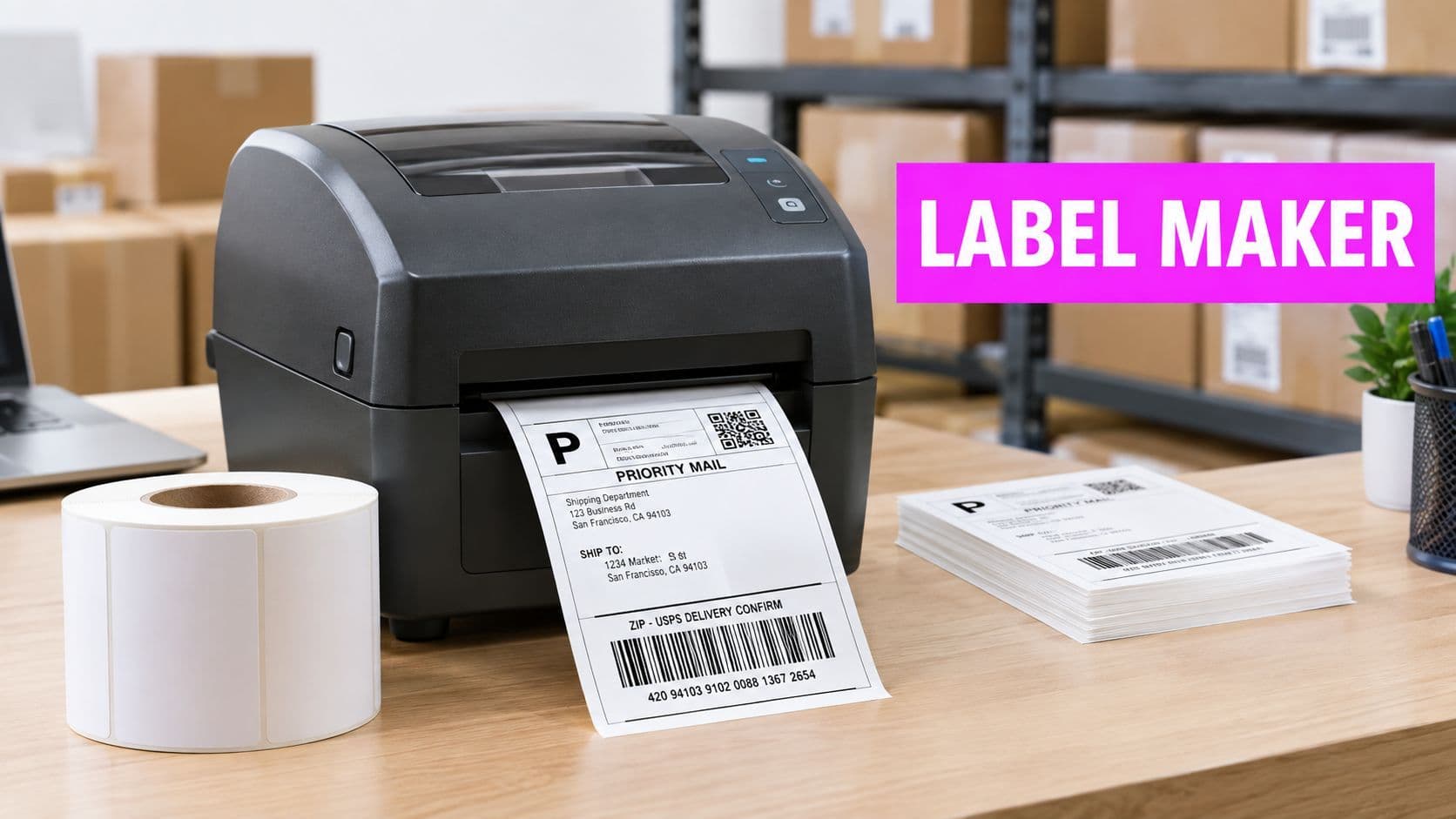
Choosing the Right Commercial Label Maker

Aarav Mehta • September 14, 2026
Find the ideal commercial label maker for your business. Compare thermal vs inkjet tech, compliance needs, and AI design workflows to scale your labeling.
You know the warning signs. A packing station is waiting on labels, someone is peeling misfed stock from a platen, and a consumer desktop printer is producing another faded barcode. The purchase looked economical until staff began correcting skewed labels, replacing unsuitable rolls, and switching between shipping, asset, and product templates by hand.
A commercial label maker should be judged as an operating system for physical information, not a faster printer. The right choice connects the print engine, media, software, data source, and application method so that labels arrive accurately, remain readable, and require minimal intervention. Speed matters, but integration, media compatibility, compliance, and rework often determine the cost.
The Reality of High Volume Labeling
A small retailer may begin with a basic desktop unit for shelf labels and occasional parcels. That arrangement works until order volume rises, product variations multiply, or several employees need to print from different workstations. The first failure usually isn't dramatic. A roll feeds inconsistently, a barcode becomes faint, or an employee spends several minutes locating the correct template.
At a warehouse bench, those interruptions accumulate quickly. A worker may pause picking to replace stock, reprint a damaged label, or carry a label across the floor because the printer is attached to one computer. The equipment hasn't merely slowed printing. It has added decisions and walking time to every order.
Practical rule: If a label error requires a person to inspect, reprint, and reapply the label, the labour cost is already higher than the label material.
Commercial equipment differs from a standard office accessory through its duty expectations, media handling, connectivity, and output consistency. It may support roll-fed stock, barcode-focused workflows, automatic cutting, peel-and-present operation, or network access. The correct configuration depends on the environment, but the common purpose is the same: keep labels available while people perform the work that generates revenue.
The market reflects that business orientation. Recent estimates value the label makers market at USD 5.6 billion in 2024, with a projection of USD 8.9 billion by 2032 at a 5.4% CAGR, while an industrial label printer estimate places that related market at USD 23.8 billion in 2025, rising to USD 38.8 billion by 2035 at a 5.1% CAGR. These figures come from Global Market Insights' industrial label printer market analysis, and they point to sustained demand from logistics, manufacturing, retail, offices, and regulated operations.
Commercial users represent 52.8% of global label maker revenue, according to the same market reference, so the category isn't driven by household use alone. For a growing operation, upgrading isn't an IT indulgence. It's a decision about whether labeling remains a support task or becomes a recurring bottleneck.
Before buying hardware, calculate how labels enter the workflow. Confirm the required stock, roll quantities, barcode format, application surface, and source of the print data. A supplier offering packing labels from The Box Warehouse can help clarify the physical stock requirement, while a team producing product imagery should also consider how a bulk image editor fits the artwork preparation stage.
The historical pattern reinforces the point. Brother launched the P-touch label printer for office work in 1988, and later marked 35 years of label printing in 2023, according to Report Prime's label maker history. A commercial label maker isn't a disposable office gadget. It belongs in the same operational planning conversation as scanners, packing benches, and inventory software.
Thermal Transfer Versus Color Inkjet Engines
The print engine determines what the label can survive, how quickly it can be produced, and which consumables the operation must manage. Choosing based only on the fastest advertised figure often creates a mismatch. A warehouse may need dependable monochrome barcode output, while a retail team may need short runs with colour, fine edges, and variable graphics.

Thermal systems favour throughput and scanning
Thermal line printing is a strong fit for shipping labels, inventory identification, and barcode-heavy work. Brother's TD-4420TN supports output of up to 152.4 mm/s at 203 dpi, according to Brother's product information, making it appropriate where operators need consistent, readable labels rather than full-colour artwork.
Thermal transfer adds a ribbon between the printhead and the label surface. That extra material gives the operator more choices for durable stock and applications exposed to handling, abrasion, or environmental stress. It also introduces ribbon loading, storage, tracking, and disposal, so the operational advantage depends on whether durability justifies those tasks.
Direct thermal systems remove the ribbon, but the label stock itself reacts to heat. That can simplify the print path, although the label's resistance to heat, light, friction, and chemicals must match its use. A parcel label that only needs to remain readable through dispatch has different requirements from an asset tag expected to stay legible on equipment.
Color inkjet earns its place in variable retail work
Epson's ColorWorks C6010A uses serial inkjet at 1200 dpi × 1200 dpi, with a maximum speed of 119 mm/s, and supports matte paper, synthetic, glossy paper, glossy film, and high-gloss labels, as documented in Epson's ColorWorks C6010P specifications. That combination suits short-run labels where colour fidelity, detailed graphics, and frequent artwork changes matter more than the lowest possible unit cost.
Inkjet is useful when a business wants to print branded product labels on demand rather than hold large quantities of preprinted stock. It can reduce the need to forecast every variation, but it requires careful attention to ink compatibility, drying, finish, and storage conditions.
| Feature | Thermal Systems | Color Inkjet Systems |
|---|---|---|
| Best fit | Shipping, barcodes, inventory, and asset identification | Product, retail, promotional, and variable-colour labels |
| Main strength | Fast, consistent monochrome output | Fine detail and brand colour reproduction |
| Durability decision | Depends on direct thermal stock or transfer ribbon and substrate | Depends on ink chemistry, coating, and label material |
| Workflow burden | Roll and ribbon management where transfer is used | Ink, maintenance, colour management, and compatible media |
| Buying priority | Scan reliability and feed consistency | Image quality, colour control, and short-run flexibility |
Resolution should follow the smallest graphic or code the label must carry. A high-resolution engine won't rescue an incorrect barcode, poor contrast, unsuitable adhesive, or a template that scales elements badly. Teams evaluating artwork should understand image resolution for print, then validate the finished label at its actual physical size.
For most warehouse floors, thermal technology is the sensible starting point. For branded, variable, short-run output, colour inkjet may justify its higher workflow complexity. The mistake is buying one because its specification sheet looks impressive, then forcing every application through it.
Matching Media Thickness and Roll Geometry
A commercial printer is only as reliable as the stock moving through its feed path. The label may be perfectly designed, yet the printer can still skew, wrinkle, or lose registration if the roll diameter, core, width, or caliper falls outside the validated range.
Zebra's ZT231 supports media widths from 19.4 mm to 114 mm, roll sizes up to 203 mm outer diameter on a 76 mm core, and media thickness from 0.076 mm to 0.25 mm, according to the ZT231 specification document. Those figures aren't interchangeable purchasing trivia. They describe the physical envelope within which the rollers, platen, sensors, and printhead are expected to work.
Read the media sheet before the printer quote
Start with the complete construction, not just the face material. Record:
- Width and length: Confirm that the stock fits the printhead and leaves enough clearance for sensors and guides.
- Outer diameter and core: A large roll can reduce changeovers, but only if the unwind mechanism supports its geometry.
- Thickness: Include the liner, adhesive, and face stock where the supplier defines caliper that way.
- Winding and gap: Make sure the printer's sensing method matches the gap, notch, mark, or continuous stock.
- Adhesive and surface: Test adhesion on the actual carton, plastic, metal, glass, or painted surface.
A broader thickness range creates flexibility, but it doesn't remove the need for validation. If stock sits at the edge of the supported envelope, platen pressure can drift, ribbon tracking can become unstable, and labels can skew. That turns a material choice into a maintenance issue.
Test the worst case, not the easiest roll
A clean paper shipping label can make almost any printer look dependable. The useful test uses the thickest tag, slickest synthetic face, smallest label, and largest roll that the operation expects to run. Print enough continuous output to expose heat buildup, tracking changes, adhesive residue, or operator loading errors.
Media is part of the machine. Treating stock as a generic consumable is one of the fastest ways to create avoidable downtime.
Keep a controlled list of approved media references. Include supplier, construction, adhesive, winding, and printer settings. When a new stock is proposed, test scanability after application, not only print quality on the bench. A label that looks sharp but lifts from a cold carton or fails under abrasion isn't fit for production.
The same principle applies to ribbon selection. Match ribbon width and formulation to the face material, print speed, and durability requirement. If the operator has to increase heat to achieve density, investigate the media and ribbon pairing before raising the print setting. Excessive heat can accelerate printhead wear and disguise a compatibility problem.
Navigating Compliance and Sustainability Mandates
A label can be visually attractive and operationally useless if it doesn't meet the requirements of its destination. Food, cosmetics, chemicals, healthcare, and international logistics may impose different expectations for ink migration, adhesive behaviour, material disclosure, hazard communication, or durability.
Recent market coverage identifies sustainability mandates, low-migration inks, linerless and compostable substrates, and smart connected packaging as forces reshaping label purchasing. Future Market Insights' label printer market coverage also projects industrial printers to hold nearly 50% share and thermal technology more than 45% of technology revenue in 2026. Those are market projections, not a substitute for product-specific certification.
Compliance begins with the finished label
Ask the supplier for documentation that applies to the complete label construction. A compliant printer paired with unapproved stock doesn't produce a compliant result.
Check:
- Ink or ribbon suitability: Confirm whether the formulation is appropriate for the product contact, packaging structure, and migration requirements.
- Substrate documentation: Request declarations or certifications relevant to the destination market and application.
- Adhesive performance: Test temperature, moisture, oil, and surface interaction under real handling conditions.
- Barcode persistence: Verify that codes remain scannable after transport, abrasion, condensation, or exposure to the expected environment.
- Variable data controls: Ensure the workflow prevents outdated ingredients, hazard symbols, lot details, or regional information from entering the template.
Sustainability requires the same discipline. Linerless labels can reduce some material handling, but they may require compatible applicators and dispensing equipment. Compostable or recycled substrates may behave differently in the printer, especially where thickness, curl, coating, or adhesive strength changes.
A procurement team should also examine waste from rejected labels, ribbon usage, obsolete artwork, and failed applications. Reducing reprints can support both cost control and environmental objectives. The best result often comes from connecting approved templates to current business data, rather than asking staff to recreate labels manually.
Teams building broader environmental governance can use guidance on how to build ESG-ready supply chains with AI, particularly when supplier evidence and material decisions need to remain visible across departments. Design teams should also verify commercial license requirements before placing generated or supplied graphics on products sold in multiple markets.

The purchasing question has changed. It isn't only, “Can this machine print the label?” It's, “Can this system produce the correct label, on the approved material, with evidence that survives an audit and the distribution journey?”
Choosing the Right Integration and Connectivity Level
The most expensive commercial label maker isn't always the most useful one. A small operation can waste money on unused automation, while a busy team can lose far more through manual entry, disconnected templates, and printers that only one workstation can reach.
Wireless and cloud-based label printing is growing by roughly 12% annually, according to Global Growth Insights' label printer market report. The same source projects the label printer market from USD 0.58 billion in 2026 to USD 0.82 billion by 2034. The direction is clear, but adoption should follow workflow needs rather than fashion.

Standalone works when the process is genuinely small
A USB-connected desktop unit can be the right choice for a single operator printing controlled batches. It keeps deployment simple, limits network dependencies, and may be easier for a small team to maintain. The weakness appears when people share the printer, use several computers, or copy data between systems.
Manual entry is especially risky for serial numbers, addresses, batch references, and regulatory fields. If employees repeatedly type information that already exists in an order or inventory system, the operation has a software problem disguised as a printer problem.
Connected printing removes handoffs
Wi-Fi, Ethernet, and cloud templates suit teams that need shared access and central control. A connected setup can keep approved artwork in one place, reduce local template drift, and allow staff to print from the point of work. It still needs ownership. Someone must manage user access, template versions, media assignments, and fallback procedures when the network is unavailable.
A mobile cart-mounted printer can be valuable on a warehouse or retail floor where the cost of walking exceeds the benefit of a fixed station. The right question isn't whether the printer is wireless. It's whether the connection places output beside the task that creates the label.
Automated integration earns its cost through repetition
API or ERP integration makes sense when label data is generated reliably by business systems and the same process runs repeatedly. An applicator-ready configuration may be appropriate for a production line, but only when the label construction, placement, and line speed have been validated together.
Use this decision test:
- Count manual fields: List every value an operator types or copies.
- Locate the delay: Measure where people wait, walk, reprint, or seek approval.
- Separate variation from volume: A high number of simple identical labels has different needs from a smaller number of complex variable labels.
- Price the failure: Include incorrect shipments, relabelling, obsolete stock, and support time.
- Choose the lowest tier that removes the bottleneck: Don't buy enterprise automation to solve a template problem.
Connectivity should lower labour and error exposure. If it only adds an administration dashboard while staff still re-enter order data, it hasn't solved the core issue.
Accelerating Design Workflows with AI Platforms
Hardware receives the file, but teams still need to create the file. Product visuals, logos, compliance icons, background treatments, and regional variants can delay a print run long before anyone loads a roll.
AI-assisted design can help when the team uses it as a controlled production aid rather than an unreviewed replacement for artwork approval. The useful workflow is structured: generate options, apply consistent edits, inspect at label size, and approve the final assets before they enter a template.
Start with the label's physical constraints
Define the label size, safe area, colour requirements, print engine, substrate, and intended viewing distance first. A beautiful image with fine tonal detail may not reproduce well on a small thermal label, while a large retail label may need colour management and a coated surface.
Use a written prompt or brief that specifies the product category, visual hierarchy, background, aspect ratio, and prohibited elements. Keep brand assets, legal text, barcode data, and regulated declarations under human control. Generative tools should create supporting visuals, not invent mandatory product information.
Generate variations in batches
Bulk Image Generation is designed to create up to 100 unique visuals in under 20 seconds, according to the publisher's stated platform capabilities. That can support a workflow where a team produces a set of product backgrounds, seasonal variants, or visual concepts before selecting the few that meet brand and print requirements.
The operational benefit comes from removing repetitive setup. Instead of opening each file separately, a batch process can apply background removal, resizing, enhancement, and related post-production actions across a group. The platform states that its batch editor can reduce editing time by half, but production teams should validate that outcome against their own review and approval steps.
Prepare output for the printer
Use a simple handoff checklist:
- Remove nonessential detail: Protect barcode contrast and readable type.
- Match dimensions: Set the artwork to the physical label specification before the final proof.
- Inspect edges: Check for halos after background removal and clipping near the bleed.
- Proof on the actual engine: Inkjet colour and thermal output won't reproduce the same way.
- Archive approved versions: Store the final asset with the template and media reference.
AI doesn't remove the need for colour, legal, and packaging review. It reduces the repetitive design work around those decisions. That matters because a commercial label maker only improves throughput when the artwork queue can keep pace with the physical output.
Building Your Long Term Labeling Strategy
A long-term labeling strategy starts with a workflow audit, not a product catalogue. Follow one label from source data through design, printing, application, scanning, storage, and disposal. Record every handoff where staff retype information, change media, wait for output, or correct a failed application. These delays often cost more than a faster print engine saves.
Build a representative test pack. Include the smallest barcode, longest text, most demanding colour asset, thickest stock, slickest surface, and label exposed to the harshest expected conditions. Test the actual roll geometry and adhesive rather than a convenient substitute. Media that feeds poorly or lifts from the application surface can create recurring labour and rework costs.
Use a deployment checklist
- Document demand: Separate shipping, asset, product, shelf, and compliance labels.
- Select the engine: Use thermal output for scan-focused work and colour inkjet where variable graphics justify the added workflow.
- Validate media: Match width, core, outer diameter, thickness, winding, adhesive, and surface.
- Choose integration deliberately: Select standalone, connected, or automated operation according to labour requirements and exposure to data-entry errors.
- Control templates: Assign owners, approval rules, version history, and data sources.
- Plan maintenance: Define cleaning, replacement parts, spare media, and escalation procedures.
- Pilot locally: Run the system at one representative station before deploying it across facilities.
Treat the equipment as infrastructure. Brother's P-touch milestone and the earlier commercial scale associated with DYMO show that dedicated labeling has remained relevant across office, warehouse, and industrial environments. The point is not to buy the oldest or most expensive model. Choose a platform whose media path, software, and support model can remain useful as the workflow changes.
For asset tracking and harsh-use applications, review options described as durable barcode label printers and request application-specific samples. A printer that performs well in a showroom may still fail on textured plastic, cold packaging, or a high-friction surface.
Prioritize total workflow efficiency over isolated print speed. The right commercial label maker produces the correct label on the right stock, from the right data, with few interventions. That protects labour, reduces rework, and gives the business room to scale without rebuilding its labeling process.
Bulk Image Generation helps teams create product visuals, branding assets, and supporting label artwork in batches, with AI generation and post-production tools designed for faster preparation. Visit Bulk Image Generation to see how it can fit the design stage of your commercial labeling workflow.