Behind the Scene Jobs: Your 2026 Career Guide

Ryan Bennett • May 19, 2026
Explore the world of behind the scene jobs in media, events, and marketing. Our 2026 guide covers roles, salaries, skills, and how to get hired today.
You know the person everyone looks for when something breaks. The deck won't export. The venue feed is dead. The asset folder is chaos. The campaign can't launch because nobody tagged the files correctly. That person usually isn't on stage, in the keynote photo, or quoted in the press release.
But they're the reason the work ships.
A lot of people who are good at behind the scene jobs don't label themselves that way. They call themselves organized, technical, detail-oriented, calm under pressure, or “the one who ends up fixing things.” In practice, those traits map to some of the most durable roles in modern work. They sit inside production, operations, content, healthcare administration, events, data, and marketing. They rarely get glamour. They often get responsibility early.
That matters more than people think. The visible result is almost never the whole job. The polished video, the sold-out event, the clean dashboard, the hiring push, the labor headline. Someone built the workflow under it.
The Unsung Heroes Behind Every Success
The familiar version of success is public. The actual version is usually hidden.
A presenter walks on stage and everything works. A film gets delivered on deadline. A hospital department runs without patients ever seeing the systems behind it. A jobs headline moves markets before breakfast. Audiences only see the output. The actual work happened earlier, in spreadsheets, call logs, version folders, ticket queues, run-of-show docs, and last-minute fixes.

I've worked around enough operators, editors, coordinators, and support leads to know the pattern. The strongest people in these roles don't just “help.” They reduce failure points. They know which detail will become a crisis later if nobody handles it now. They build calm by preparing for disorder.
That's why behind the scene jobs aren't a side category. They're a structural part of how industries function. One clear example comes from the labor data many people treat as a simple monthly headline. The U.S. Bureau of Labor Statistics' establishment survey interviews about 130,000 employers, and the agency uses around 300 people working the phones to gather and verify that data, as described in this report on how the monthly jobs report is put together.
Practical rule: If the public only sees the final number, final show, or final deliverable, there is usually an invisible team holding up the result.
That's the core truth of this career path. If you're drawn to making systems run, keeping work accurate, or improving output without needing the spotlight, you're not choosing a lesser lane. You're choosing one of the places where substantial influence lies.
What Are Behind the Scene Jobs Really
Behind the scene jobs are roles that make visible work possible without being the visible work itself. They support delivery, quality, timing, coordination, compliance, and scale. Some are technical. Some are administrative. Some are creative support roles that shape what the audience sees without ever appearing in front of it.
A useful way to understand them is by function, not by title.

Operations and logistics
These are the people who keep work moving. Think coordinators, schedulers, recruiters, office managers, production assistants, vendor managers, and operations specialists.
Their value isn't abstract. They remove friction. They catch missing approvals, late shipments, broken handoffs, and unclear ownership before those problems spread.
Technical backbone
This group includes IT support, systems admins, media asset managers, health information staff, billing specialists, data coordinators, and workflow operators. Their work is often invisible until it fails.
In many businesses, a strong technical support role exemplifies resilience. This role doesn't just react to tickets. It creates cleaner systems, better documentation, and fewer repeat errors.
Creative enablement
These roles sit close to output. Editors, assistant editors, copy editors, retouchers, designers, motion support staff, studio coordinators, and content ops leads all fit here.
They may not be the face of the brand, but they determine whether the brand looks polished or sloppy.
The easiest way to identify a behind-the-scenes role is to ask one question: if this person disappeared for a week, what would stop working?
Healthcare is one of the clearest examples of how substantial these roles can be. In non-clinical healthcare, The Muse highlights BLS-linked pay data showing median annual wages of $70,260 for health information technicians, $53,690 for medical records coordinators, $76,060 for human resources specialists, $77,720 for public relations specialists, and $166,410 for healthcare-related marketing managers in its guide to non-clinical healthcare jobs. Those are not side roles. They're core business functions inside care delivery.
Why these jobs are often hard to find
The hidden nature of the work often matches a hidden hiring process. The same Muse article cites StandOut CV research reporting that 70% of jobs are never publicly advertised and 85% are filled via networking. That explains why people can be qualified for behind the scene jobs and still miss them if they rely only on job boards.
In practice, what works is:
- Direct skill proof: Show the workflow you built, the files you organized, the campaign ops process you improved, or the edit sequence you finished.
- Specific networking: Don't “network generally.” Talk to production managers, ops leads, studio managers, recruiters, and department coordinators.
- Role-language matching: If you're applying for content ops, use content ops language. If it's media management, show naming conventions, handoff discipline, and QA habits.
A lot of good candidates lose out because they describe themselves too broadly. Behind the scene jobs reward specificity.
Spotlight on Three Booming Industries
Some industries are built on backstage competence more than others. If you want a practical starting point, look where coordination, asset flow, deadlines, and system reliability matter every day. Three strong areas are media and entertainment, live events, and digital marketing.
Media and entertainment
Film and TV make the structure easy to see because the work is already divided into phases. Pre-production handles planning, storyboarding, casting, locations, props, costumes, and setup. Production is the shoot itself. Post-production handles editing, graphics, music, color, and finishing.
The important career insight is this: post-production often becomes the pressure point. In the CUNY overview of film and TV pathways, post-production is described as usually taking longer than principal photography. That's why editors, assistant editors, colorists, media managers, and VFX support roles have considerable influence. If ingest is messy, proxies are late, or version control breaks, the whole project slows down.
Typical behind the scene jobs here include:
- Pre-production coordinator
- Script supervisor support
- Data wrangler
- Assistant editor
- Media asset manager
- Color pipeline support
- VFX coordinator
People often chase the glamorous title and ignore the workflow titles. That's a mistake. Workflow jobs are where you learn how the machine runs.
Live events
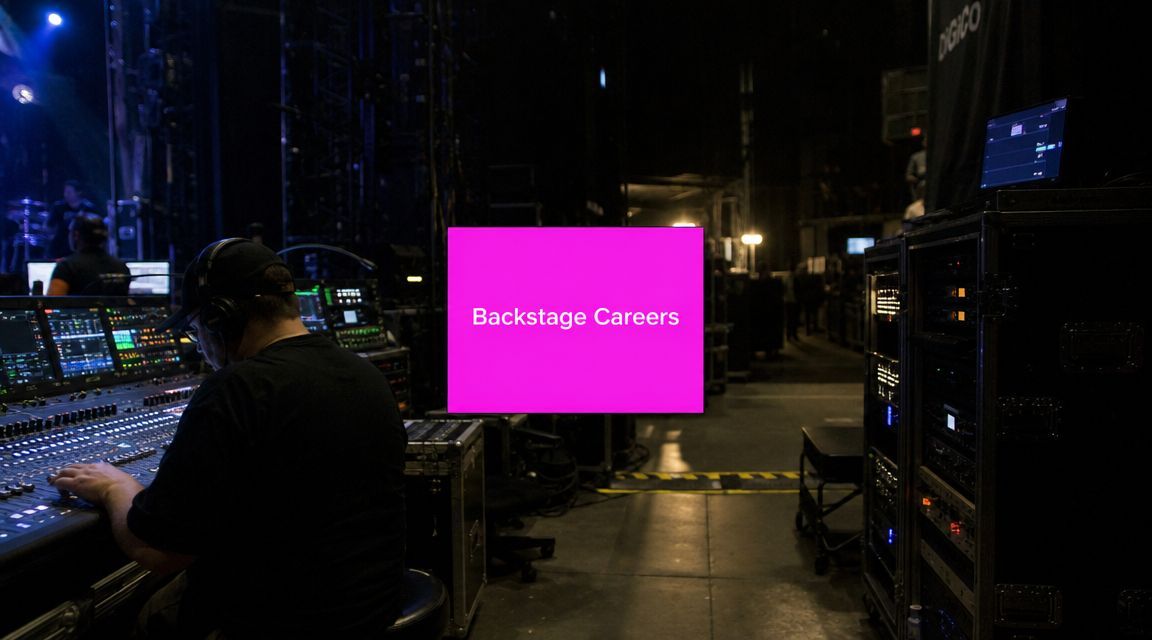
Live events reward people who can think in timelines, contingencies, and technical dependencies. The audience sees a smooth show. The backstage team sees cue sheets, A/V checks, load-in timing, power constraints, signage issues, headset comms, and vendors who are late.
Strong roles here include production coordinator, stage manager, A/V technician, show caller support, credentialing lead, and venue operations staff. These jobs suit people who like urgency but hate chaos. The best event operators aren't adrenaline junkies. They're people who reduce surprises before doors open.
Here's what separates good from weak event talent:
- Good operators keep updated run-of-show documents and confirm dependencies early.
- Weak operators rely on memory and fix things only after they break.
- Good technicians communicate clearly with non-technical stakeholders.
- Weak technicians know gear but create confusion.
Digital marketing
This is one of the most overlooked homes for behind the scene jobs. Everyone sees the ad, post, landing page, or email. Fewer people think about the people building the asset pipeline, campaign logic, taxonomy, approvals, localization flow, and reporting structure.
That's where content operations managers, marketing automation specialists, CRM coordinators, lifecycle ops staff, asset librarians, and creative production managers sit. These roles have become more valuable as teams produce more content, in more formats, across more channels.
If you work in visual production or campaign support, it's worth tracking where creative workflows are heading. A useful example is this breakdown of AI image generation trends in 2025, because it shows why content-heavy teams increasingly need operators who can manage volume, consistency, and review, not just one-off design.
Behind the scenes roles at a glance
| Role | Industry | Median Salary Range (2026 est.) | Core Skills |
|---|---|---|---|
| Assistant Editor | Media and Entertainment | Varies by market and project type | Ingest, proxy workflow, timeline organization, version control |
| Colorist | Media and Entertainment | Varies by specialization | Color correction, finishing workflow, client review handling |
| Production Coordinator | Live Events | Varies by venue and event scale | Scheduling, vendor coordination, documentation, calm communication |
| A/V Technician | Live Events | Varies by technical scope | Audio, signal flow, troubleshooting, show support |
| Marketing Operations Specialist | Digital Marketing | Varies by company size | Automation platforms, QA, CRM logic, reporting |
| Content Operations Manager | Digital Marketing | Varies by channel complexity | Asset management, approvals, localization, workflow design |
That salary column is qualitative on purpose. Titles vary widely by city, employer, and contract structure. What matters first is whether the role builds durable skills that transfer across teams.
A Day in the Life of a Backstage Pro
Job descriptions hide the texture of the work. Two titles can sound similar and feel completely different once you're inside the day. The best way to judge fit is to look at how the hours move.
The post-production editor
The morning starts with a note that should have arrived yesterday. A client wants the latest cut tightened, lower thirds corrected, two music options swapped, and one segment re-ordered. None of that is impossible. The danger is cumulative sloppiness.
A solid editor doesn't just start clicking. They check the project structure, confirm the current approved sequence, duplicate the timeline cleanly, label the revision correctly, and make sure new graphics won't break later exports. Most of the job is judgment. Which note matters? Which change creates ripple effects? Which version is safe to send?
By afternoon, the work becomes part technical, part diplomatic. Stakeholders often ask for “small changes” that alter pacing, continuity, or audio flow. The editor has to protect the deadline without sounding defensive.
Good editors don't just make footage look better. They make revision rounds survivable.
This role suits people who like concentration, pattern recognition, and craft. It frustrates people who need instant closure.
The event production manager
This day starts before attendees arrive. Someone from the venue says a room setup changed overnight. A speaker is late. One sponsor's display doesn't match the approved footprint. Catering needs a timing adjustment because rehearsal ran long.
Nothing looks dramatic from the audience side. Backstage, every adjustment affects something else.
The event production manager is translating constantly. They talk to venue staff one way, talent another way, and the client another way still. They track what must happen now, what can wait, and what can be solved without dragging more people into it.
A good one carries two mental models at once:
- The published plan
- The actual plan after friction starts
That's why event work is demanding in a specific way. You need stamina, but you also need a low-ego style. The role goes badly when someone wants credit more than control.
The marketing operations specialist
The calendar says “campaign launch,” but the actual work is upstream. The form field mapping has to match the CRM. The email sequence needs logic checks. The creative assets must be named correctly, approved, and loaded into the right system. If one audience segment is misconfigured, reporting gets messy fast.
This role often looks quiet from the outside because much of the day happens inside platforms, docs, dashboards, and QA lists. But it's one of the highest-impact seats on a growth team. The specialist sees where campaigns fail mechanically, not just strategically.
A strong operator in this role asks practical questions early:
- Is the audience logic clean?
- Are the assets final or still “final-final”?
- Who owns UTM consistency?
- What happens if a lead enters mid-sequence?
- Has anyone tested the handoff to sales?
The work feels satisfying if you like systems more than slogans. It feels draining if you prefer big ideas and hate cleanup. Neither preference is wrong. But knowing the difference saves a lot of career confusion.
How to Build Your Behind the Scenes Career
Individuals don't break into behind the scene jobs by collecting vague qualifications. They break in by becoming useful in a specific workflow.
That matters even more now because routine tasks are changing. Indeed notes that the World Economic Forum expects 39% of core worker skills to change by 2030, with growth concentrated in AI, data, and technology while routine administrative tasks decline, in its discussion of behind-the-scenes jobs. The practical takeaway isn't “avoid backstage work.” It's “avoid roles built only on repeatable clerical tasks.”
Pick a lane with tool depth
Generalists often struggle early because hiring managers can't place them. “I'm organized and creative” is not a hiring pitch. “I can manage media ingest, prep proxy workflows, and keep revision control clean in Premiere-based teams” is.
Good entry lanes include:
- Content operations
- Marketing automation support
- Media management
- Video post support
- Healthcare records and billing support
- Workflow QA
- Production coordination
Some of these roles are more accessible to career-switchers than people assume. A useful perspective comes from behind-the-scenes medical jobs at Regis College, which points to strong demand in healthcare support functions while also highlighting that entry paths differ depending on credentials and software requirements. That distinction matters. Some jobs are learnable through focused training and practice. Others require licenses or regulated certifications.
Build proof, not just interest
Hiring teams trust evidence they can inspect. That means sample dashboards, process docs, organized file systems, scheduling templates, campaign builds, edit reels, annotation examples, QA checklists, or before-and-after workflow cleanups.
If your target is post-production, it helps to study how professionals build an effective video editor portfolio. The strongest portfolios don't dump every clip into one page. They show judgment, role clarity, and a clean presentation of what the editor handled.

Learn the kinds of AI-adjacent work that last
The more durable backstage roles now sit next to automation, not in denial of it. Human-AI quality control, asset review, workflow design, content production oversight, and system orchestration are stronger bets than purely repetitive support work.
A smart way to consider it:
- Let software handle repetition. Don't build your identity around tasks a tool can perform consistently.
- Own the handoffs. Most failures happen between systems, teams, and approval steps.
- Get fluent with production tools. The person who can run the workflow usually beats the person who only understands the theory.
If you're looking at freelance or side-income paths while building experience, this guide on how to make money with AI is useful because it frames AI as a production skill, not magic. That's the right mindset for behind the scene jobs too.
Work Smarter with Modern Creative Tools
Content-heavy backstage work breaks down in familiar places. Too many image requests. Too many versions. Background cleanup that takes longer than expected. Social assets that need to be resized for multiple channels. Product visuals that all need the same treatment. Nobody remembers which file is the approved one.
The bottleneck usually isn't creativity. It's throughput.

Where manual workflows start failing
A social media manager might need dozens of variations for one campaign. A marketing specialist may need localized visuals with consistent styling. An educator building worksheets or visual materials may need repeatable asset sets, not one polished hero image.
In all of those cases, the backstage professional's job is to keep output moving without letting quality drift. That's where modern AI tools help most. Not by replacing taste, but by compressing repetitive production work.
Useful capabilities include:
- Bulk generation: Create many on-brand visual options without rewriting prompts from scratch every time.
- Batch editing: Remove backgrounds, resize assets, and standardize formats in one pass.
- Template-based production: Keep campaigns visually consistent even when the volume increases.
- Fast QA loops: Review sets, reject weak outputs, and refine direction quickly.
What practical tool fluency looks like
Tool fluency doesn't mean chasing every new app. It means knowing which tools reduce friction in your specific workflow. For visual production, that may include AI image generation, upscaling, background removal, and simple editing pipelines. For campaign work, it may also include DAM systems, approval tools, and scheduling platforms.
If you're comparing options for retouching, enhancement, or cleanup, this roundup of AI photo editing software is a good place to narrow the field based on actual use case. And if your role touches campaign execution, it helps to understand the wider stack around AI marketing software, because image production only solves one part of the workflow.
The winning skill isn't “using AI.” It's knowing where AI saves time, where it introduces errors, and where a human should still make the call.
That's the difference between someone who experiments with tools and someone who becomes valuable because of them. Behind the scene jobs increasingly reward the second person.
The Unseen Engine of Every Success Story
The phrase “behind the scenes” can make these careers sound secondary. They aren't. They're the operating layer that lets visible work happen on time, at quality, and at scale.
That's why behind the scene jobs hold up so well for people with the right temperament. If you like solving practical problems, building cleaner systems, handling detail without losing the big picture, and making the team better without needing constant visibility, this path makes sense. It also gives you room to evolve. Operations can lead to management. Editorial support can lead to finishing or producing. Campaign setup can lead to strategy, analytics, or systems ownership.
The best career move now is to stop treating backstage work like a fallback. Treat it like infrastructure. Learn a real toolset. Build proof of work. Get specific about the workflows you want to own.
The spotlight will always go somewhere else. The advantage often won't.
If your work depends on producing visual assets fast, keeping output consistent, or scaling creative operations without adding more manual steps, Bulk Image Generation is worth exploring. It helps behind-the-scenes teams generate professional visuals in bulk, streamline batch edits, and support high-volume content workflows without getting buried in design bottlenecks.