Best App That Turns Picture Into Painting AI 2026

Ryan Bennett • April 18, 2026
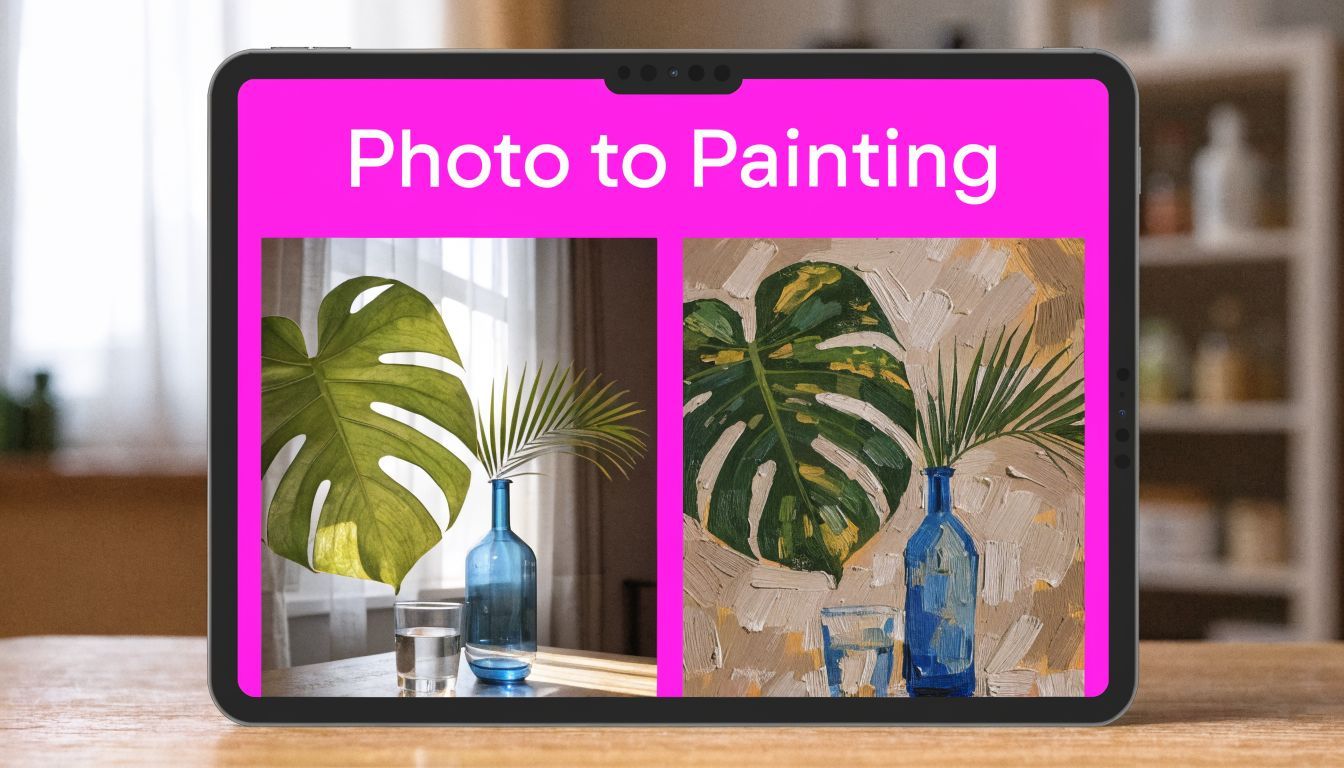
Find the best app that turns picture into painting with AI. Our 2026 guide shows how to convert photos in bulk for marketing, art, and more.
A social media manager once showed me a folder full of product photos and said, “I don’t need one pretty result. I need a campaign by tomorrow.” That’s the moment one stops looking for a fun filter and starts looking for an app that turns picture into painting as part of a real production workflow.
From Photo to Fresco The Modern AI Art Revolution
The first wave of photo-to-painting apps felt magical because they collapsed a slow design task into a tap. What used to require layered edits, custom brushes, and a patient hand suddenly looked possible on a phone while waiting for coffee. For hobbyists, that was enough.
For professionals, it wasn’t.

A content team doesn’t just need one painterly portrait. It needs a set of matching visuals for a launch, seasonal banners, email headers, ad variants, and social posts that all feel like they belong to the same brand. That’s where the category changed from novelty to infrastructure.
Prisma is the clearest early marker of that shift. The mobile app market for photo-to-painting applications has grown rapidly since the mid-2010s, and Prisma, launched in June 2016, quickly reached 100 million downloads worldwide and became the #1 free photo app in over 100 countries within its first year, according to this overview of leading photo-to-painting apps. That kind of adoption didn’t happen because people suddenly wanted more toy filters. It happened because people wanted speed, style, and easier creative output.
Where the old workflow breaks
Single-image apps still work well when the goal is personal expression. They break down when the job has deadlines, approvals, and multiple output sizes.
- Campaign work needs consistency. A watercolor effect on one image means nothing if the next ten images look like they came from a different brand.
- Mobile-first tools often assume one-off use. That’s fine for a profile picture, not for a month of scheduled content.
- Teams need repeatability. If a designer can’t recreate the look next week, the workflow isn’t reliable.
Practical rule: If the tool makes you re-decide style, crop, and finishing choices for every image, it’s still a hobbyist workflow.
That’s also why adjacent use cases matter. Teams creating stylized headshots, character visuals, or campaign-friendly AI portraits often run into the same issue. The challenge isn’t making one striking image. It’s producing a cohesive set without rebuilding the process every time.
The modern AI art revolution isn’t really about filters. It’s about moving from isolated edits to controlled visual systems.
Understanding the AI Artist Filter vs Generative AI
It's common to lump every painting app into one category. That's a mistake. Two tools can both claim to turn a photo into art and still behave very differently in practice.
The simplest way to think about it is this. A filter-based app is like hiring a fast production artist who works from a fixed style kit. Generative AI is closer to giving a creative brief to an illustrator who interprets the photo and re-renders it with more freedom.
Filter-based tools
Filter-based transformation applies preset artistic logic to the existing image. Apps like BeCasso use this model, processing locally for speed and giving you adjustable presets with strong control over the final look, as described in the BeCasso App Store listing.
That model is usually the better fit when you need:
- Fast previews on mobile
- More predictable output
- High-resolution control
- Small refinements rather than dramatic reinterpretation
If you want to test concepts quickly before production, a lightweight image generator workflow is useful because it helps you define the visual direction first, then decide whether a fast filter approach is enough.
Generative tools
Generative AI takes the source image as guidance, then produces a new interpretation through neural networks. It often gives you broader style variety, and it’s better at creating painterly results that feel less like an overlay and more like a reimagined artwork.
That freedom comes with trade-offs.
| Approach | Best at | Common weakness |
|---|---|---|
| Filter-based | Speed, consistency, direct control | Can feel formulaic |
| Generative AI | Style range, more original-looking art | Can drift from the source |
What professionals should actually care about
The wrong question is “Which app is best?” The right question is “Which method matches the job?”
Use filter-based tools when the original composition is already strong and you want a painting finish without losing structure. Product shots, simple portraits, and clean travel images usually fit here.
Use generative AI when the source photo is more of a starting point than a final frame. That includes mood-heavy branding visuals, editorial hero images, and concept-rich social artwork.
The more your job depends on preserving layout, faces, or product details, the more cautious you should be with generative drift.
A lot of frustration comes from expecting one method to behave like the other. Teams open a fast filter app and expect artistic invention. Or they use a generative tool and get annoyed when details shift. Once you know the distinction, choosing an app that turns picture into painting gets easier because you stop shopping by screenshots and start choosing by workflow.
Preparing Your Canvas Choosing the Right Photo
Bad input wastes more time than a bad app. If the source image is muddy, cluttered, or poorly lit, even a strong painting engine has to fight the photo before it can stylize it.
The best conversions start with images that already have one dominant subject, readable lighting, and a clear depth structure. In plain terms, the AI needs something obvious to preserve and something obvious to simplify.

What works well
Some photos convert beautifully because they already contain the ingredients of a painting. Portraits with side lighting, architecture with clean lines, food photography with one focal dish, and outdoor scenes with visible foreground and background usually respond well.
Use this checklist before you upload anything:
- Clear subject. One person, one product, one building, or one obvious focal area works better than a scene with competing attention points.
- Clean separation. If the subject blends into the background, many apps smear edges when applying painterly effects.
- Decent exposure. Blown highlights and crushed shadows reduce detail that the app could have stylized.
- Simple background. A busy room often becomes visual noise after transformation.
- Natural color structure. Strong but believable color contrast usually survives stylization better than flat, gray photos.
What usually fails
The weakest results tend to come from photos people try to “rescue” with art effects. A painting style can enhance an image. It rarely fixes one.
Common problem photos include:
- Low-light phone shots with visible noise
- Tiny crops pulled from screenshots
- Group photos where no face is dominant
- Hard backlighting that turns the main subject into a silhouette
- Overedited originals with excessive sharpening or filters already applied
Don’t ask the app to solve composition, lighting, and style at the same time. Fix the first two before you ask for the third.
A quick preflight helps. Straighten the image, crop out distractions, and decide whether the subject should stay centered or move slightly off-center for a more gallery-like composition. That small prep step often matters more than the difference between two similar apps.
When people say an app that turns picture into painting “looks inconsistent,” the cause is often the source folder, not the software.
Creating Your First AI Painting A Single-Image Workflow
Before you scale anything, make one image work on purpose. That sounds obvious, but many teams skip this stage and end up batch-producing weak variations of a vague idea.
A good single-image workflow does three things. It chooses the right source photo, picks a style with intent, and gives the app enough direction to avoid generic output.

The category has become much more accessible over time. The move from older desktop tools like FotoSketcher to AI-powered mobile apps also brought a pricing and access shift. By 2025, 80% of top apps use a freemium model, reaching 2.5 billion smartphone users in key markets and cutting editing time by up to 90% compared to manual methods, according to FotoSketcher’s market overview. Accessibility is no longer the problem. Direction is.
Start with the style goal, not the app
Don’t open Prisma, Painnt, Brushstroke, or PicsArt and scroll until something looks interesting. Decide what the final image needs to do.
For example:
- A café menu visual might need a soft watercolor feel.
- A luxury skincare post might need an oil painting look with smooth highlights.
- A bold promo graphic might need impasto texture and stronger color contrast.
This sounds simple, but it changes the result. When the style goal is clear, the app becomes a tool, not a slot machine.
Prompt the image like an art director
When a tool accepts text guidance, keep the prompt anchored in visual language. Avoid long storytelling prompts. Use medium, texture, mood, and restraint.
If you need help drafting clean instructions, a dedicated free AI image prompt generator can speed up the wording and reduce vague prompts that produce muddy results.
Here are practical examples you can adapt:
| Style | Weak prompt | Better prompt |
|---|---|---|
| Watercolor | make this artistic | soft watercolor painting, gentle pigment bleed, light paper texture, preserve face details |
| Oil painting | turn into oil art | classical oil painting, visible brush strokes, rich midtones, realistic skin texture, museum-style finish |
| Impasto | thick paint effect | impasto painting, heavy textured brushwork, bold highlights, expressive strokes, vivid color separation |
Refine with restraint
The first version tells you what the app wants to exaggerate. Your job is to decide whether that exaggeration helps the image.
Make one adjustment at a time:
- Dial back intensity if skin, product labels, or architecture edges start breaking apart.
- Re-crop if the style effect is getting wasted on empty background.
- Switch families of style if the image fights the treatment. Some scenes want watercolor softness. Others need the structure of oil paint.
- Check export quality before approving anything for client or brand use.
A usable AI painting usually comes from one clear style choice and two small refinements, not ten dramatic edits.
There’s also a useful crossover here with merchandise and branded asset creation. Teams experimenting with print-ready visuals often borrow ideas from workflows discussed in guides on AI design with AvatarIQ, especially when consistency matters across multiple items or campaigns.
The point of the single-image workflow isn’t perfection. It’s proof. Once you can reliably turn one image into a polished painting, you’re ready to think like a production team instead of a casual user.
The Industrial Revolution of Art Bulk Image Generation
Single-image apps hit a wall the moment your creative problem becomes operational. A marketing team doesn’t need one stylized portrait. It needs twenty ad images, six story variants, three hero banners, and a backup set for testing. That’s where most “best app that turns picture into painting” articles stop being useful.
The issue isn’t image quality alone. It’s throughput.
A major gap in this category is batch guidance. Mobile apps often focus on one-at-a-time transformation, and bulk users feel that pain quickly. According to PortraitArt’s discussion of current limitations and newer batch-capable platforms, user forums point to 70% abandonment for bulk tasks when mobile apps take over 5 minutes per image, while Flux 1.1-powered platforms have enabled 100 images in under 20 seconds since Q1 2025. That gap changes what “best” means for business use.

Why bulk changes the evaluation criteria
Once you’re producing at volume, your checklist shifts.
A hobbyist asks:
- Does this filter look cool?
- Is the app easy to use?
- Can I share it quickly?
A business asks different questions:
- Can I keep style consistency across a set?
- Can I review outputs quickly?
- Can I resize and export without hand-editing every file?
- Can the workflow handle a campaign folder instead of a single photo?
That’s why speed alone isn’t enough. Fast chaos is still chaos.
A workable bulk process
Professionals need a process that removes repeated decisions. The best bulk workflows don’t ask you to reinvent the style image by image. They let you define the direction once, then apply it across a set with controlled variation.
A practical sequence looks like this:
-
Group similar source images together Don’t batch portraits, interiors, product shots, and outdoor scenes in one run if you need cohesive output. Group by subject type and lighting first.
-
Choose one style language for the whole set
Decide on “editorial watercolor,” “textured oil painting,” or “bold acrylic poster look.” Mixed style language produces mixed campaign results. -
Standardize dimensions before generation when possible
If the campaign is built for square posts or vertical stories, decide that early. Later cropping can destroy painterly composition. -
Review in contact-sheet mode
Looking at outputs one by one hides inconsistency. Looking at them as a set reveals it immediately. -
Fix outliers, not everything
In a strong batch, a few images usually need intervention. Reworking the whole set wastes time.
Bulk generation isn’t about making art less creative. It’s about removing repetitive labor so you can spend time judging direction instead of clicking through the same settings.
A utility like a bulk image resizer becomes more important than people expect because campaign production rarely ends with one format. The art may be approved, but the job still includes square, portrait, widescreen, and storefront-ready versions.
What doesn’t work at scale
Some habits are harmless on one image and disastrous on fifty.
| Habit | Why it fails in bulk |
|---|---|
| Choosing styles by eye for each image | The set loses visual unity |
| Uploading mixed-quality photos together | The AI exaggerates inconsistency |
| Over-tweaking every result | The batch becomes slower than manual editing |
| Ignoring post-production needs | Approved art still isn’t ready for actual channels |
The big shift is mental. Stop thinking of a painting app as an effect machine. Start treating it like a production engine for visual campaigns. That’s when the workflow becomes useful to agencies, social teams, and small brands that need output they can deploy.
Refining Your Collection Batch Editing and Post-Processing
Generated artwork is rarely the final deliverable. It’s the raw creative material. Professionals still need to clean it, standardize it, and prep it for the channels where it will live.
That’s why post-processing matters as much as generation. If your images are painterly but inconsistent in size, background treatment, or contrast, the campaign still looks unfinished.
The finishing moves that matter most
For social and brand work, these edits tend to matter more than extra style tweaking:
- Background cleanup. If the painting effect leaves distracting edges or clutter, remove them consistently across the set.
- Tone alignment. Bring brightness and contrast into the same family so adjacent posts don’t look unrelated.
- Format adaptation. Prepare square, vertical, and widescreen versions without improvising the crop on every file.
- Detail protection. Check faces, product edges, and logos. Painterly tools can distort the exact areas brands care about most.
Build one finishing standard
A campaign gets stronger when all images pass through the same finishing checklist. That keeps the set from feeling like random experiments.
A simple internal standard might be:
- approve style
- remove obvious distractions
- normalize crop
- align contrast and color warmth
- export for each destination
If your final set looks like it came from five different apps, the problem is usually finishing discipline, not generation quality.
Cost matters differently in bulk
Consumer pricing can look cheap until usage rises. For higher-volume work, subscription decisions should be evaluated differently. As noted in Linda Holt Creative’s pricing comparison for painting apps, BeCasso costs $3.49 per month and Painnt costs $9.99 per year, but businesses using 100+ images monthly should evaluate volume discounts and API access because the economics change at scale.
That’s the right lens for agencies and small teams. Don’t ask only, “Is the app affordable?” Ask:
- Does pricing stay sensible when usage rises?
- Can the tool fit into a repeated workflow?
- Will exports and edits create extra manual labor elsewhere?
One-time purchase apps like Brushstroke can still be useful for niche jobs. Subscription tools can also be worth it when they reduce hands-on labor. The wrong buy is the tool that looks inexpensive but creates hours of repetitive cleanup.
Professional post-production is boring compared to style generation. It’s also the part clients notice when it’s missing.
Your New Role as Art Director
Once you stop treating an app that turns picture into painting as a novelty, your role changes. You’re no longer just applying effects. You’re directing visual output.
That means choosing the right source image, understanding whether the job needs a filter-based look or a generative reinterpretation, and knowing when a single-image craft workflow should become a bulk production system. It also means judging consistency across a set, not falling in love with one standout image that can’t be repeated.
The strongest teams don’t ask AI to replace taste. They use AI to scale taste.
Good creative direction now includes prompt judgment, source selection, batch review, and finishing discipline.
That’s the key upgrade. You move from user to art director. One polished painting is nice. A repeatable gallery of on-brand assets is what changes the way a business creates.
If you’ve outgrown one-image-at-a-time apps and need a faster production workflow, Bulk Image Generation is built for that shift. It lets teams generate professional-quality images in bulk, refine them with batch editing tools, and move from scattered experiments to a repeatable visual system that fits real campaign deadlines.