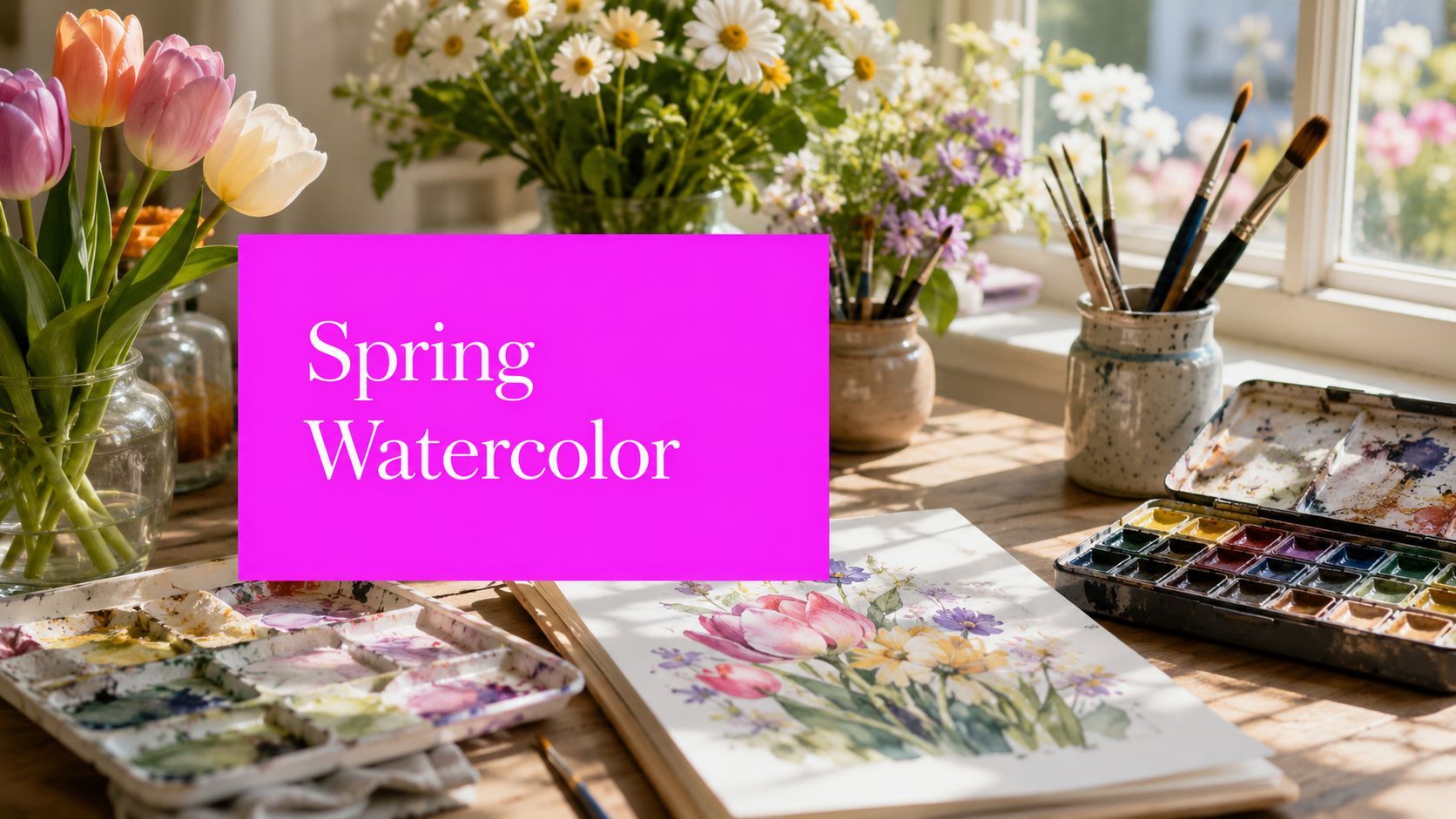
Your Spring Flowers Watercolor Guide: From Brush to AI

Ryan Bennett • May 25, 2026
Learn to paint beautiful spring flowers watercolor art with our step-by-step guide. Plus, discover how to use AI to generate stunning floral assets in bulk.
You need spring floral visuals fast.
Maybe you're filling out a seasonal content calendar, building a worksheet pack for a classroom, refreshing product packaging, or trying to make a set of sticker designs feel like they belong together. The usual advice is split in two unhelpful camps. Traditional watercolor tutorials show you how to paint one pretty bloom. AI tutorials show you how to type a vague prompt and hope for the best. Neither solves the actual production problem.
The useful middle ground is knowing enough watercolor to direct the outcome. If you understand how a tulip petal turns, where a daisy center sits, why one wash stays luminous and another goes muddy, you can paint by hand with more control. You can also prompt AI with much better precision. That's where spring flowers watercolor becomes more than a hobby subject. It becomes a visual system.
Embracing Spring Flowers in Watercolor and AI
A common situation goes like this. You need a cluster of spring botanicals for a launch, but not just one hero image. You need square social crops, a vertical pin, a printable card front, maybe a repeating pattern, and a few looser decorative elements for headers. Painting each piece from scratch can be satisfying, but it's slow. Generating everything with AI can be fast, but the results often drift into waxy petals, chaotic leaf shapes, or color that feels digitally loud instead of painted.
That's why I still come back to watercolor fundamentals first. Watercolor was historically the premier medium for floral illustration, and the founding of the Society of Painters in Water Colours in 1804 helped establish its legitimacy as a serious art form, as noted in this watercolor floral history overview. Spring flowers became a standard subject for learning wash control and petal structure, and that matters now for the same reason it mattered then. Flowers teach control through repetition.

Why spring flowers still work so well
Spring blooms are forgiving enough for beginners and structured enough for professionals. A crocus is basically a set of upright petal forms with soft value changes. A tulip gives you a cup shape and clean overlap. Daisies teach spacing, symmetry, and white preservation. Those lessons transfer directly into both brushwork and prompting.
If your end goal is volume, the smartest move is to treat the subject as a system instead of a one-off painting. A useful reference point is a gallery of seasonal image ideas for spring campaigns, not because you should copy a style, but because it helps you think in sets rather than singles.
Practical rule: If you can describe the flower's structure clearly enough to paint it, you can usually describe it clearly enough to prompt it.
What traditional skill adds to AI work
When artists complain that AI florals look generic, they're usually reacting to weak art direction. “Watercolor flowers” is too broad. “Loose spring flowers watercolor with preserved white paper, layered transparent petals, soft wet-into-wet centers, crisp shadow-side edges” is much closer to how a painter really thinks.
That vocabulary changes the output. It also changes your editing decisions later. You stop judging an image only by whether it looks attractive. You start asking whether the petals have believable spacing, whether the values separate cleanly, and whether the composition leaves room for text or cropping.
That's the key advantage of combining both worlds. The brush teaches judgment. The prompt scales it.
Choosing Your Essential Watercolor Painting Kit
A spring flower setup doesn't need to be large, but it does need to be dependable. Cheap materials can still be useful for sketching, but floral work exposes weak supplies quickly. Petals need clean edges, soft transitions, and enough transparency to layer without choking the painting.
Start with paper, not paint
If the paper fights you, everything else gets harder. For spring flowers watercolor, I prefer cold-press watercolor paper because it gives enough texture to keep washes lively without making petals look ragged. Hot-press can work for very crisp botanical detail, but beginners often find it less forgiving because water sits differently on the surface.
Choose paper that can handle repeated layering and light lifting. Floral work often asks for both. A petal might start with a pale wash, then get a second pass in the shadow, then a small softened edge near the base. Thin paper tends to buckle, dry unevenly, or pill when you correct.
Buy fewer sheets of better paper before you buy more colors of paint.
Keep the brush kit small
You don't need a giant roll of specialty brushes. For most spring flowers, a small working kit looks like this:
- Round brush: Your main tool for petals, stems, and controlled washes.
- Smaller round brush: Useful for veins, petal separations, and leaf shadows.
- A pointed detail brush or small round with a sharp tip: Better for tight centers and finishing marks than trying to force a large brush to behave.
- Optional dagger or leaf-shaped brush: Handy if you like expressive leaves, though not required.
What matters most is point retention and water control. A brush that dumps too much water will wreck your detail stage.
Use a limited floral palette
A restrained palette mixes more harmoniously than a giant tray of unrelated colors. In floral painting, that matters because petals and foliage should feel related, not assembled from separate color worlds.
Here's a compact starting palette built around mixtures commonly used in flower lessons.
| Pigment Name | Hue Family | Mixing Notes |
|---|---|---|
| New Gamboge | Warm yellow | Mix with pink for warm petal variations |
| Pink | Red-pink | Pushes yellows toward peach and floral coral |
| Sap Green | Mid green | Mix with yellow-green for fresh spring foliage |
| Yellow-green | Bright green-yellow | Lightens and freshens leaf mixtures |
| Prussian Blue | Deep blue | Mixed into yellow to shift hue and create depth |
| Ultramarine Blue Deep | Blue | Cools and darkens green foliage mixtures |
| Burnt Sienna | Earth brown | Mixed with ultramarine for gray-violet shadows |
Don't overbuy before you paint
Beginners often buy large pan sets because they look complete. In practice, a smaller set of reliable paints teaches better mixing habits. Spring flowers are all about subtle shifts. A petal rarely needs a brand-new tube color. It usually needs one base mix pushed warmer, cooler, lighter, or slightly grayer.
A simple prep checklist helps:
- Tape down your paper if you tend to flood washes.
- Pre-mix two or three related floral colors before you begin.
- Test a leaf mix beside a petal mix so your greens don't overpower the bloom.
- Keep a water jar just for clean blending if you want soft edges without contamination.
Good materials don't paint the flower for you. They remove friction so you can see what your brushwork is doing.
Painting Foundational Spring Flower Shapes
The fastest way to improve at spring flowers watercolor is to stop thinking in finished paintings and start thinking in repeatable parts. Most blooms are built from a few recurring decisions. Where is the center? How many petals sit in the first ring? Which petals overlap? Where does the value darken?
That's why flowers scale so well. Their structure is teachable and repeatable. In one tutorial model, a daisy is simplified into 5 petals, while layered flowers such as dahlias begin with a small 5-petal star center and build outward in rings, as shown in this flower structure demonstration. Those repeatable patterns are exactly what make floral subjects so useful for both practice and bulk image generation.
Build from the center outward
Most weak flower paintings fail because the artist paints random petals first and invents the flower as they go. That usually leads to uneven spacing and confused overlap. A better approach is to anchor the center, then place petals around it with purpose.
Use this method:
- Mark the center lightly.
- Paint the first ring of petals or the main cup shape.
- Leave tiny gaps of white so neighboring petals don't fuse.
- Add outer petals with slight value or color variation.
- Delay stems and leaves until the bloom shape reads clearly.
The white gaps matter more than many beginners expect. They keep the petal edges readable and stop the flower from collapsing into one soft blob.

Practice three flower types first
You don't need ten species on day one. Three forms give you enough range to learn the main mechanics.
Daisy
A daisy teaches spacing. Paint a simple center, then place petal strokes around it with visible white separation. Keep some petals narrower, some wider, and let a few tilt slightly. Perfect symmetry makes it stiff.
Tulip
A tulip teaches enclosure and overlap. Think cup first, petal second. Start with the front petal, then side petals, then the back edge or opening. The flower should feel like it wraps inward, not like flat petals pinned together.
Crocus or bluebell-like bloom
This shape teaches directional petals and soft transitions. The petal bases often want a darker tone dropped into a damp area, while the outer edges stay lighter and cleaner.
If the flower reads clearly in a pale first pass, the structure is working. If it only reads after heavy outlining, the structure is weak.
Match technique to the shape
The method should fit the part you're painting.
- Use wet-on-dry for petal edges when you need clean shape control.
- Use wet-into-wet in centers or lower petal areas when you want color to bloom softly.
- Use a push-and-twist stroke for leaves if you want a tapered form that narrows naturally at the tip.
- Shift greens cooler with ultramarine blue deep rather than reaching for a separate dark green every time.
A reliable shadow mix for floral scenes is ultramarine plus burnt sienna, with more blue than sienna to avoid turning it brown. That mix works well when you need a gray-violet note in shadows without killing the freshness of the painting.
What usually goes wrong
Three mistakes show up again and again.
- Too much water in detail work: lines spread, veins disappear, and shadows lose shape.
- Petals painted at one value: the flower looks cut out and flat.
- No white preservation: everything merges and the bloom loses air.
Test the brush load before adding detail. A smaller brush with controlled moisture almost always works better than a larger brush with a good point but too much water in the belly.
Adding Depth with Advanced Watercolor Techniques
Flat flower shapes are useful for practice, but depth comes from restraint. Most spring blooms don't need more paint. They need better sequencing. The strongest floral watercolors are usually built in transparent passes, each doing one job well.
A professional workflow is to build the flower in 2 to 3 transparent layers, starting with a very light watery base, then adding a second controlled shadow pass, and reserving the darkest accents for the final stage, as shown in this layered watercolor flower technique tutorial. That order keeps the color luminous and prevents the chalky, overmixed look that ruins delicate petals.
Use one flower as your test subject
Take a single tulip or crocus rather than a whole bouquet. The goal is to feel how form appears through layering.
First layer
The first wash should look almost too light. That's normal. You're mapping the overall petal color, not finishing anything. Keep it transparent and leave natural variation where possible rather than scrubbing for perfection.
Let it dry completely.
Second layer
The flower starts turning in space. Add darker color only in the shadow zones, near petal bases, overlaps, and areas that angle away from the light. Use less water and a more precise tip. Some edges should soften with clear water. Others should stay sharp.
Third layer
This layer is for the deepest shadow-side accents, separations, or selective outline reinforcement. If you use it everywhere, the flower hardens. If you place it carefully, the bloom snaps into focus.

Blend soft and sharp edges deliberately
A flower with all soft edges looks sleepy. A flower with all hard edges looks cut from paper. The interest comes from contrast.
Try this edge pattern:
- Keep the petal center transition soft.
- Let one outer contour stay crisp.
- Sharpen the overlap where one petal passes in front of another.
- Soften one shadow edge with a damp brush after the paint partially sets.
That mix gives the eye somewhere to rest and somewhere to focus.
Mud usually doesn't come from color choice. It comes from touching an area that hasn't earned another layer yet.
Advanced moves that help, and one that often hurts
Lifting is useful when a highlight has disappeared or a petal edge needs more air. It works best when done gently, not as frantic rescue work. Negative painting also helps define white or pale petals by shaping the area around them rather than outlining them directly.
Dry brush can add fine texture, but use it sparingly in floral work. Spring petals usually look fresher with smooth transparent passages than with too much surface texture.
What hurts most often is overworking a damp wash. Once pigment starts shifting unpredictably in a half-dry area, stop. Let it dry, then decide whether the next move belongs in glaze, lift, or edge refinement.
A better standard for realism
Realism in watercolor isn't about copying every vein. It's about convincing value structure, believable edge control, and enough transparency that the light still seems to pass through the petals. If the flower keeps that freshness, small imperfections often make it stronger.
That same logic matters later in digital work. If you can identify where the luminosity comes from in a hand-painted flower, you'll know what to ask for and what to reject when generating variations.
Scaling Your Art with AI Spring Flower Generation
Most watercolor instruction stops after the finished painting. That's useful if you want one framed piece. It's not enough if you need a coordinated set of floral visuals for classroom printables, brand graphics, stickers, or social posts. Many tutorials stay focused on one-off techniques, while the main production challenge is variation, consistency, and output across formats. A technique-led tutorial roundup also points out that this gap matters more now because Adobe's 2024 Digital Trends report and Canva's 2025 State of Visual Communication report indicate growing pressure for scalable visual content, summarized in this discussion of the batch-creation gap.
That's where watercolor knowledge becomes prompt engineering.
Turn painting language into prompt language
AI responds better when your prompt describes visual decisions, not just subjects. Instead of asking for “watercolor spring flowers,” specify the things a painter would care about:
- flower type and structure
- transparency of layers
- preserved white paper
- edge quality
- palette relationships
- composition spacing
- intended output format
A bad prompt asks for a style label. A strong prompt describes construction.
What to include in a useful floral prompt
Think in these categories when directing AI:
Subject structure
Say whether you want daisies with separated petals, tulips with overlapping cup-shaped petals, or layered dahlia-like forms radiating outward. Structure reduces weird anatomy.
Water behavior
Use terms like transparent wash, soft wet-into-wet center, crisp wet-on-dry edges, light first wash, controlled shadow glazing. These phrases push the image away from generic digital painting and closer to actual watercolor logic.
Surface and spacing
Ask for visible paper texture only if you want it. Ask for preserved white gaps between petals if you want cleaner readability. Ask for negative space if the asset needs room for copy.
Batch consistency
When generating a set, keep the palette, brush behavior, and composition family stable while changing flower type, angle, or crop. That's how a collection stays cohesive.

Prompt templates that actually map to art decisions
Use these as starting points.
For social media graphics
Delicate spring flowers watercolor illustration, soft transparent layers, tulips and daisies, preserved white paper between petals, fresh sap green foliage, light airy composition, gentle shadow glazing, hand-painted look, clean negative space for text, vertical and square variations
For classroom worksheets or kids' printables
Simple spring flower watercolor shapes, clear petal structure, minimal background, soft pastel palette, easy-to-read outlines created through value contrast rather than ink, consistent spacing, printable style, multiple variations with tulips, crocuses, daisies, and leaves
If you're working with children or making art prompts for beginner creators, Kubrio's guide to unlocking kids' creative potential with AI is a useful companion because it frames prompting as a skill-building exercise rather than a shortcut.
For branding assets or sticker sets
Cohesive set of spring botanical watercolor elements, transparent layered petals, controlled wet-on-dry details, soft floral centers, balanced white space, matching palette across all assets, isolated blooms and small clusters, suitable for packaging, labels, and pattern building
Use tools to refine language before generating at scale
If your art vocabulary is still developing, use a helper instead of guessing. A dedicated free AI image prompt generator can help turn broad ideas into more specific visual instructions. That's especially useful when you know the mood you want but haven't yet learned the exact wording for edge behavior, composition, or medium effects.
What works and what doesn't
The biggest win is that traditional watercolor knowledge gives you better filters. You can spot when petals are too symmetrical, when shadows are opaque instead of glazed, or when the image says “watercolor” but behaves like soft digital acrylic.
What doesn't work is treating AI like a mind reader. If you ask for “pretty spring floral watercolor,” you'll get a broad average. If you ask for layered transparent petals, center-outward construction, selective hard edges, restrained leaf color, and batch-cohesive variation, you're directing an image system the way an art director would direct an illustrator.
That is the bridge. Painting teaches the eye. Prompting gives that eye range.
Blending Traditional Artistry with Digital Creation
A lot of artists still treat brushwork and AI as opposing camps. In practice, they solve different parts of the same problem. Hand painting teaches observation, sequencing, restraint, and taste. Digital generation helps when the project needs breadth, speed, and format variation.
The strongest workflow uses both. Paint enough flowers to understand petal logic, water control, and transparent layering. Then carry that language into your digital process so generated work reflects actual artistic decisions instead of surface-level style tags.
The hybrid creator has an advantage
If you can paint a convincing petal, you're harder to fool. You can judge whether a generated floral asset has believable overlap, whether the values create form, and whether the white space is intentional. That matters for marketers, educators, and small teams because visual consistency usually breaks at the review stage, not the generation stage.
This cross-discipline thinking shows up in other crafts too. People who work in fabric design, appliqué, or surface pattern often move between hand skills and digital production naturally. If that blend interests you, Famcut's sewing and quilting courses are worth a look because they reinforce the same mindset of structure, repetition, and design translation across mediums.
Keep one standard across both mediums
Use the same questions whether the flower is on paper or on screen:
- Does the bloom have a clear center and readable petal order
- Are the light and shadow areas separated cleanly
- Do the edges vary with purpose
- Is the palette fresh, or has it gone muddy
- Will the image still work when cropped, resized, or repeated
The medium can change. The judgment standard shouldn't.
You don't need to choose between being a watercolor artist and a digital creator. The better position is to become fluent in both. Paint enough to understand the subject. Prompt enough to scale it. Edit enough to keep the quality bar high.
If you want one place to turn that hybrid process into finished assets, an AI art generator built for production workflows can help you move from visual idea to usable output without losing the artistic direction that makes the work feel intentional.
If you're ready to create spring flower collections instead of one-off images, Bulk Image Generation is built for that exact workflow. You can turn natural-language art direction into batches of cohesive visuals, then handle resizing, cleanup, and format changes in one place. For marketers, educators, and small brands, that makes it much easier to produce polished floral assets at scale without giving up creative control.