How to Print Coloring Pages From AI Art to Finished Product

Ryan Bennett • March 6, 2026
Learn how to print coloring pages from AI art. This guide covers file prep, printer settings, and paper choices for flawless, high-quality results at home.
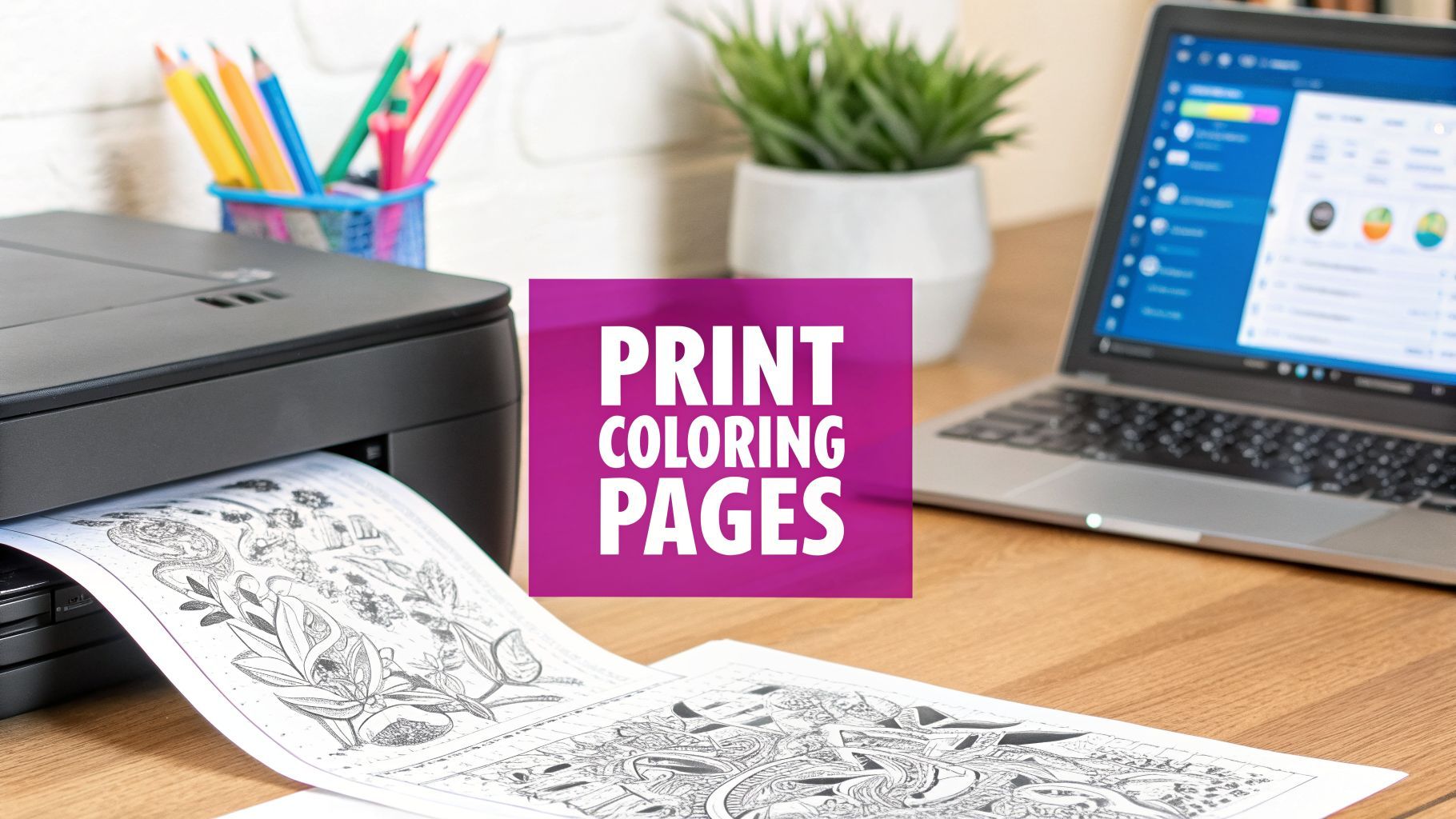
Learning to print coloring pages that actually look good is pretty simple. All it really boils down to is having a high-quality image file, the right kind of paper, and knowing which printer settings to tweak. It's about taking your design, formatting it for a standard sheet of paper, and hitting "Print" with the right options—like "High Quality"—to get those crisp, clean lines that are perfect for coloring.
Your Guide to Perfect Custom Coloring Pages
So, you're ready to turn those digital designs into a stack of physical coloring pages. Whether you're a teacher prepping for a classroom full of kids, a marketer creating some unique swag for an event, or just someone exploring a new creative hobby, I'll walk you through it. We'll go from a simple idea to a perfectly printed page, without the usual headaches.
It’s no secret this hobby has blown up. The adult coloring book market shot up to a massive $2.5 billion in 2024 and is on track to hit $5.1 billion by 2033. That’s not just a trend; it’s a global favorite for creativity and just chilling out. And for anyone wanting to jump in and create their own, modern tools have made it incredibly easy.
Getting From Screen to Paper
The path from a digital file to a stack of ready-to-color sheets doesn't have to be a struggle. The secret is making a few smart choices right at the start to dodge common frustrations like blurry lines or flimsy paper that soaks through with ink.
I like to break it down into three main parts:
- Finding Your Image: Where is the design coming from? You can find tons of pre-made pages online or even use AI to generate something completely original.
- Prepping the File: This is where you make sure your image has a high resolution (you're aiming for 300 DPI) and is saved in a print-friendly format like a PDF.
- The Final Print: Choosing the right paper and tweaking a couple of printer settings is the last step to lock in that professional-looking result.
Depending on your goal, you can find a huge variety of designs out there to get started, like these downloadable children's emotions coloring sheets, which are great for educational or therapeutic use.
Let's quickly summarize the key decisions you'll make along the way. Think of this as your cheat sheet for getting started.
Quick Start Printing Checklist
This table breaks down the typical choices for a casual hobbyist versus someone printing in bulk, like a teacher or event planner.
| Stage | Hobbyist Choice | Educator/Bulk Choice | Key Consideration |
|---|---|---|---|
| Image Source | Free online coloring sites | AI-generated or custom designs | Uniqueness and usage rights. |
| File Format | Single PNG or JPG | Multi-page PDF | PDF is king for printing multiple pages. |
| Resolution | 72-150 DPI (often acceptable) | 300 DPI (non-negotiable) | Higher DPI means sharper lines. |
| Paper Type | Standard 20 lb printer paper | 24-32 lb paper or cardstock | Heavier paper prevents ink bleed. |
| Printer Setting | "Standard" or "Normal" | "High Quality" or "Best" | Quality settings use more ink but look better. |
Each of these choices has a direct impact on your final product, so it's worth taking a moment to get them right.
The big takeaway? If you're just printing a page or two for fun, a simple PNG and whatever paper you have is probably fine. But for a teacher needing 100 copies for a class or a marketer creating event handouts, setting up a multi-page PDF and using slightly heavier paper is a much smarter move.
The best part is that you’re in complete control. You can generate designs that perfectly match a classroom theme, a corporate brand, or a personal art project. If you're looking for ideas or a deep dive into creating your own art, our guide on creating unique AI coloring pages will get you started on the right foot.
Creating Unique Coloring Pages With AI
Finding the perfect coloring page can feel like a scavenger hunt. You spend ages scrolling through search results, only to find images that are blurry, watermarked, or just not quite right. What if you could skip the search entirely and just create exactly what you need, on demand?
That’s where AI art generators completely change the game. You can generate completely custom, high-resolution line art in seconds, moving you way beyond generic templates. It gives you total control.
Imagine needing a specific scene for your classroom—say, "a whimsical forest with fairies and mushrooms for kids." Or maybe you want "a series of intricate geometric patterns for adults." You just describe it, and the AI delivers dozens of options almost instantly. The real magic is being able to dial in the exact style, complexity, and theme you want.
From Prompt to Page in Seconds
You don’t need to be a graphic designer or a tech wizard to make this work. Modern AI tools are built for plain English. If you can describe it, you can create it.
Your prompt is everything. A good one is the difference between a masterpiece and a mess. Here are a few prompts I’ve used that work well:
- For Kids: "Coloring page for a 5-year-old, simple cute dinosaur with thick black outlines, white background, no shading."
- For Adults: "Intricate mandala coloring page, symmetrical floral and leaf patterns, detailed thin lines, black and white line art."
- For Marketing: "Coloring page of a coffee cup with steam forming our company logo, clean lines, professional and fun style."
The whole workflow is pretty straightforward once you get the hang of it.

As you can see, it really boils down to three key stages: getting a great image, picking the right paper, and nailing your printer settings.
The biggest win with AI is generating content at scale. A teacher needing 30 different animal designs for a unit study can get them in minutes, not hours.
Platforms like Bulk Image Generation, for example, can produce up to 100 unique pages from a single prompt. This is a lifesaver for anyone who needs variety, whether you're an educator building a week's worth of activities or a marketer creating a whole campaign of promotional materials.
Tailoring AI Art for Coloring
Just a heads-up: not every image that comes out of an AI is instantly colorable. Many default to full-color images with shading and complex backgrounds. The trick is to be specific in your prompt. Always include terms like "line art," "coloring book page," or "black and white" to get those clean, unfilled designs you’re after.
You’ll also want to make sure you’re getting a high-resolution output—I always aim for 300 DPI. This keeps your lines looking sharp and professional, not jagged and pixelated, when you print. If your first attempt isn’t perfect, just tweak your prompt. You can learn more about how to use an AI art generator to get the hang of refining your requests.
Adding simple phrases like "thick outlines," "minimalist," or "black and white vector style" can make a huge difference. Honestly, experimenting with prompts is half the fun. You’ll quickly build a library of your own go-to phrases that give you exactly what you need, every time.
Prepping Your Digital Files For Printing
I’ve seen it happen a thousand times: you have a brilliant image on your screen, but the print comes out looking like a pixelated mess. This is the single biggest roadblock people hit, but luckily, a few quick tweaks can make all the difference.
Getting your files ready for paper is all about ensuring the lines are sharp and the image fits the page perfectly. It’s also helpful to know a bit about what digital downloads are and how they work, since that’s how most coloring pages are delivered these days. Let’s get these technical bits sorted.

Why Resolution Is King
Ever grab an image from a website only for it to print out blurry and jagged? That’s a classic resolution issue.
For print, the magic number is 300 DPI (dots per inch). This is the standard for ensuring your coloring page lines are crisp and clean, not fuzzy. Most images you find online are set to a much lower 72 DPI, which is fine for a screen but looks terrible on paper.
When generating your images, always aim for a high-resolution output from the start. It saves a ton of headaches later.
Choosing The Right File Format
The type of file you save also has a huge impact on your final print. For coloring pages, you’ll really only need to worry about two formats, and they each have a clear purpose.
- PNG (Portable Network Graphics): This is my go-to for single coloring pages. PNGs are fantastic at handling clean lines and solid colors without losing any quality. The ability to have a transparent background is also a great bonus if you’re layering different designs.
- PDF (Portable Document Format): This is your best friend for bulk printing. If you have a whole set of pages for a classroom or want to create a small booklet, a PDF is the way to go. It bundles everything into one file and locks in the formatting, so what you see on screen is exactly what you get from the printer.
My Personal Tip: For teachers or anyone printing in volume, I always recommend compiling your images into a single, multi-page PDF. It’s an absolute game-changer. Instead of opening and printing 30 different PNGs, you just hit "Print" once.
This is especially relevant now. The art supplies market has exploded to over $1.1 billion, and one of the biggest trends is a move toward shorter, more accessible coloring books. Slimmer 40-page books are becoming the new standard, making them perfect for printing at home.
Save Time With Batch Processing
Okay, so you’ve just generated 100 amazing coloring pages with your AI tool. Fantastic! But they’re all different sizes. Resizing them one by one would be a nightmare.
This is where batch processing becomes your secret weapon. A batch editor is a tool that applies the same change—like resizing—to an entire folder of images instantly. You can set them all to a standard letter size (8.5 x 11 inches) with a single click.
Our free bulk image resizer was built for exactly this. You can format an entire set of images in seconds, making sure every page prints perfectly. For anyone serious about printing in volume, this step isn't just a time-saver; it's essential.
Choosing The Right Paper And Printer Settings

You can have the most perfect digital file, but if you print it on flimsy paper with the wrong settings, it's all for nothing. This is where your digital work becomes a physical reality, and a few smart choices here make the difference between a sad, soggy page and a fantastic coloring experience.
Let's talk paper. You don't need to break the bank, but that standard, thin copy paper (20 lb / 75 gsm) you have lying around is usually a terrible choice for coloring. It tears easily, and worse, markers will bleed right through, ruining the sheet underneath and staining your table. I've seen it happen countless times.
A small upgrade makes a world of difference. For crayons or colored pencils, moving up to a 24 lb or 28 lb (90-105 gsm) paper gives you a much sturdier and more pleasant surface. If you’re dealing with anything wet like markers or watercolor pencils, I always recommend 32 lb (120 gsm) paper or even a light cardstock (65 lb / 176 gsm). This weight feels more substantial and holds ink without bleeding.
Matching Paper To Your Coloring Tools
Choosing the right paper really comes down to what you'll be coloring with. A child with a box of crayons needs something different than an artist using alcohol markers.
This table breaks down which paper works best for different tools, so you can pick the right one for your project.
| Paper Type (Weight) | Best For (Coloring Tool) | Pros | Cons |
|---|---|---|---|
| Standard (20 lb/75 gsm) | Crayons, Dry Pencils | Inexpensive and readily available. | Prone to tearing; markers will bleed. |
| Mid-Weight (24-28 lb) | Colored Pencils, Gel Pens | Better durability; reduced bleed-through. | Slightly more expensive than standard. |
| Heavyweight (32 lb/120 gsm) | Markers, Watercolor Pencils | Excellent opacity; prevents bleed-through. | Higher cost; may not feed in all printers. |
| Cardstock (65-80 lb) | All Media, Keepsakes | Very durable; feels premium and professional. | Can be expensive; check printer compatibility. |
Just a quick tip before you buy a whole ream: double-check your printer’s specs. Most modern home inkjet printers handle up to 80 lb cardstock just fine, but older models might jam if you feed them anything heavier than standard paper.
Navigating Your Printer Settings For Crisp Lines
Now for the printer itself. Your printer’s default settings are almost always optimized to save ink and print fast—not to produce crisp, beautiful line art. To get those sharp black lines that are so satisfying to color in, you have to take a quick detour into the settings menu before you hit "Print."
Don’t just hit the print button and hope for the best. Taking 30 seconds to adjust two or three settings is the most important part of the entire printing process.
Here are the exact settings to look for every single time:
-
Print Quality: Find this option and switch it from "Standard" or "Normal" to "High" or "Best." This makes the printer work a little slower and use more ink, but the result is dramatically sharper, darker lines.
-
Paper Type: Let your printer know what you’re feeding it. If you're using cardstock, select "Heavyweight Paper," "Cardstock," or even "Matte Photo Paper." This tells the printer how to adjust the ink flow and how firmly to grip the paper.
-
Color Mode: If your coloring page is just black outlines, don't waste your expensive color ink. Select "Grayscale" or "Black and White." This will dramatically lower your printing costs, especially if you’re printing in bulk. For smaller batches, don't forget that many public libraries offer free printing, often up to 20-30 pages per day.
Solving Common Printing Problems
You’ve generated the perfect set of coloring pages, hit 'Print,' and… disaster. The edges are sliced off, or the lines look like a blurry mess. It’s a frustrating moment that can kill a creative project before it even starts.
But don't start wrestling with your printer just yet. Most of these issues come down to a single setting that’s easy to miss. I've been there, and I’ve learned that a quick tweak in the print dialog box is usually all it takes to get things right.
Fixing Pages With Cut-Off Edges
This is probably the most common headache. You have a beautiful, full-page design, but the printer chops off the borders. It’s not your fault—it’s the printer’s. Nearly all home printers have built-in margins, a non-printable area around the edge of the paper they simply cannot reach.
When your image is even slightly larger than this printable area, the printer gives up and cuts off whatever doesn’t fit. The good news is the fix is incredibly simple.
- Look for "Fit to Page" or "Scale to Fit": When the print menu pops up, scan for a scaling option. Ticking the box for "Fit," "Fit to Printable Area," or "Scale to Fit" tells the printer to automatically shrink the image just enough to respect its own margins.
- For PDFs, use "Shrink Oversized Pages": If you’re printing from a PDF viewer, you’ll often see this option instead. It does the exact same thing, ensuring your entire design makes it onto the paper.
My personal rule is to always select "Fit to Page" for any full-page design. It takes one second and solves this problem 99% of the time. It’s a simple habit that guarantees nothing gets lost.
Why Are My Printed Lines Blurry or Jagged?
Nothing ruins a great coloring page faster than fuzzy, pixelated lines. This almost always points back to one of two things: a low-resolution file or the wrong printer quality setting.
First, check your image source. If you just saved a picture from a website, it’s likely a 72 DPI file. That looks fine on a screen, but it just doesn't have enough data to print cleanly. For crisp, professional lines, 300 DPI is the gold standard.
If you're confident your image file is high-resolution, then the culprit is your printer settings. Printers default to a "Standard" or "Draft" mode to save ink and time. You need to tell it to do better. Dig into the settings and select "High Quality" or "Best." This one change makes a world of difference.
With the adult coloring book market hitting $151.23 million and projected to double by 2030, the demand for high-quality printables is exploding. You can read more about these market trends and see why getting this right matters. This massive interest is exactly why knowing how to print perfectly is now a key skill for everyone from teachers to marketers.
Your Coloring Page Printing Questions, Answered
Even the best-laid plans can hit a snag. When it comes to printing, a few common questions always seem to pop up right when you're ready to go. I've been there. Let's get these sorted out so you can get back to creating.
What’s the Best File Format for a Coloring Page?
This really comes down to what you’re printing.
For a single, standalone coloring page, PNG is usually your best bet. It’s fantastic at preserving sharp, clean lines without losing quality, which is exactly what you need for detailed artwork. The fact that it supports transparent backgrounds is a nice little bonus for more complex design work, too.
However, if you're putting together a whole packet for a classroom or creating a themed coloring book, a PDF is non-negotiable. It wraps all your pages into one neat, organized file. This locks in your formatting and lets anyone print the entire collection with a single click, making it the clear winner for distributing multiple pages.
How Can I Use Less Black Ink When Printing?
Ah, the classic ink-drain problem. Printing dozens of pages with heavy black lines can empty a cartridge faster than you can say "out of ink." You’ve got a couple of smart ways to handle this.
The quickest fix is to dig into your printer settings for a "Draft" or "Economy" mode. This will definitely reduce how much ink is used, but be warned: the lines often come out fainter and less satisfying to color.
A much better method, giving you more control, is to tweak the image file itself before printing. Instead of using pure black (#000000), edit the line art to be a dark gray. On paper, the difference is almost impossible to spot, but it can make a huge difference in your ink consumption over a big print job.
This little trick is a lifesaver for teachers or marketers who need to print hundreds of pages at once.
Can I Print a Design That Is Bigger Than My Paper?
You absolutely can. This is often called "tiling" or "poster printing," and it’s a brilliant way to create large-scale art projects or classroom murals. Most modern PDF readers and a lot of printer software have this feature built right in.
When you choose this option, the software automatically slices the large image into sections that fit on standard sheets of paper. You just print out the individual "tiles," trim off the extra margins, and tape them together like you're assembling a simple puzzle.
On the flip side, if your goal isn't a giant poster but just printing a large image on a single sheet, look for the "Fit to Page" option. This will simply shrink the design to fit neatly within your paper's printable area.
Why Are My Printed Lines Blurry or Pixelated?
This is one of the most frustrating printing problems, and it almost always boils down to one of two things: a low-resolution source image or the wrong printer settings.
First, check your digital file. Images you find online are often a low-resolution 72 DPI (dots per inch). That looks perfectly fine on a screen, but it will look fuzzy and jagged when you print it. For crisp, professional-looking lines, your source file needs to be at least 300 DPI.
If you're sure you have a high-resolution image, the problem is likely your printer settings. To save ink, many printers default to a "Standard" quality. You need to take control. Before hitting print, go into the settings menu and manually select "High Quality" or "Best." While you're there, double-check that the "Paper Type" setting matches the paper you’re actually using. This helps the printer apply the ink correctly for that specific surface, giving you the best possible result.
Ready to skip the tedious file prep and generate hundreds of unique, print-ready coloring pages in seconds? Bulk Image Generation uses advanced AI to turn your ideas into high-resolution line art, perfectly formatted for printing. Create classroom activities, marketing materials, or personal projects effortlessly. Start creating with Bulk Image Generation today!