Mastering the Craft: A Deep Dive Into 10 Different Styles of Drawing for 2026

Ryan Bennett • February 12, 2026
Explore 10 different styles of drawing, from photorealism to flat design. Get tips, use cases, and AI prompts to master each artistic approach.
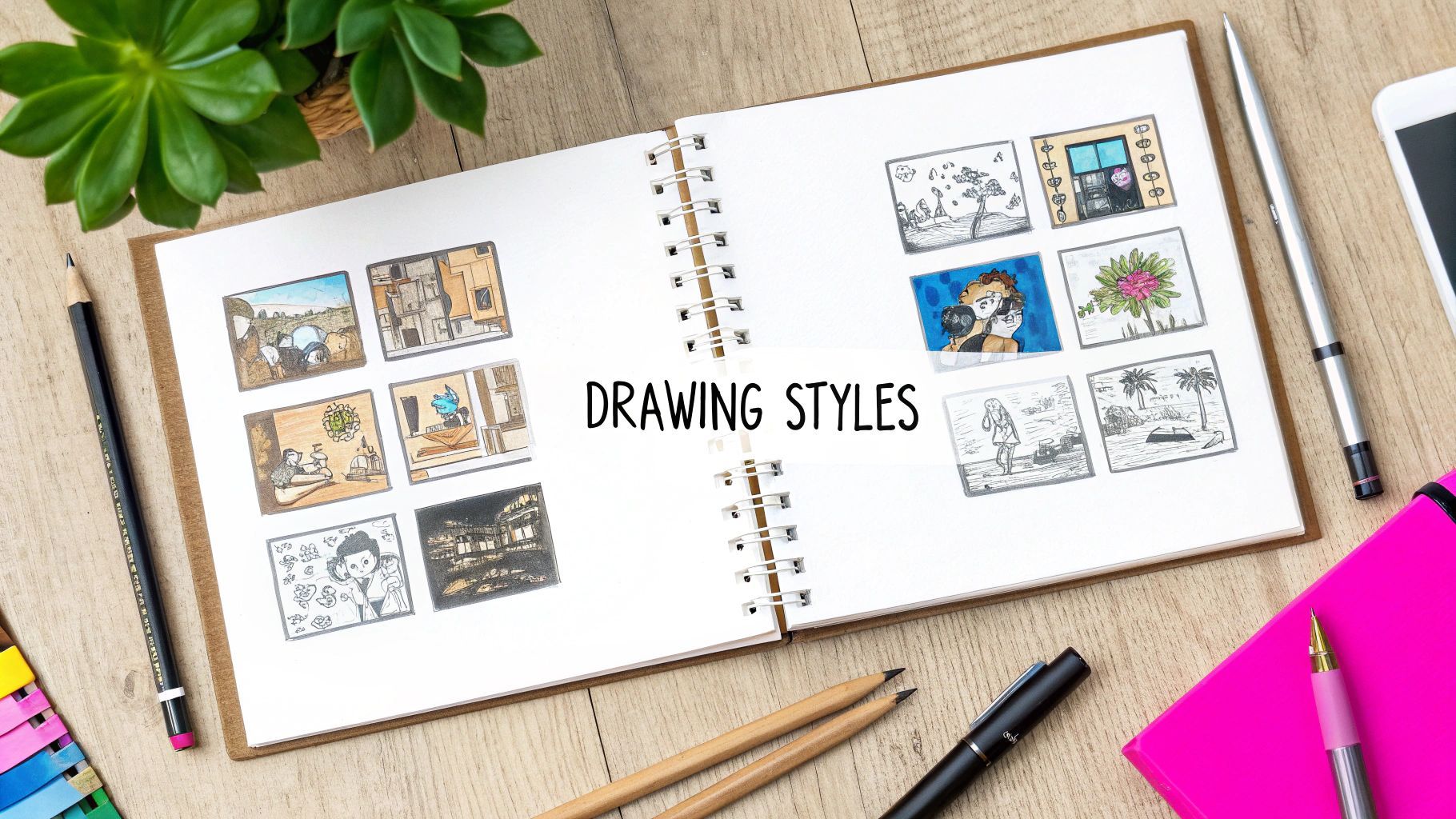
Welcome to the vibrant world of visual art, a landscape rich with diverse and powerful ways to communicate ideas. The ability to harness different styles of drawing is no longer just for professional artists; it's a critical skill for marketers, content creators, and innovators looking to make an impact. From the hyper-detailed precision of photorealism to the bold simplicity of minimalist line art, each style offers a unique visual language to capture attention, convey emotion, and build a memorable brand identity. Understanding these distinct approaches allows you to select the perfect aesthetic for any project, ensuring your message resonates effectively with your target audience.
This comprehensive guide is your ultimate roadmap to understanding and implementing ten of the most impactful drawing styles. We will move beyond simple definitions to provide a practical toolkit for each one. You'll discover key characteristics, typical use cases, and actionable techniques to achieve the look yourself.
More importantly, we will equip you with ready-to-use AI prompts, designed to help you generate high-quality visuals at scale. Whether you're designing a social media campaign, creating assets for a website, or developing a unique brand look, mastering these styles will elevate your creative output. This resource is built to be scannable and immediately useful, helping you find the right style and put it into practice without delay. Let's explore the visual voices that can transform your creative projects from good to unforgettable.
1. Realistic/Photorealism
Realistic drawing, often escalating into photorealism or hyperrealism, is a style dedicated to replicating images with the highest possible fidelity. The core principle is to create a drawing that is virtually indistinguishable from a high-resolution photograph. This meticulous approach demands a deep understanding of light, shadow, texture, and form to achieve its lifelike effect.
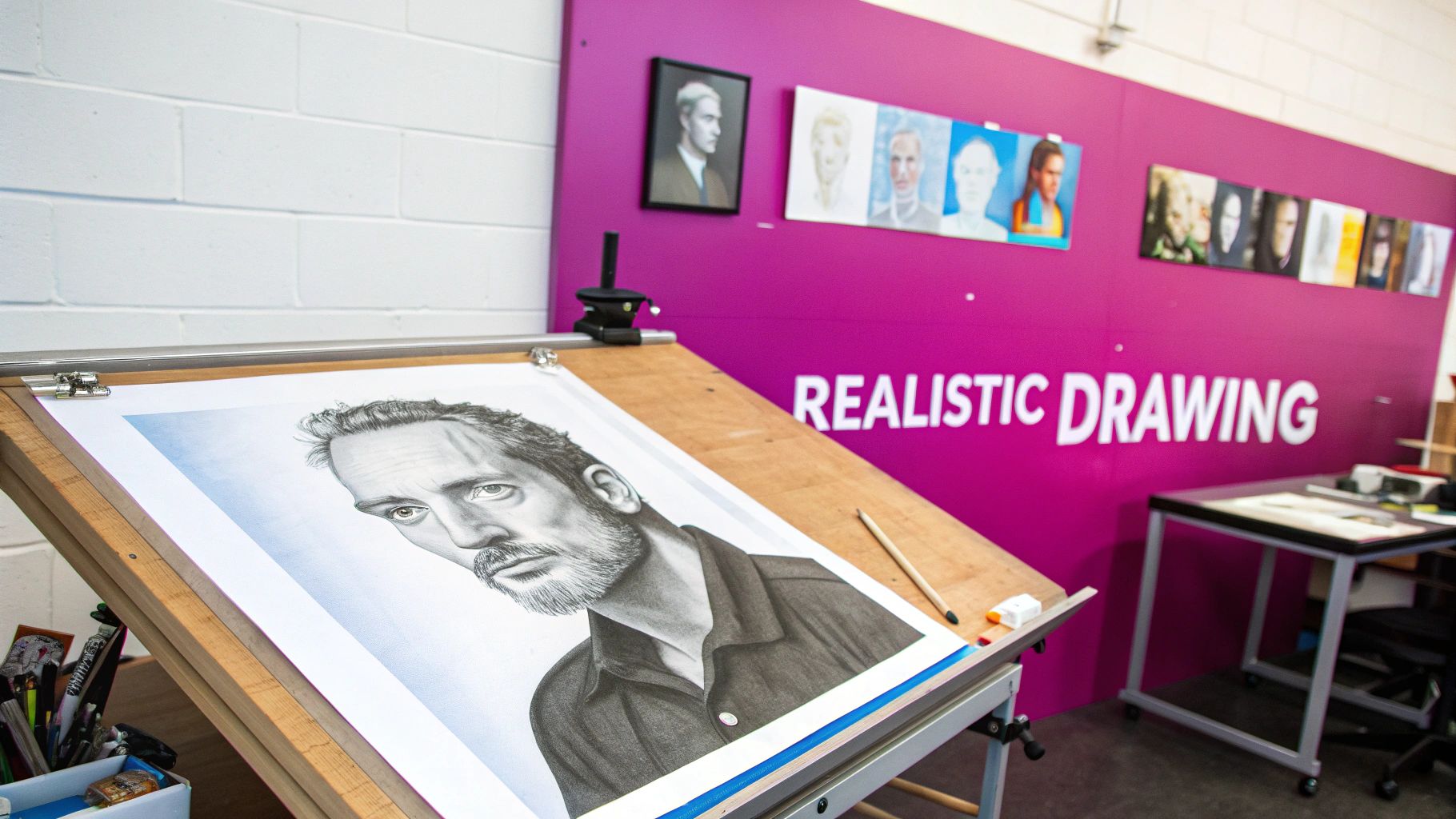
Among the different styles of drawing, realism is prized for its ability to convey authenticity and precision, making it invaluable for commercial applications. Its power lies in creating a sense of trust and quality, whether showcasing a product's fine details or presenting a professional headshot.
Key Characteristics
- High Fidelity: Extreme attention to detail, texture, and reflection.
- Accurate Proportions: Precise scaling and placement of every element.
- Subtle Gradations: Smooth and gradual transitions between light and shadow to create depth and form.
- Focus on Light: Meticulous rendering of how light interacts with surfaces, including highlights and cast shadows.
Best Use-Cases
This style excels in contexts where authenticity is paramount. For marketing professionals and business owners, it's the go-to for creating compelling visual assets that build consumer confidence. Examples include:
- E-commerce: Creating flawless product images for online stores.
- Branding: Professional headshots for corporate websites and LinkedIn profiles.
- Advertising: High-end campaigns for luxury goods or real estate listings.
Quick Tips for Realistic Drawing
To master this demanding style, focus on precision and patience. Start with a high-quality reference photo; the better the source, the better the result. Use a grid system to ensure accurate proportions. Work in layers, gradually building up tones and details from light to dark. This technique helps create depth and avoids irreversible dark marks early on. For digital marketers needing consistent, high-quality visuals at scale, you can explore how AI can accelerate your product photography while maintaining a photorealistic look.
2. Minimalist/Line Art
Minimalist drawing, often executed as line art, champions the principle of "less is more." This style strips an image down to its essential components, using clean lines, a limited color palette, and abundant negative space to convey a concept. The goal is to communicate an idea with maximum clarity and impact by removing all non-essential details, a philosophy that makes it a powerful tool in modern design.
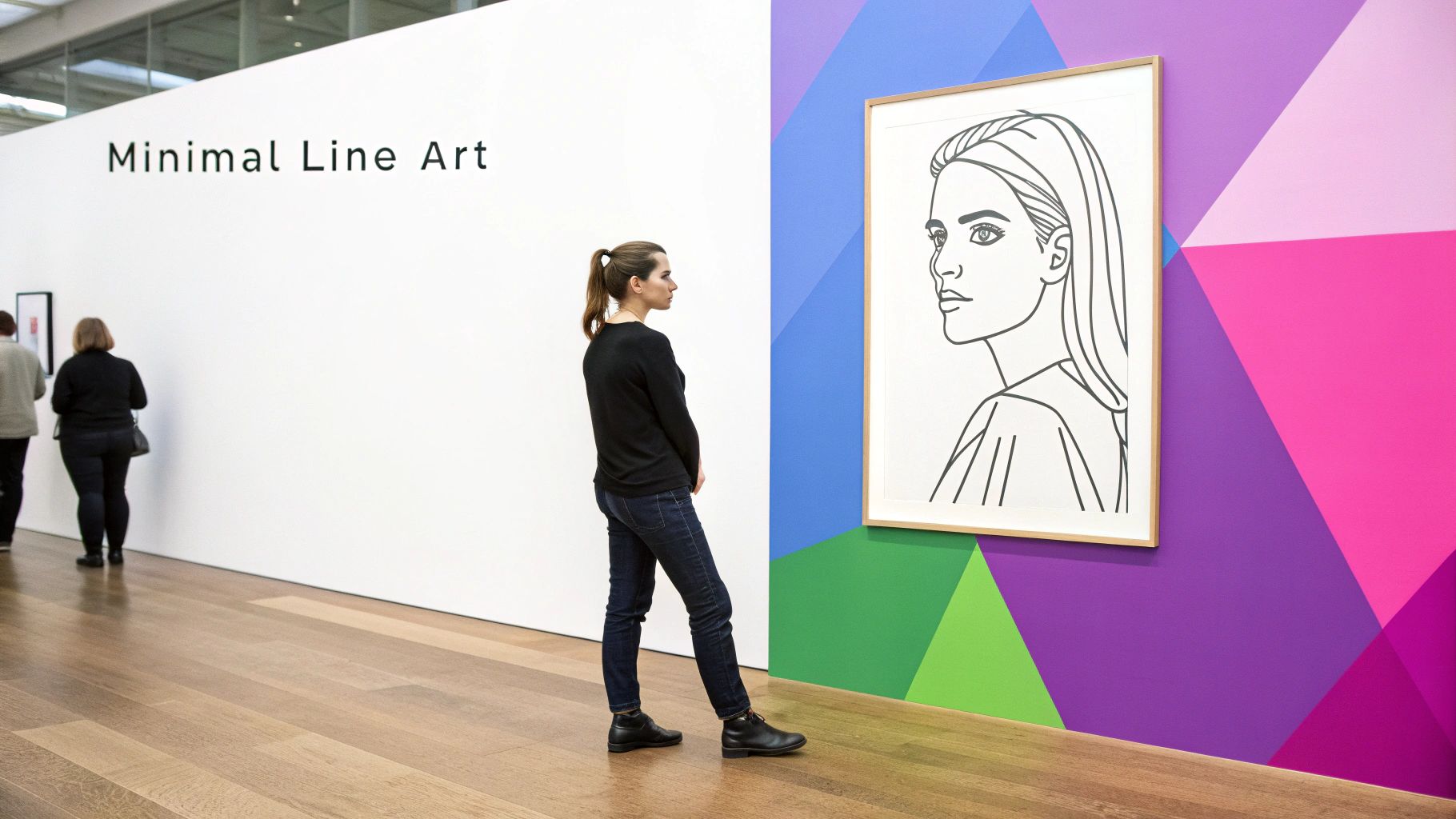
Among the different styles of drawing, minimalism is highly valued for its elegance, versatility, and efficiency. Its clean aesthetic allows for quick comprehension, making it perfect for logos, icons, and infographics where immediate recognition is crucial. The style's simplicity creates a sophisticated and contemporary feel that resonates with audiences in a visually saturated world.
Key Characteristics
- Simplicity: Focuses on fundamental shapes and forms, omitting complex details.
- Negative Space: Uses empty or "white" space as an active and intentional design element.
- Limited Palette: Often uses monochrome or a very restricted selection of one to three colors.
- Clean Lines: Employs crisp, consistent line weights to define subjects clearly and boldly.
Best Use-Cases
This style is exceptionally effective in branding and digital communication where clarity and scalability are key. For marketers and designers, it provides a clean, modern visual language that is easily adaptable across various platforms.
- Branding: Creating memorable logos, icons, and favicons (like Apple's or Airbnb's).
- Social Media: Designing clean, eye-catching graphics for Instagram Stories and posts.
- Web Design: Developing user interface (UI) icons and elements for a seamless user experience.
- Publishing: Illustrating book covers or creating simple diagrams and instructional materials.
Quick Tips for Minimalist Drawing
To master minimalist art, focus on conceptual clarity and deliberate reduction. Begin with your core idea and strategically eliminate details until only the most essential elements remain. Use a consistent line weight to create a cohesive and unified look. Remember that negative space is just as important as the lines themselves; let it shape and define your subject. Finally, test your design at various sizes to ensure it remains legible and impactful, even as a small icon.
3. Illustration/Digital Art
Digital illustration merges classic drawing principles with modern technology, creating artwork that is both expressive and incredibly versatile. This style is not defined by a single look; instead, it spans a vast spectrum from clean, cartoon-like visuals to intricate, semi-realistic pieces. The digital canvas offers boundless freedom for color exploration, complex layering, and effortless revisions, making it a powerhouse in the creative world.
Among the different styles of drawing, digital illustration is a favorite for brands aiming to build a distinct and friendly personality. Its strength lies in its ability to communicate complex ideas and evoke emotion through stylized visuals, making it perfect for storytelling in marketing campaigns, like the memorable brand assets used by companies such as Slack and Mailchimp.
Key Characteristics
- Stylistic Versatility: Can range from flat, minimalist designs to richly textured and painterly aesthetics.
- Vibrant Color Palettes: Digital tools allow for unlimited and precise color choices, often resulting in bold, eye-catching schemes.
- Clean Lines & Shapes: Vector-based software enables crisp, scalable lines, while raster-based programs offer organic, textured strokes.
- Layer-Based Workflow: Artists build images in layers, allowing for easy editing, repositioning, and experimentation without altering other elements.
Best Use-Cases
This style shines in digital-first contexts where engagement and brand identity are key. For marketers and business owners, it's an effective tool for creating a unique visual language that resonates with modern audiences. Examples include:
- Branding: Developing mascots, custom icons, and unique brand assets.
- Content Marketing: Creating engaging visuals for blog posts, social media, and newsletters.
- Advertising: Designing animated explainers, web banners, and cohesive campaign illustrations.
Quick Tips for Digital Illustration
To create compelling digital art, start by establishing a consistent style guide to ensure brand coherence across all visuals. To effectively capture the nuances of digital styles like illustration, knowing how to choose the right tools is paramount, from mastering various techniques to selecting the ideal hardware, such as the best iPad stylus for drawing. Leverage your illustrations for emotional storytelling in campaigns, and combine them with strong typography for maximum impact. For creating multiple variations of an illustration, you can use an AI art generator to rapidly produce assets for A/B testing or diverse social media content.
4. Flat Design
Flat design is a minimalist drawing style that prioritizes simplicity and clarity over three-dimensional realism. It strips away gradients, drop shadows, and complex textures, focusing instead on solid blocks of color, clean lines, and simple geometric shapes. This approach creates a two-dimensional aesthetic that is clean, modern, and highly legible, making it a cornerstone of contemporary digital design.
Among the different styles of drawing, flat design is exceptionally effective for communicating information quickly and efficiently. Its power lies in its ability to create user-friendly interfaces and clear visual narratives, making complex data easy to digest in infographics or guiding users seamlessly through an app.
Key Characteristics
- Two-Dimensionality: A complete absence of depth, shadows, or gradients.
- Simple Shapes: Reliance on basic geometric forms like circles, squares, and triangles.
- Bold Colors: Use of vibrant, often contrasting color palettes to define elements.
- Focus on Typography: Clean, sans-serif fonts are often a central design element.
Best Use-Cases
This style excels in digital environments where clarity and user experience are paramount. For marketers and UX/UI designers, it’s the standard for creating intuitive and visually appealing digital assets. Examples include:
- Web & App Design: Creating clean user interfaces (UI) and icons.
- Infographics: Visualizing data and complex information in a digestible format.
- Marketing Materials: Designing modern presentations, logos, and digital ads.
Quick Tips for Flat Design
To master this minimalist style, focus on clarity and deliberate use of color. Begin by establishing a bold, harmonious color palette that ensures high contrast for accessibility. Use a consistent library of shapes and icons to maintain a cohesive visual language across all assets. While the design is static, you can combine it with subtle micro-interactions or animations to add a layer of engagement. For brands needing consistent iconography or illustrations at scale, AI tools can batch-generate flat design assets that adhere to your specific style guidelines.
5. Sketch/Hand-Drawn Style
The sketch or hand-drawn style captures the raw, expressive quality of preliminary drawings. This approach intentionally retains visible lines, hatching, and charming imperfections to evoke a sense of authenticity, warmth, and human touch. It’s a style that feels approachable and personal, making it a powerful tool for building a genuine connection with an audience.
Among the different styles of drawing, the sketch aesthetic is prized for its ability to communicate ideas quickly and with personality. Its unpolished nature makes complex information feel more digestible and relatable, as seen in the visual thinking work of Dan Roam and the design philosophy of companies like Basecamp.
Key Characteristics
- Visible Linework: The lines are often loose, energetic, and clearly visible rather than blended away.
- Imperfect and Organic: Embraces imperfections, such as varied line weights, stray marks, and asymmetry.
- Expressive Quality: Focuses on capturing the essence and energy of a subject rather than precise detail.
- Use of Shading Techniques: Often employs hatching, cross-hatching, or scribbling to create depth and shadow.
Best Use-Cases
This style is perfect for brands and creators who want to appear transparent, creative, and relatable. It excels in contexts where the process is as important as the final product. Examples include:
- Branding: Creating a friendly, approachable brand identity for startups and creative businesses.
- Education: Developing engaging explainer videos, like those from TED-Ed, or sketchnote infographics.
- Marketing: Designing storyboards for social media campaigns or illustrating behind-the-scenes content.
Quick Tips for Sketch/Hand-Drawn Style
To achieve an authentic hand-drawn look, prioritize movement and expression over perfection. Start by working quickly to keep your lines loose and confident. Vary the weight and texture of your lines to add visual interest and depth. Pairing sketch-style illustrations with handwritten typography can further enhance the personal, authentic feel. For businesses needing to produce this style at scale, using AI to generate consistent sketch visuals can be a major time-saver while maintaining a uniform brand aesthetic.
6. Vector/Geometric Art
Vector/Geometric art is a style defined by mathematical precision, utilizing points, lines, and curves to create clean, scalable images. Unlike raster-based drawings made of pixels, vector graphics are built on mathematical equations, allowing them to be scaled to any size without losing quality. This style combines artistic expression with the logic of geometry, resulting in sharp, clear, and highly versatile artwork.
Among the different styles of drawing, vector art is the foundation of modern digital design and branding. Its infinite scalability makes it indispensable for creating assets that must look crisp across various mediums, from a tiny app icon to a massive billboard. This adaptability ensures brand consistency and professional quality in every application.
Key Characteristics
- Scalability: Graphics can be resized indefinitely without any loss of clarity or detail.
- Geometric Foundation: Built from basic shapes like circles, squares, and triangles, as well as complex curves.
- Clean Lines: Characterized by sharp, well-defined edges and smooth curves.
- Mathematical Precision: Every element is defined by precise mathematical coordinates rather than a grid of pixels.
Best Use-Cases
This style is a cornerstone for digital marketers, branding agencies, and web designers who need flexible and consistent visual assets. Its clean aesthetic is perfect for clear communication. Examples include:
- Branding: Designing memorable and versatile company logos (e.g., Slack, Spotify).
- Marketing: Creating infographics, icons, and animated explainer videos.
- Web & UI Design: Developing responsive graphics and user interface elements for websites and apps.
Quick Tips for Vector/Geometric Art
To excel in vector drawing, think in terms of shapes and paths. Start by building complex images from simple geometric forms. Use a limited color palette to maintain a clean and modern look. For artists collaborating on projects, knowing how to open Adobe Illustrator files is essential for sharing and editing work seamlessly. For businesses needing to produce numerous vector-style logos or icons efficiently, you can use an AI logo generator to create variations that maintain a consistent geometric style.
7. Watercolor/Painted Style
The watercolor or painted style of drawing mimics the transparent, flowing nature of traditional watercolor painting. This approach is characterized by soft edges, organic color bleeding, and luminous washes of color that appear to soak into the paper. It creates a delicate, artistic, and often ethereal aesthetic that feels both handcrafted and elegant.
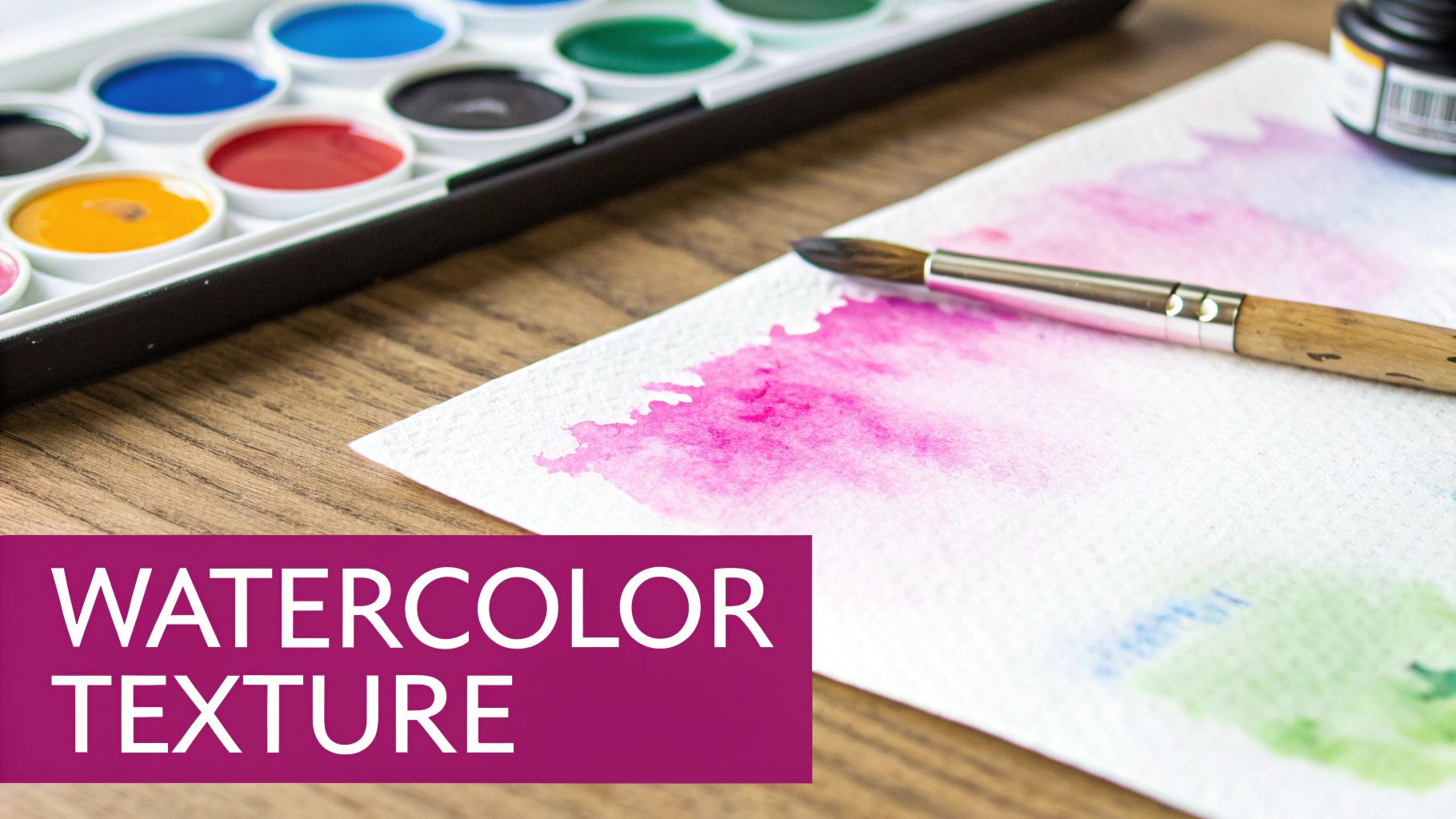
Among the different styles of drawing, the watercolor effect is valued for its ability to convey warmth, creativity, and sophistication. For businesses, this style is perfect for brands that want to project a personal, artistic, or gentle image, making a strong connection with audiences in the wellness, beauty, and lifestyle sectors.
Key Characteristics
- Transparency: Layers of color are translucent, allowing underlying colors and textures to show through.
- Soft Edges: Colors bleed into one another, creating soft, undefined borders rather than hard lines.
- Granulation: Visible texture created by pigment settling into the paper's surface, adding organic depth.
- Luminous Washes: Smooth, broad applications of diluted color that create a light and airy feel.
Best Use-Cases
This style is highly effective in contexts that call for an artistic and elegant touch. It’s a favorite for brands and marketers aiming to create a gentle yet memorable visual identity. Examples include:
- Branding: Packaging for cosmetics, beauty, and organic food products.
- Event Marketing: Wedding invitations, stationery, and event branding.
- Content Creation: Social media backgrounds and lifestyle blog graphics.
- Publishing: Illustrations for children's books and editorial pieces.
Quick Tips for Watercolor/Painted Style Drawing
To achieve an authentic watercolor look, focus on layering and fluidity. Start with light washes and build up color gradually, allowing layers to dry in between to control bleeding. Embrace imperfections like drips and blooms, as they contribute to the style’s unique charm. For digital applications, use brushes with soft, textured edges and experiment with layer blending modes like "Multiply" to replicate transparency.
8. Comic/Cartoon Style
Comic and cartoon drawing styles are characterized by their playful and dynamic aesthetic, using bold outlines, simplified shapes, and often vibrant, flat colors. This style prioritizes clear communication and expression over realistic accuracy, featuring exaggerated facial expressions and dynamic action lines to convey emotion and movement effectively. It encompasses a wide range, from the detailed action panels of comic books to the simplified forms of modern animated series.
Among the different styles of drawing, the comic/cartoon approach is exceptionally effective for storytelling and brand personification. Its accessible and engaging nature makes it perfect for creating memorable brand mascots, social media comic strips, or educational content that needs to simplify complex ideas and connect with audiences on an emotional level.
Key Characteristics
- Bold Outlines: Strong, clear lines define shapes and characters, making them stand out.
- Simplified Forms: Details are reduced to their essential shapes for clarity and easy recognition.
- Exaggerated Expressions: Features are amplified to clearly communicate emotions like joy, anger, or surprise.
- Vibrant Color Palettes: Often uses bright, saturated colors to create a lively and energetic mood.
Best Use-Cases
This style is ideal for brands and creators looking to be approachable, humorous, or engaging, especially with younger demographics. For marketers, it’s a powerful tool for building a friendly brand personality.
- Branding: Designing memorable and friendly company mascots (e.g., LEGO).
- Content Marketing: Creating shareable comic strips and memes for social media engagement.
- Advertising: Developing animated explainer videos that break down complex products or services.
- Gaming: Designing appealing characters and assets for video games.
Quick Tips for Comic/Cartoon Drawing
To create effective cartoon art, focus on character consistency and clear storytelling. Develop a "model sheet" for your characters to ensure their design remains consistent from every angle. Use dynamic poses and action lines to inject energy into your scenes. When creating content for a brand, pair your illustrations with humorous or witty copywriting to maximize engagement. For creating a series of related visuals, apply batch editing to maintain a consistent color palette and line weight across all images.
9. Abstract/Conceptual Art
Abstract art is a style that diverges from depicting reality, instead using shapes, forms, colors, and gestural marks to achieve its effect. The core principle is to communicate ideas, emotions, and concepts through non-literal visual language, leaving room for viewer interpretation. This expressive approach breaks free from traditional representation, focusing on the intrinsic qualities of the artistic elements themselves.
Among the different styles of drawing, abstract art is highly valued in modern branding and contemporary design. Its power lies in its ability to convey a feeling or an advanced concept instantly, making it ideal for innovative tech startups, creative agencies, and forward-thinking brands that want to communicate originality and sophistication.
Key Characteristics
- Non-Representational: It does not attempt to accurately depict a visual reality.
- Emphasis on Composition: The arrangement of elements like color, line, and shape is paramount.
- Expressive Use of Color: Colors are often chosen for their emotional or symbolic impact rather than naturalism.
- Focus on Form and Texture: The intrinsic qualities of the medium and marks are often highlighted.
Best Use-Cases
This style excels in contexts where conveying an emotion, idea, or modern identity is more important than showing a literal product. For marketers, it's a powerful tool for creating a unique and memorable brand aesthetic. Examples include:
- Branding: Creating a distinctive visual identity for tech startups or creative firms.
- Web Design: Using abstract background patterns to add visual interest and sophistication.
- Advertising: Campaigns that aim to evoke a mood, like Airbnb's abstract 'Belongings' campaign.
- Media: Designing evocative cover art for music albums, podcasts, or book covers.
Quick Tips for Abstract Drawing
To master this conceptual style, ground your work in a clear idea or emotion. Use color psychology strategically to guide the viewer’s response. While the form is abstract, ensure the visual elements work harmoniously and don’t obscure the intended message, especially when paired with text. For a consistent brand look, try generating variations on abstract themes to create a cohesive set of visual assets for different marketing channels.
10. Isometric/3D Illustration
Isometric illustration is a drawing style that creates a three-dimensional illusion on a two-dimensional surface. It uses an axonometric projection where all three axes (x, y, and z) are equally foreshortened, and parallel lines in the object remain parallel in the drawing. This technique bridges the gap between flat design and full 3D rendering, offering depth and complexity while maintaining a clean, accessible aesthetic.
Among the different styles of drawing, isometric illustration has become a favorite in the tech and SaaS industries. Its structured, almost diagrammatic nature is perfect for visualizing complex systems, user interfaces, and data flows in a way that is both engaging and easy to understand. Brands like Stripe and Asana use it to make abstract digital concepts feel tangible.
Key Characteristics
- 3D Perspective on a 2D Plane: Creates a sense of depth and volume without using vanishing points.
- Parallel Lines: All vertical lines remain vertical, and horizontal lines are drawn at a consistent 30-degree angle from the horizontal axis.
- No Foreshortening: Objects do not appear smaller as they get further away, maintaining uniform scale.
- Clean and Geometric: Relies on structured shapes and clean lines, giving it a modern, organized look.
Best Use-Cases
This style is ideal for visually explaining processes, systems, or environments where clarity and structure are key. For marketers and business owners, it’s a powerful tool for simplifying complex information.
- Tech/SaaS: Illustrating software features, platform architecture, or user workflows.
- Data Visualization: Creating compelling infographics that show relationships and hierarchies.
- Gaming: Designing game assets, maps, and environments, especially in indie and mobile games.
- Branding: Developing a unique and modern visual identity for a tech-focused brand.
Quick Tips for Isometric Illustration
To create effective isometric drawings, consistency is crucial. Start by establishing a strict isometric grid or guide system to ensure all angles and proportions are accurate. Use color and shading strategically to create a visual hierarchy and enhance the illusion of depth. For businesses needing a suite of consistent visuals, creating a library of reusable isometric elements can dramatically speed up the creation of new illustrations for websites, presentations, and marketing materials.
Comparison of 10 Drawing Styles
| Style | Implementation complexity | Resource requirements | Expected outcomes | Ideal use cases | Key advantages |
|---|---|---|---|---|---|
| Realistic / Photorealism | High — expert technique or advanced AI | High — high‑res references, time, skilled artist or compute | Photo‑like fidelity and accurate detail | Product photography, branding, advertising, real estate | Authenticity; trustworthiness; strong product detail |
| Minimalist / Line Art | Medium — strong design fundamentals | Low — simple tools, small files, limited palette | Clean, highly recognizable visuals | Logos, social media graphics, favicons, modern brands | Fast loading; scalable; memorable |
| Illustration / Digital Art | Medium — artistic vision and tool proficiency | Moderate — digital tools, style guide, iteration | Expressive, brand‑adaptable artwork | Social campaigns, storytelling, mascots, content marketing | Emotional connection; flexible; quick to iterate |
| Flat Design | Low–Medium — rule‑based, consistent execution | Low — vector tools, modest assets | Clean, usable UI‑friendly visuals | Web/apps, infographics, SaaS product design | Fast loading; accessible; easy to scale |
| Sketch / Hand‑Drawn Style | Medium — organic skills; consistency challenge | Moderate — brushes/textures, careful iteration | Authentic, approachable, humanized visuals | Tutorials, educational content, authentic branding | Relatable; stands out vs polished content |
| Vector / Geometric Art | Medium–High — precision and planning | Moderate — vector software, reusable libraries | Crisp, infinitely scalable graphics | Logos, infographics, icon systems, responsive assets | Infinite scalability; small files; brand consistency |
| Watercolor / Painted Style | Medium — control over organic effects | Moderate — textured brushes, color layering | Delicate, artistic, emotive visuals | Lifestyle brands, stationery, web backgrounds | Elegant, unique, emotionally engaging |
| Comic / Cartoon Style | Medium — character design and consistency | Moderate — illustration tools, style guidelines | Playful, attention‑grabbing visuals | Children’s media, gaming, viral social content | Memorable; fun; strong storytelling potential |
| Abstract / Conceptual Art | Medium — strong concept and direction | Low–Moderate — creative direction, design tools | Distinctive, interpretive visuals that suggest ideas | Tech & innovation brands, contemporary marketing | Distinctive; evokes emotion; positions as innovative |
| Isometric / 3D Illustration | High — strict spatial rules and precision | High — skilled designers, element libraries, time | Technical, layered visuals with implied depth | SaaS, data visualization, technical marketing, UX diagrams | Conveys complexity clearly; consistent visual system |
From Inspiration to Implementation: Scaling Your Creative Workflow
We've journeyed through a vibrant landscape of visual expression, exploring ten distinct and powerful styles of drawing. From the exacting precision of Photorealism and the clean elegance of Minimalist Line Art to the playful energy of Comic styles and the conceptual depth of Abstract art, you now have a comprehensive toolkit for visual communication. The core lesson is clear: style is more than mere decoration. It is a strategic language that shapes perception, evokes emotion, and drives engagement.
The true value lies in understanding which of these different styles of drawing best serves your purpose. A SaaS company might use clean, informative Isometric illustrations to explain complex software features, while a boutique coffee shop could leverage a hand-drawn Sketch aesthetic to convey an artisanal, authentic brand identity. Your choice of style directly influences how your audience connects with your message, making it a critical component of any successful creative or marketing strategy.
Bridging the Gap Between Concept and Creation
The primary challenge has always been execution. In the past, creating a large volume of high-quality, stylistically consistent assets was a significant bottleneck. This process required intensive manual labor, specialized artistic skills, and considerable time, resources that are often in short supply for small businesses, educators, and marketing teams. The dream of producing a hundred unique, on-brand illustrations for a content campaign or a suite of custom icons for a new website often remained just that: a dream.
Fortunately, the creative landscape has evolved dramatically. The barrier between a brilliant idea and a library of finished assets has been effectively dismantled by technology. Modern AI-powered tools have revolutionized the workflow, transforming a process that once took weeks into one that can be accomplished in minutes. This isn't about replacing human creativity; it's about amplifying it. It’s about giving you the power to direct the creative vision while automating the repetitive, time-consuming tasks of production.
A New Era of Scalable Visual Content
Imagine the possibilities this unlocks. A social media manager can now generate a month's worth of visually cohesive content in various styles, A/B testing which aesthetic resonates most with their audience. An educator can create an entire semester's worth of custom coloring pages or visual aids, perfectly tailored to their lesson plans. A branding agency can rapidly prototype multiple visual identities for a client, showcasing concepts in Photorealistic, Flat Design, and Watercolor styles to find the perfect fit.
This is achieved by leveraging platforms that understand your creative goals through natural language. You no longer need to be an expert in complex "prompt engineering." Instead, you can focus on the high-level strategy: defining the mood, selecting the style, and guiding the overall artistic direction. When combined with powerful batch processing and editing features, you can ensure pixel-perfect consistency across hundreds or even thousands of images, solidifying your brand's visual identity at a scale previously unimaginable. The mastery of different styles of drawing is no longer just about your ability to hold a pen; it’s about your ability to direct a powerful creative engine.
Your next step is to move from passive learning to active creation. Experiment with the styles we've covered. Combine them. Push their boundaries. Find the visual language that speaks for your brand or project, and then use the power of modern tools to bring that vision to life, consistently and at scale.
Ready to transform your creative workflow and produce stunning, on-brand visuals in seconds? Bulk Image Generation allows you to leverage all the different styles of drawing we've discussed, generating hundreds of unique images from a single prompt. Start scaling your creative output today at Bulk Image Generation.