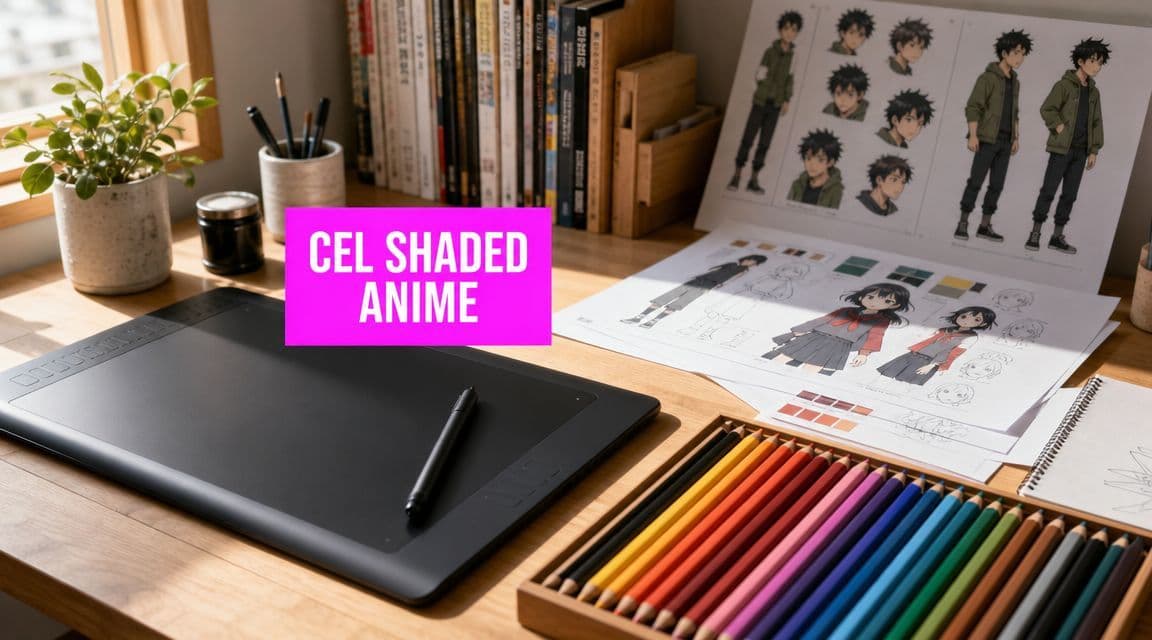
Cel Shaded Anime: Your Guide to Creating the Style

Ryan Bennett • June 6, 2026
Learn what cel shaded anime is and how to create the iconic look. Our guide covers the principles, examples, and how to use AI for cel shaded art.
A client once told me their AI anime images looked “almost right, but somehow mushy.” They had the big eyes, the bright hair, even the right poses. What they were missing was the discipline that makes cel shaded anime feel crisp instead of merely anime-inspired.
The Unmistakable Look of Cel Shaded Anime
You know the look before you know the term. A character turns their head, and the face doesn't melt through a dozen soft tones. The cheek stays mostly one color, the shadow lands in a clean shape, and the whole frame reads instantly.
That graphic snap is why cel shaded anime sticks in memory. It's the visual language behind the punch of action scenes, the clarity of expressive faces, and the reason a silhouette can feel iconic after a single glance. Bold outlines do part of the work, but they aren't the whole story. The magic lies in how the color and shadow stay controlled.
For decades, that look came from a physical production reality. One industry retrospective says that “pretty much every anime produced before the turn of the millennium was hand-drawn on cels,” tying that period directly to titles such as Akira, My Neighbor Totoro, and Neon Genesis Evangelion in its discussion of pre-digital anime workflows, as noted in this cel animation retrospective. That history matters because the style wasn't invented as a filter. It came from a medium that rewarded clean separation.
What people usually notice first
Most viewers read cel shaded anime through a few immediate signals:
- Sharp shadow shapes that sit on the form like cut paper
- Flat, saturated color areas that don't drift into muddy gradients
- Dark, intentional outlines that keep the figure readable
- Strong silhouette design so the character still works at a glance
That last point gets overlooked. A lot of failed AI generations include anime eyes and hair, but the image falls apart when you shrink it. Good cel shading survives reduction. It still reads as a poster, icon, thumbnail, or frame grab.
Cel shading isn't “less rendered.” It's rendered with stricter rules.
That's why the style still feels current. Whether you're making social graphics, educational illustrations, sprite concepts, or AI-assisted character sheets, the same visual discipline that made classic anime memorable still solves modern problems. It keeps images legible, consistent, and fast to understand.
What Exactly Is Cel Shading
At its simplest, cel shading is a way of painting light without smooth transitions. Instead of letting color fade gradually from bright to dark, you divide the surface into a few deliberate regions.
Imagine it as a digital coloring book with strategic, hard-edged shadows. You fill the shirt with one blue, then decide where the shadow shape goes, then maybe add a lighter area or highlight. You don't airbrush your way between them. You place them.

The visual idea in plain language
If photorealism tries to imitate how light behaves in reality, cel shading tries to organize light for readability. That's a big difference.
A painterly image might celebrate subtle gradation in skin, cloth, and atmosphere. Cel shaded anime usually resists that softness. It says, “This side is lit. This side is shadow. Read the form quickly.”
A screen-printing analogy helps here. In screen printing, each ink layer needs clear boundaries. Cel shading feels similar. The image is built from stacked decisions, not endless blends.
Three pillars: flat base colors, hard-edged shadows, and clean outlines.
What cel shading is not
People often confuse cel shading with “anything anime.” That's where many prompts go wrong.
Cel shading is not automatically:
- Painterly anime art with lots of brushed texture
- Soft glamour lighting with glows and bloom everywhere
- Semi-real skin rendering with blended blush and pores
- Gradient-heavy concept art that uses anime proportions
All of those can be anime-influenced. They just aren't strict cel shading.
Why the style feels so clear
The style works because it removes ambiguity. You're reducing the number of tonal decisions the viewer has to process. That's why it's so useful for:
| Use case | Why cel shading fits |
|---|---|
| Character design | Features stay readable from far away |
| Educational visuals | Shapes and expressions stay clear |
| Social content | Strong contrast survives resizing |
| Game assets | Icons and sprites need clean value separation |
The “simple” look is controlled design. If your image generator keeps giving you soft cinematic results, the issue usually isn't that the model can't do anime. It's that your instructions describe the surface theme, not the underlying visual rules.
The Art and Science Behind the Style
The technical core of cel shading is straightforward once you see it. Cel shading works by quantizing continuous lighting into discrete bands, typically two or three tone regions such as light, shadow, and deep shadow. This process is what makes 3D models appear as flat, hand-drawn imagery instead of physically smooth gradients. Artists often keep the palette intentionally sparse to preserve legibility, as described in Wikipedia's explanation of cel shading.
If “quantizing” sounds abstract, use a map metaphor. A realistic render behaves like smooth terrain. Every tiny slope changes gradually. A cel-shaded render behaves more like a topographical map with bold contour zones. Instead of every in-between value, you get stepped regions.

How light gets simplified
In a realistic workflow, a cheek might contain many tiny shifts caused by curvature, reflected light, subsurface effects, and ambient bounce. In cel shading, you collapse that complexity into a short decision tree.
A practical breakdown looks like this:
-
Base tone
The local color of the object. Skin, jacket, hair, metal, all start here. -
Shadow band
A distinct shape placed where the form turns away from the light. -
Optional deeper band or highlight
Used sparingly to push focus or clarify volume.
That's why cel shading can feel so graphic. You aren't simulating every nuance. You're selecting the tonal zones that matter most.
Why thresholds matter
The line between light and shadow is the heartbeat of the style. If that threshold softens too much, the image drifts toward painterly rendering. If it becomes too harsh in the wrong places, the result can look mechanical or noisy.
Many AI outputs wobble. The model may understand anime costumes and faces, but still introduce blended shading because its default image logic leans toward “nice lighting” rather than “disciplined value separation.”
The best cel-shaded images don't ask, “How realistic is this light?” They ask, “How clearly does this light describe the form?”
The role of outlines and sparse palettes
Outlines do more than decorate. They lock edges, separate overlapping forms, and protect readability when colors are similar. Without them, flat color regions can merge too easily.
Sparse palettes do the same job internally. If every object contains many shades, the image loses its poster-like force. With fewer tones, the eye understands the composition faster.
Here's a useful mental model for production:
- Use fewer values than you think you need
- Make shadow shapes descriptive, not fuzzy
- Treat outlines as structure, not garnish
- Check the image small, because cel shading should survive scale reduction
For creative professionals, this matters beyond aesthetics. A style built on controlled tonal bands is easier to repeat across assets, campaigns, and character variations. That repeatability is exactly what AI workflows need.
From Animation Cels to Video Game Classic
A painted cel on a light table and a cel-shaded 3D model in a game engine solve the same visual problem. Both need to read fast, hold their form under changing poses, and stay consistent from shot to shot. That continuity is why cel shading survived the move from analog animation to digital art.

The physical roots of the style
Traditional cels imposed discipline. Artists separated line, fill, and shadow into clear decisions because the medium rewarded clarity. You could not hide weak form under soft rendering tricks. Every painted region had to earn its place.
That production logic still matters. Many creators copy the surface signals of anime, such as big eyes, flat color, or bold ink lines, but miss the system underneath. Cel shading works like graphic design applied to form. You simplify value changes, group shadows into readable shapes, and protect silhouettes so the character stays legible at a glance.
For AI workflows, that distinction matters even more. A model can imitate anime features easily. Keeping the same shadow logic, edge control, and color grouping across a batch of images is harder. The old cel process offers a useful rule set because it forces consistency instead of decoration.
The digital rebirth
As 3D rendering improved, some artists chose stylization over realism. They built shaders that split light into firm tonal bands, often preserving ink-like outlines so 3D characters could carry the snap of 2D animation. Cel shading became a deliberate rendering choice rather than a byproduct of physical production.
Game history helped popularize that shift. One design history describes how Jet Set Radio brought cel shading into public view and made the look feel modern, graphic, and native to interactive media in this history of cel shading and Jet Set Radio.
That change also expanded the style's job. In animation, cel discipline helped frames read clearly. In games, the same discipline had to survive motion, camera changes, and repeated asset use. The style proved it could scale.
That lesson carries directly into AI image generation. If you want cel-shaded characters to remain coherent across poses, outfits, and expressions, treat the style as a production framework, not a filter. A practical example is this guide to an AI character sprite sheet workflow, which mirrors the same need for repeatable shapes, stable costume details, and controlled shading across a full set of assets.
How to Create Cel Shaded Images with AI
Most AI image generators can produce “anime-style” pictures quickly. That's not the hard part. The hard part is making the output stay consistently cel-shaded across many images, poses, crops, and use cases.
That gap shows up in a lot of tutorials. They explain flat colors and hard shadows, but they don't say much about batch production or style drift. One guide specifically points out that maintaining a consistent cel-shaded look across large image sets is a frequent challenge in AI workflows, and recommends avoiding soft-glow and gradient-heavy modifiers because they fight the crisp, flat look in this cel shading guide for AI image generation.

Write prompts for rules, not vibes
If your prompt says “beautiful anime illustration,” the model has too much freedom. It may choose glossy skin, cinematic blur, painterly lighting, or detailed texture work that weakens cel shading.
A stronger prompt describes the image as a system of constraints.
Use positive terms like:
- cel-shaded anime
- flat colors
- hard-edged shadows
- bold outlines
- limited palette
- clean line art
- graphic lighting
- anime key visual
Then remove the common failure modes with negative terms such as:
- photorealistic
- soft lighting
- airbrushed shading
- gradient-heavy
- painterly
- soft glow
- volumetric haze
Prompt examples that hold up better
These aren't magic formulas. They're starting points that encode the discipline of the style.
Practical rule: Prompt for shape hierarchy first, then subject details, then exclusions.
For a social media character mascot
“Cel-shaded anime mascot, clean line art, flat color regions, hard shadow shapes, limited palette, bold outline, simple background, graphic readability, no photorealism, no soft glow, no painterly texture”
For a game asset icon
“Health potion icon, cel-shaded anime game asset, flat saturated colors, hard-edged highlights and shadows, crisp silhouette, simple readable shape, bold contour lines, no realistic glass rendering, no gradients”
For an educational coloring-page style character reference
“Friendly anime character, cel-shaded style, minimal shading, clean black outlines, sparse palette, simple shadow placement, high readability, white background, no textured brushwork, no soft lighting”
Build consistency across a batch
A single good image is easy. A whole set is where most creators lose control.
Use a repeatable framework:
| Element to lock | What to keep stable |
|---|---|
| Lighting logic | One main light direction and similar shadow behavior |
| Value structure | Similar contrast between base tone and shadow |
| Outline treatment | Same line weight feel across images |
| Palette discipline | Reuse color families instead of improvising every frame |
| Composition intent | Similar crop, pose type, or asset framing |
If you're generating many assets, store your best prompt as a base template. Then swap only the subject variables. Don't rewrite the style language from scratch each time.
For creators testing styles at speed, an AI image generator built for iterative prompting can help you compare how small wording changes affect shadow edges, palette simplicity, and line consistency.
Where creators get confused
The most common mistake is chasing “more polished” output. In cel shaded anime, more polish often means more gradients, more texture, and less clarity.
Another mistake is over-describing materials. If you tell the model to make skin luminous, hair glossy, armor reflective, and fabric richly textured, you're inviting realistic shading logic back into the image.
The better question is simpler. Does every image obey the same visual rules? If the answer is yes, you're building a style. If the answer is no, you're collecting lucky accidents.
The Enduring Appeal of Simplified Style
Cel shaded anime has lasted because it solves a visual problem cleanly. It tells the eye where to look, what matters, and how forms relate, without burying the image under excess rendering.
That's why the style keeps resurfacing across media. It began in the discipline of painted cels, evolved into a deliberate digital language, and now asks something useful of AI creators too. Not more detail. Better choices.
Why it still works
The appeal isn't only nostalgic. It's practical.
- Clarity beats clutter when images need to work at small sizes
- Limited value structure makes characters easier to recognize
- Hard shadow design creates graphic impact without visual noise
Strong cel shading is an editing mindset. You keep what helps the image read, and you cut what muddies it.
That mindset is what translates so well into modern workflows. AI can generate endless variations, but cel shading gives you a filter for judging them. Keep the versions with clean separation, stable palettes, and readable forms. Discard the ones that drift into glossy confusion.
For artists, educators, marketers, and small teams, that's the core strength of the style. Cel shaded anime isn't just a look you imitate. It's a visual discipline you can apply.
Cel Shaded Anime FAQ
Creators usually hit the same wall here. They can describe the surface of cel shaded anime, but their prompts still drift because they are asking for a vibe instead of a lighting system. If you want a stronger starting point for that system, a free AI image prompt generator for cel-shaded style testing can help you build a repeatable prompt base before you start swapping characters, poses, or scenes.
Is cel shading the same as anime style
No. Anime style covers character design, proportions, line choices, color taste, and many rendering methods. Cel shading refers to how light is simplified into clear bands of color and shadow.
A useful way to separate them is this. Anime is the language family. Cel shading is one accent within it.
Is toon shading different from cel shading
They overlap, but they are not always identical. Toon shading is the broader technical category for non-photoreal shading with simplified lighting. Cel shading usually points to the sharper, anime-adjacent version with flat fills and distinct shadow shapes.
For AI workflows, that distinction matters. "Toon" can still produce soft 3D cartoon results. "Cel shaded anime" gives the model a narrower target.
Can I apply cel shading to photographs
Yes, but only if you simplify hard. A photograph is packed with small shifts in value, texture, and reflected light. Cel shading works by editing that information down to a few intentional statements.
If you keep every pore, fabric wrinkle, and lighting transition, the result reads like a filtered photo, not cel-shaded art.
Why do my AI images look soft even when I ask for anime
Because "anime" is too broad. The model may choose glossy rendering, airbrushed skin, bloom lighting, or soft gradients unless you tell it how to organize light.
Ask for flat local colors, hard-edged shadows, limited value groups, controlled highlights, and clean line emphasis. Those terms describe the structure, not just the aesthetic label. That is the difference between copying the costume of cel shading and using its actual logic.
Do all cel-shaded images need thick outlines
No. Clear shape separation matters more than line weight.
Some cel-shaded work uses bold outlines. Some uses finer lines and lets shadow grouping do more of the work. If the character still reads cleanly at a glance, the image is doing its job.
How do I make prompts more consistent
Build a fixed style block and protect it. Treat it like a model sheet for lighting. Keep the same instructions for palette control, shadow hardness, line treatment, background simplicity, and render discipline, then change only the subject information.
That approach scales well. Instead of prompting each image from scratch, you create a stable visual rule set and run variations through it. Traditional animation relied on consistency sheets for the same reason. AI image generation needs the same discipline if you want a batch to feel like one series instead of unrelated experiments.