How to Create Social Media Ads That Convert

Ryan Bennett • November 29, 2025
A practical guide on how to create social media ads that deliver real results. Learn audience targeting, compelling creative, and data-driven optimization.
Before you even think about creative or copy, the real work of a killer ad campaign happens far away from the ad manager.
It's a common mistake. People get excited, jump straight into designing a flashy visual, and throw money at it, hoping for the best. But successful social media advertising isn't built on hope; it's built on a rock-solid strategic foundation. Without this groundwork, you're not advertising—you're just guessing with your budget.
This planning phase is what separates the campaigns that drive a real return from the ones that burn through cash with nothing to show for it. It forces you to get brutally honest about what you want to achieve.
Building the Foundation for Ads That Work
What’s the Point? Defining Your Campaign Objectives
First things first: what does success actually look like for this campaign? Your answer to that question dictates everything that follows, from the audience you target to the visuals you create.
Are you trying to:
- Generate Brand Awareness? This is about getting your name in front of a broad audience that has no idea who you are. You're playing the long game.
- Drive Lead Generation? Your goal here is to capture contact info, like email addresses, from people who might buy later.
- Get Sales or Conversions? This is the bottom line. You want people to click and buy your product or service, right now.
- Boost Engagement? You're looking for likes, comments, and shares to build a loyal community around your brand.
Here's a pro tip: A campaign designed to generate immediate sales is going to look completely different from one built for brand awareness. Trying to do both with a single ad usually means you fail at both. Get focused.
Where Do Your People Hang Out? Choosing the Right Platform
Don't just default to the biggest, most popular platform. You need to be where your customers are actually active and—this is key—receptive to your message.
A B2B software company will almost always find a better audience on LinkedIn. A brand selling beautiful, handcrafted jewelry? They belong on visually-driven platforms like Instagram or Pinterest. Understanding how to run ads on Facebook for real results is still a core skill, of course, as it remains a powerhouse for countless consumer brands.
The sheer scale of social advertising is staggering. Projections show that by 2025, worldwide social ad spend will climb to $276.72 billion. With 65.7% of the world's population on social media—and the average person using nearly seven different platforms a month—picking the right channel is more critical than ever.
Setting a Realistic Budget and Defining Your KPIs
Your budget needs to match your goals. Start with something you can afford to test with—a modest daily budget is perfect for gathering data without breaking the bank.
This is also where you can get smart about costs. For small businesses, creative production can be a huge expense. Using tools that create AI images for small business can slash your design costs, freeing up more of your budget for the actual ad spend.
Finally, you need to know what you're measuring before you launch. These are your Key Performance Indicators (KPIs).
- For Sales: Track your Return on Ad Spend (ROAS) or Cost Per Acquisition (CPA).
- For Leads: Keep a close eye on your Cost Per Lead (CPL).
- For Awareness: Measure Reach, Impressions, and Cost Per Mille (CPM).
These numbers aren't just vanity metrics; they're the data that tells you whether your strategy is actually working or if it's time to pivot.
Finding the Right People—Not Just More People

Let's be real: you could have the flashiest, most creative ad in the world, but if it reaches the wrong people, it’s just noise. Effective ad targeting isn’t a numbers game about reaching a massive audience; it's about connecting with the right one.
This is where you have to move past basic demographics and dig deep to understand who your customer truly is, what makes them tick, and where they spend their time online.
The digital world is mind-bogglingly vast. We're talking about 5.66 billion active social media identities globally in 2025—that's over two-thirds of the world's population. With YouTube's potential ad reach at 2.58 billion and platforms like TikTok and Instagram each commanding audiences of nearly 2 billion, precision is your best friend. A scattergun approach just won't cut it anymore.
To give you a better idea of where your ideal customers might be hanging out, here's a quick look at the major platforms and their audience makeup.
Platform Audience Reach Comparison
| Platform | Potential Ad Reach (Monthly Users) | Primary Audience Demographics |
|---|---|---|
| ~2.9 Billion | Broad; Strong in 25-55+ age groups | |
| YouTube | ~2.5 Billion | Wide range, particularly strong with 18-49 |
| ~2.0 Billion | Skews younger; high engagement in 18-34 | |
| TikTok | ~1.7 Billion | Primarily Gen Z and younger Millennials (16-24) |
| ~930 Million | Professional; 25-44, educated, B2B focus | |
| ~460 Million | Female-dominant; strong in DIY, retail, home | |
| X (Twitter) | ~550 Million | Male-dominant; news, tech, politics, sports |
Data compiled from various 2024-2025 industry reports.
This table is a great starting point, but true success comes from narrowing your focus even further. This is where the real work of creating killer social media ads begins. You've got to know your audience better than they know themselves.
Building Your Ideal Customer Persona
A customer persona is way more than just "women ages 25-34." It’s a detailed, almost living profile of your ideal buyer. To really connect with people, the first step is always to create effective buyer personas that feel like real human beings.
Start asking yourself some deeper questions to bring this person to life:
- What are their biggest goals, and what’s getting in their way?
- Which social platforms do they scroll through for fun versus for work advice?
- What kind of content do they actually trust? Is it expert reviews, content from other users, or influencer endorsements?
- What’s the one big pain point in their life that your product or service can actually solve?
Answering these helps you craft messages that feel personal and genuinely helpful, not like just another ad cluttering up their feed.
Harnessing the Power of Advanced Targeting
Once you’ve got a clear picture of your ideal customer, you can use the incredibly powerful targeting tools on social platforms to find them. This is where the magic happens—you can start layering different criteria to build a super-specific audience.
Key Takeaway: The goal of layering is to find the intersection of multiple interests and behaviors. This ensures you’re not just targeting people with a passing interest, but those who are most likely to be passionate about what you offer.
For example, on Facebook, instead of just targeting "yoga enthusiasts," you could get much more specific:
- Interests: They follow Lululemon, read Yoga Journal, and use meditation apps.
- Behaviors: They are "Engaged Shoppers" who have made online purchases in the last 30 days.
- Demographics: They live in urban areas and have a college degree.
This combination finds someone who not only likes yoga but also actively spends money online on related products. Now that's a warm prospect.
Re-Engaging Warm Leads with Retargeting
Let's face it, not everyone who shows interest is ready to buy the first time they see you. That's perfectly normal. Retargeting is your strategy for bringing those people back into the fold.
This involves showing specific, tailored ads to users who have already interacted with your brand in some way—maybe they visited your website or even added an item to their cart but got distracted.
Imagine someone landed on your pricing page but didn't sign up. You can create a retargeting campaign just for them, showing an ad that tackles common objections or highlights a limited-time offer. This is easily one of the most cost-effective ways to run ads because you're talking to an audience that already knows who you are.
Crafting Creative That Stops the Scroll
Alright, you've figured out who you're talking to. Now comes the fun part: creating something that actually makes them stop scrolling. In the blink-and-you'll-miss-it world of a social media feed, your ad creative—the visual and the words you pair with it—is your entire pitch. You have about three seconds to earn their attention. No pressure.
Good creative isn't about being the loudest or flashiest thing on the screen. It's about feeling like it belongs there. An ad that sticks out like a sore thumb gets ignored instantly. The trick is to blend in just enough to feel native to the platform, but stand out just enough to get noticed.
The Anatomy of High-Performing Ad Copy
Your words need to pull their weight, and they need to do it fast. There’s simply no room for fluff when attention spans are measured in seconds. I've found that a simple, punchy formula works best.
-
The Hook (Headline): Your first line is your make-or-break moment. Hit them with a question that gets their head nodding, a statistic that makes them raise an eyebrow, or a bold statement that speaks directly to a problem they have. A fitness app shouldn't say, "Get Fit Today." Try something like, "Struggling to find time for the gym?" See the difference?
-
The Value (Body Text): This is where you quickly lay out how you solve the problem you just brought up. Keep it short, sweet, and focused on the benefits. Don't just list features; tell them what those features do for them.
-
The Action (CTA): End with a crystal-clear Call-to-Action. Tell people exactly what you want them to do next. "Learn More" is okay, but you'll almost always see better results with specific CTAs like "Get Your Free Meal Plan" or "Shop the Collection."
Scaling Visuals Without Scaling Your Budget
Incredible copy is only half the battle; it needs a killer visual to back it up. But the thought of creating dozens of unique images for different platforms and A/B tests is enough to give any marketing team a headache. This is where AI tools are completely changing the game.
The demand for content is relentless. Some brands are pushing out 48 to 72 posts per week across their channels just to stay relevant. It’s no wonder generative AI is being adopted so quickly for ad creation, as Hootsuite's trend reports have highlighted.
Instead of sinking hours into Photoshop, you can fire up a bulk social media image generator and get a whole suite of ad variations in minutes. Just describe what you're looking for, and the AI can spit out unique visuals tailored for different audiences or promotions. This lets you test what really connects without burning through your entire design budget.
I've learned this the hard way: the best-performing social ads often don't even look like ads. They mimic the organic, user-generated content people are already there to see. Think candid UGC-style photos, behind-the-scenes videos, or simple, relatable graphics that feel authentic.
Before you finalize your visuals, run through this quick checklist to make sure you've covered all the bases for a high-performing ad.
Ad Creative Elements Checklist
| Creative Element | Best Practice | Why It Matters |
|---|---|---|
| Clear Focal Point | Have one central subject that draws the eye immediately. | Prevents visual clutter and instantly communicates the ad's subject. |
| Minimal Text on Image | Keep text overlay brief and bold. Let the copy do the talking. | Many platforms penalize ads with too much text, reducing their reach. |
| Brand Identity | Subtly include your logo or brand colors. | Builds brand recognition even if the user doesn't click. |
| Human Element | Feature people (especially relatable faces) whenever possible. | People connect with people. It makes the ad more authentic and engaging. |
| Vibrant Colors | Use colors that pop and contrast with the platform's UI. | Helps your ad stand out in a visually crowded feed. |
This isn't about ticking boxes for the sake of it; it's about making sure every piece of your creative is working as hard as it can to grab that initial bit of attention.
Optimizing Formats for Every Platform
One size fits all is a recipe for disaster in social advertising. That beautiful landscape image from your Facebook ad? It's going to look awful when it gets butchered and cropped into a vertical Instagram Story. You have to create visuals specifically for each placement.
-
Instagram & Facebook Stories/Reels (9:16): Vertical video is everything here. Keep it snappy, always use captions (most people watch with the sound off), and get your main point across in the first 3 seconds.
-
Facebook & Instagram Feed (1:1 or 4:5): Square or slightly vertical images and videos are your best bet. They take up more screen real estate than landscape formats, which is exactly what you want.
-
TikTok (9:16): Jump on trending sounds and embrace a raw, unpolished video style. The ads that perform best on TikTok feel like they belong on the "For You" page, not like they were created in a boardroom.
Tailoring your creative to each platform's native environment shows your audience you get it. It's a simple step, but it can make a massive difference in how your social media ads perform.
Testing Your Way to the Top
Hitting "publish" on your social media ad isn't the finish line—it’s the starting gun. I've learned over the years that the best campaigns aren't born from a single flash of genius. They're built, piece by piece, through careful, deliberate testing. This is where you stop guessing what your audience wants and start letting the data show you for sure.
The secret sauce here is A/B testing, or split testing. It’s a beautifully simple idea: create a couple of ad variations where everything is identical except for one single thing. You run them at the same time and see which one performs better. This methodical approach is how you turn a decent campaign into a real moneymaker.
How to Structure Your First A/B Test
If you want clean, reliable data, you have to be disciplined. Seriously, just change one variable at a time. If you swap out both the headline and the image, you'll never know which one actually made the difference.
Start by zeroing in on the variables with the most impact. Here are the usual suspects:
- Headline: Does a direct statement get more clicks, or does a question spark more curiosity?
- Visuals: Will a clean, product-focused graphic outperform a messy, real-world lifestyle photo? Sometimes the answer is surprising.
- Call-to-Action (CTA): Is "Shop Now" a stronger pull than a discount-focused CTA like "Get 20% Off"?
- Audience Segment: Does your ad connect better with a cold lookalike audience, or is it more effective with a warm retargeting list?
This flowchart breaks down the three core creative elements that make or break an ad. These are perfect candidates for your first round of A/B tests.
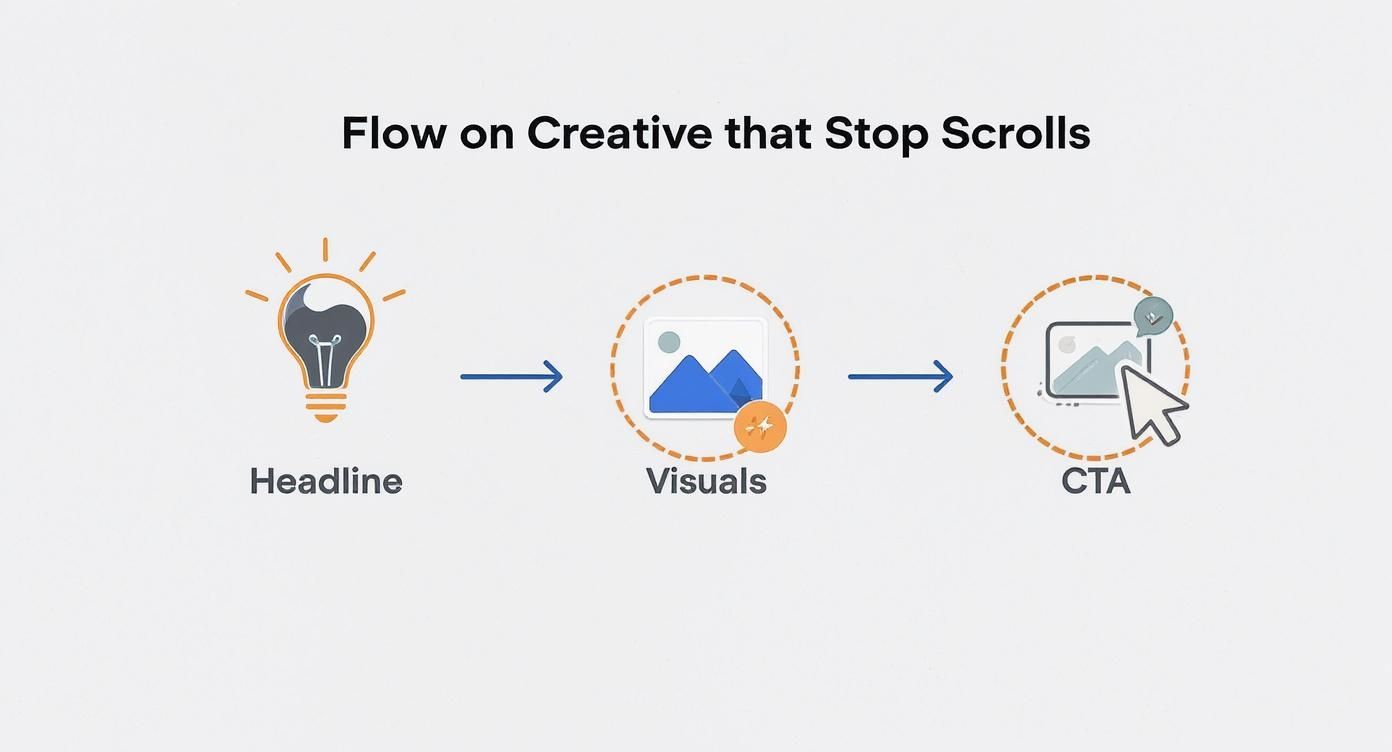
As you can see, the headline, visuals, and CTA are the big three. A small tweak to any of these can dramatically lift your ad performance.
Let's imagine a real estate agency running a test. Ad A uses a stunning shot of a home exterior with the headline "Your Dream Home Awaits." Ad B uses that exact same image but changes the headline to "See Homes in Your Area Under $500k." By keeping the visual the same, the agency can figure out which message is the real driver for clicks.
Testing isn't a one-and-done hunt for the "perfect" ad. It's about building a continuous feedback loop. You launch, gather data, learn from it, and then iterate. This ongoing process of refinement is what steadily improves your Return on Ad Spend (ROAS) over time.
Making Sense of the Results (Without Getting Lost)
Okay, so your test has been running for a bit—usually 5-7 days is enough to get a reliable amount of data. Now it's time to see what happened. It's easy to get sidetracked by vanity metrics like likes or comments, but you need to stay focused. Look at the one Key Performance Indicator (KPI) that actually matters for your campaign goal.
- If your goal was sales, look straight at your Cost Per Acquisition (CPA) and ROAS.
- If you were after leads, your Cost Per Lead (CPL) is what you care about.
Once you have a clear winner, don't hesitate. Turn off the losing ad and make the winning element your new "control" or baseline. Then, you start the cycle all over again with a new variable to test. This iterative process is the engine that scales social media advertising successfully.
You can also explore different types of AI marketing software to help with this. Some tools are fantastic at analyzing performance data and can even help predict which creative elements are most likely to resonate with your audience in future tests.
Reading the Data and Making Smart Optimizations

Your ads are live and the data is pouring in. This isn’t the finish line; it’s where the real work of a media buyer begins. Your ad dashboard is telling you a story about what your audience actually responds to, and learning to read that story is how you turn a modest budget into serious returns.
It’s incredibly easy to get overwhelmed by the sheer number of metrics available. The key is to keep your analysis clean and effective by focusing only on the numbers tied directly to your campaign’s original goal. Everything else is just noise that can lead you down the wrong path.
Decoding the Metrics That Matter
Don't get sidetracked by vanity metrics like likes or reach if your goal is sales. You need to zero in on the KPIs that directly impact your bottom line. For most campaigns, these are the big three that will guide your optimization decisions.
- Return On Ad Spend (ROAS): This is the ultimate measure of profitability. It tells you exactly how much revenue you’re generating for every dollar you spend on ads. A ROAS of 4:1 means you’re making $4 for every $1 spent. Simple as that.
- Cost Per Acquisition (CPA): This metric reveals how much it costs to land one customer. If you’re selling a $100 product and your CPA is $25, you have a healthy profit margin. But if your CPA creeps up to $95, your campaign is in trouble.
- Conversion Rate: This is the percentage of people who clicked your ad and then took the action you wanted (like making a purchase). A low conversion rate often signals a problem with your landing page, not necessarily the ad itself.
Key Insight: A high click-through rate (CTR) paired with a low conversion rate is a classic sign of a disconnect. It means your ad creative is doing its job and getting the click, but your landing page is failing to close the deal. You need to investigate that post-click experience immediately.
Spotting Ad Fatigue Before It Drains Your Budget
Ad fatigue is a real and costly problem. It happens when your audience has seen your ad so many times they start to ignore it, causing your costs to spike and performance to plummet. A tell-tale sign is a rising Cost Per Click (CPC) coupled with a declining CTR.
When you spot this trend, you have two primary levers to pull:
- Refresh the Creative: This is often the quickest fix. Use a different image from your Bulk Image Generation batch, tweak the headline, or try a new video angle. Sometimes a simple visual change is all it takes to make an ad feel fresh again.
- Refine the Targeting: If new creative doesn’t move the needle, your audience segment might be saturated. Try expanding to a new lookalike audience or layering on different interests to reach a fresh pocket of potential customers.
The process of creating social media ads that consistently perform is a cycle: launch, read the data, and make informed adjustments. You have to be ruthless. Pause the underperforming ad sets, shift more budget to the winners, and never, ever stop testing. This continuous loop of optimization is what separates amateur advertisers from the pros.
Your Top Social Media Ad Questions, Answered
If you're running social media ads, you've got questions. It doesn't matter if you're a seasoned pro or just starting out—everyone hits the same roadblocks. Let's cut through the noise and get you some quick, practical answers to the most common questions I hear.
How Much Should I Spend on Social Media Ads?
Forget about finding a single magic number. The right budget is always tied to your industry, what you're trying to achieve, and who you're talking to. For a small business just testing the waters, a budget of $20-$50 per day on a single campaign is a solid starting point.
But that initial spend isn't for making a profit; it's for buying data.
The real number you need to focus on is your target Cost Per Acquisition (CPA). Before you spend a dollar, figure out the absolute maximum you can afford to pay for a new customer. Let that number be your guide. Start small, prove your ad can actually turn a profit, and only then should you confidently start scaling up your budget.
What Is the Most Important Ad Metric to Track?
It’s incredibly easy to get lost in a sea of metrics. Click-Through Rate (CTR) and Cost Per Click (CPC) are great for a quick health check, but they don't pay the bills. The only metric that truly matters is the one directly linked to your business goal.
It’s a simple rule: if your goal is to make sales, you live and die by your Return On Ad Spend (ROAS) and CPA. If you’re after leads, your world revolves around Cost Per Lead (CPL). And for brand awareness, you're watching reach and engagement rate.
Everything else is just noise. Focus on the metrics that directly impact your bottom line.
How Long Should an Ad Run Before I Make Changes?
I get it—the urge to jump in and start tweaking a new ad is strong, especially if it's not performing well right away. But you have to resist. Platforms like Facebook and Google have a "learning phase," and it needs time and data to do its job. The algorithm is literally figuring out who to show your ad to for the best results.
Give any new campaign at least 5-7 days before you touch anything significant. This gives the algorithm enough runway to optimize and gives you enough data to see trends across different days of the week. If you act too soon, you're just making decisions in the dark.
Why Are My Ads Getting Clicks But No Conversions?
This is easily one of the most frustrating problems in advertising, but the answer is usually pretty clear: there's a disconnect between your ad and what happens after the click. A high CTR is a good thing! It means your targeting and your ad creative are working—you’ve successfully grabbed someone’s attention.
The problem almost always lives on your landing page.
Ask yourself these questions, and be honest:
- Is my landing page slow, confusing, or a mess on mobile?
- Does the headline and offer on the page perfectly match the promise I made in the ad?
- Is the offer itself actually good enough to make someone pull out their credit card?
Dig into the entire user journey after the click. That's where you'll find the conversion killer. It’s rarely just the ad’s fault.
Ready to scale your ad creative without the hassle? Bulk Image Generation uses advanced AI to create hundreds of unique, professional-quality images in seconds, slashing your design time and costs. Stop editing one image at a time and start creating at scale. Learn more and try it for free at https://bulkimagegeneration.com.