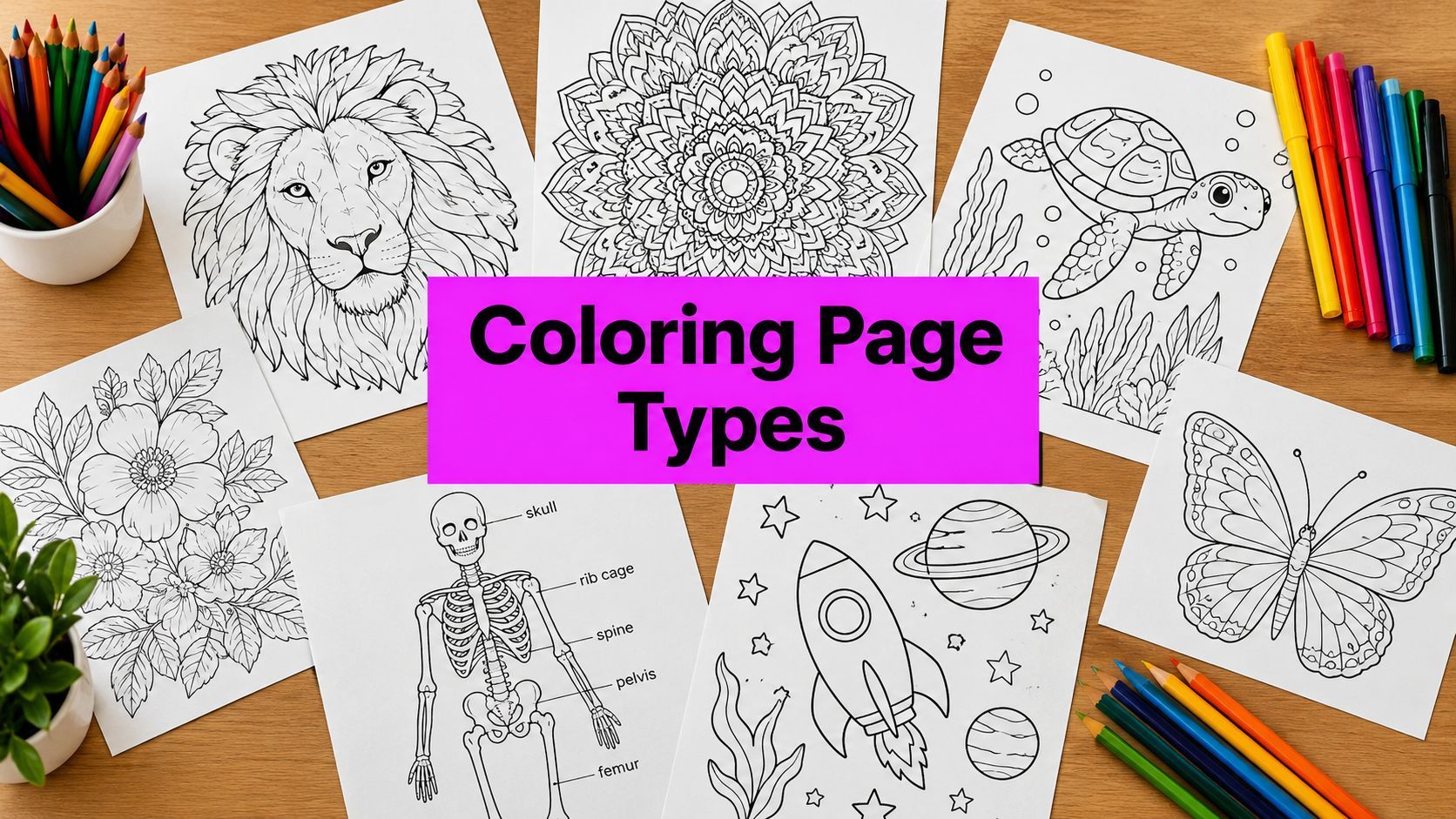
Types of Coloring Pages for Every Age and Style

Ryan Bennett • October 3, 2026
Explore the main types of coloring pages for kids, adults, and educators, with style breakdowns, use cases, and quick prompts to generate your own.
A Sunday morning can turn into a surprisingly difficult art-supply decision. A parent or teacher opens a laptop, searches for “coloring pages,” and finds mermaids, tractors, mandalas, alphabet worksheets, anatomy diagrams, and elaborate floral patterns all mixed together. Every thumbnail says “coloring page,” but the pages clearly serve different people and purposes.
That confusion happens because types of coloring pages are no longer separated only into children's sheets and adult designs. A page has an audience, a structural style, and a job to do. Once you learn to read those three features, choosing the right page becomes much easier.
Why Coloring Pages Come in So Many Forms
Coloring pages began as simple line drawings, but the format has always been adaptable. The first mass-produced coloring book in the United States is widely identified as Little Folks' Painting Book, published by McLoughlin Brothers in New York in 1879. By 1905, McLoughlin had sold more than 4.2 million copies, helping establish coloring books as inexpensive, distributable educational and recreational products. These historical details are discussed in the systematic review of educational coloring books.
The basic page has since split into many working formats. A preschool sheet may use one large animal with a thick outline. A primary classroom page may combine a life-cycle diagram with labels. An adult relaxation book may use a radial mandala, while a printable craft seller may produce themed pages for a narrow audience such as cottagecore fans, gardeners, or astronomy students.
Several changes have pushed this variety forward:
- Adult hobby use: Coloring has become a regular creative activity for people who want a quiet, screen-free task, not only a children's pastime.
- Printable publishing: Digital marketplaces make it practical to sell individual worksheets, classroom packs, downloadable activity books, and print-on-demand collections.
- Accessible image tools: Generative systems let creators test unusual subjects and produce variations without drawing every outline manually.
- Specialized teaching: Educators use coloring books and pages as classroom resources, especially in early childhood and primary settings. The review linked above examined 45 peer-reviewed empirical studies and 194 educational coloring books, and found that many classroom materials focus on images to complete, while fewer invite discussion or collaborative reasoning.
Teacher's rule: A page should earn its place by serving the moment. A beautiful design can still be the wrong choice if its details, instructions, or subject don't match the learner.
That is why a long list of themes isn't enough. “Animals,” “flowers,” and “space” describe subjects, but they don't tell you whether the page is suitable for a toddler, a science lesson, a tired adult, or a person who needs a low-pressure activity. The useful question is not only “What does this page show?” It is “Who can use it, how is it built, and what should happen while using it?”
Three Ways to Classify Any Coloring Page
Before sorting individual page types, look at every sheet through three separate lenses. These lenses overlap, but they answer different questions.
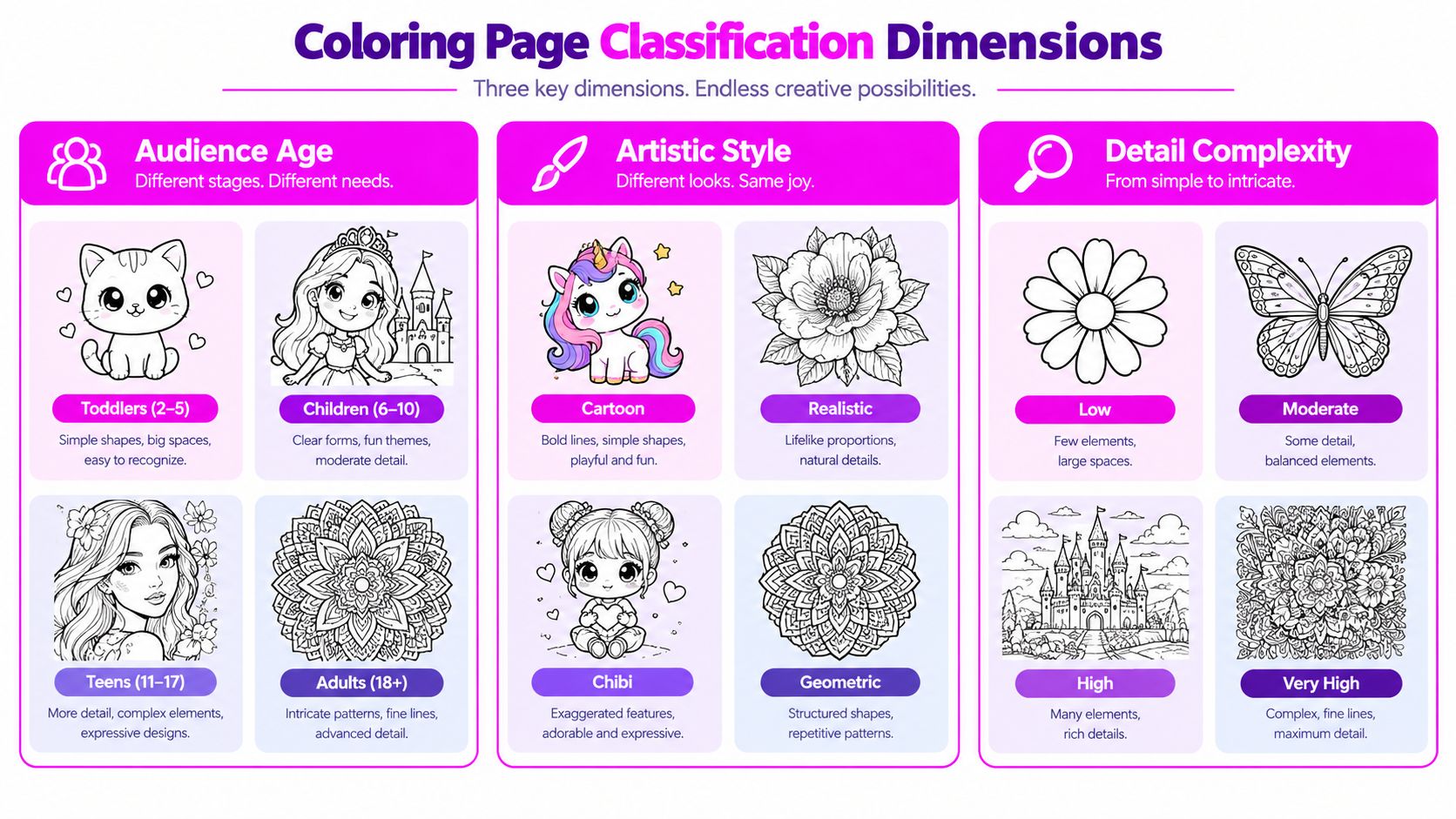
First lens is audience
Age is a useful starting point, but “kids versus adults” is too broad for practical decisions. A four-year-old and an eight-year-old may both be children, yet they need very different line work and page demands.
Use four working audience bands:
- Toddler and preschool, roughly ages 2 to 5: Large areas, thick outlines, one obvious subject, and limited visual clutter.
- Early elementary, roughly ages 5 to 8: More objects, recognizable scenes, simple story connections, and basic educational labels.
- Tween and teen: More control over detail, stronger interest in identity and subjects, and room for illustrative or decorative complexity.
- Adult: Any level of detail, provided the page matches the user's patience, vision, motor comfort, and available time.
These are design bands, not rigid rules. A child with strong drawing experience may enjoy a detailed page, while an adult may prefer a very simple flower.
Second lens is structure
Next, inspect how the page is built.
- Bold and easy: Thick contours, large enclosed regions, and a clear focal subject.
- Geometric or mandala: Repetition, symmetry, radial organization, tessellations, or pattern-based areas.
- Illustrative and detailed: Scenes, textures, overlapping objects, fine line work, and many small regions.
- Educational or diagram-style: Labels, arrows, sequences, maps, anatomy, vocabulary, or reference elements.
Structure predicts the kind of attention the page demands. A bold outline invites quick decisions. A mandala invites repetition. A diagram asks the user to connect visual information with a concept.
Third lens is use case
Finally, ask what the page is meant to accomplish.
- Calming and mindfulness: Repetition, manageable focus, and a satisfying visual rhythm.
- Classroom instruction: A page tied to a lesson, vocabulary set, observation task, or review activity.
- Therapy and occupational work: Accessible line weight, appropriate contrast, and a comfortable motor challenge.
- Commercial or print-on-demand: Consistent formatting, a clear audience, and a coherent collection rather than one isolated sheet.
Consider a dense floral mandala marked for older children. Its audience may be tweens or experienced young colorists. Its structure is geometric and detailed. Its use case might be quiet independent work, an art activity, or a commercial activity book. Those labels don't contradict one another.
Most arguments about whether a page is “good” come from mixing up these lenses. A page can be excellent for an experienced hobbyist and frustrating for a preschool group. Tag the audience, structure, and purpose separately, and you can classify almost any page in seconds.
Coloring Page Types for Children and Classrooms
Children's pages work best when their visual demands match the learner's control and the teacher's objective. A cheerful subject alone doesn't make a page educational. The outline, number of regions, instructions, and connection to the lesson all matter.
Bold outlines for young children
For preschool learners, choose single-subject pages with thick, continuous outlines. A large apple, friendly dog, boat, or rain cloud gives a child room to grasp a crayon, stay within a boundary, and notice color differences without managing a crowded scene.
These sheets are useful during short activity periods, transition time, or an introductory lesson about an object. A page with many tiny petals may look attractive to an adult but creates unnecessary control demands for a young child. Use large open areas when the goal is participation and confident mark-making.
Themed illustrations for early elementary learners
Children in the early elementary years can handle a page that tells a small visual story. Animals, holidays, transportation, and storybook scenes work well beside reading units because the child can connect the image to a character, setting, or event.
A farm page might support a lesson about vocabulary. A forest scene might accompany a story about habitats. The coloring isn't the whole lesson, but it gives children a way to revisit the subject through observation and conversation. Leave enough open space for the main forms to remain recognizable after coloring.
Educational diagrams and reference sheets
An educational page should make the concept easier to see, not merely decorate it. Alphabet pages, number sheets, maps, life cycles, body systems, and labeled anatomy drawings belong in this category.
A cartoon frog is a pleasant art activity, but a frog life-cycle diagram is stronger when the science standard involves sequence and change. Likewise, a map with a small word bank can support place recognition more directly than a generic scene.
Educators can find production and formatting guidance in this guide to coloring book publishing. For examples focused specifically on classroom use, see these coloring pages for teachers.
Activity hybrids
Connect-the-dots, hidden pictures, matching tasks, and simple mazes add a second layer to coloring. They ask children to scan, follow an order, compare shapes, or locate visual information before filling the page.
Use these hybrids when a class needs a quiet task that still involves directed attention. They aren't substitutes for free drawing, though. A child who always receives a template gets fewer chances to make independent choices about scale, color, and composition.
| Page Type | Typical Age | Best Classroom Use | Primary Skill Built |
|---|---|---|---|
| Bold single-subject outline | 2 to 5 | Introduction to objects, transitions, free exploration | Grip control and color recognition |
| Themed illustrative scene | 5 to 8 | Reading units, seasonal lessons, vocabulary review | Visual storytelling and observation |
| Educational diagram | 5 to 8 and older | Science, social studies, language, and reference work | Concept recognition and visual association |
| Connect-the-dots hybrid | 5 to 8 and older | Sequencing and directed independent work | Order and hand-eye coordination |
| Hidden-picture hybrid | 5 to 8 and older | Visual scanning and review activities | Attention to detail and comparison |
| Free-draw coloring frame | Any age with adaptation | Weekly choice-based art practice | Color decisions and personal expression |
Classroom practice: Rotate in one free-draw page each week. The other formats provide helpful boundaries, but free drawing gives children practice choosing colors without template guidance.
The strongest classroom collection mixes these formats rather than repeating one attractive style. Give children a bold animal when the priority is confidence, a diagram when the priority is content, and an open-ended frame when the priority is artistic independence.
Coloring Page Types for Adults and Stress Relief
An adult sits down after a demanding day, opens a coloring book, and finds either a crowded mandala or one large, welcoming object. The first page may invite sustained concentration. The second may offer a calmer entry point when attention is already tired. Both belong to adult coloring, but they serve different moments.
Adult coloring pages therefore form several visual and practical categories. The useful question is not whether a design looks “adult.” Ask how much visual effort it requires, what tools it supports, and whether the goal is focus, relaxation, creative practice, or a short break.
Structured patterns can help with calming because they provide clear boundaries and a repeatable focal point. Psychology Today's discussion of adult coloring books summarizes comparative adult studies in which 20 to 30 minute coloring sessions produced measurable reductions in state anxiety. Guided mandala formats often performed better than simpler freeform layouts for immediate calming outcomes. For a closer look at calming formats and accessibility considerations, see these therapeutic coloring pages.
Detailed mandalas and zentangles
Mandalas use radial symmetry, repeated motifs, and nested regions. Zentangle-inspired pages rely on small marks, curves, grids, and organic patterns. Both suit adults who enjoy sustained attention and want the image to develop gradually as each area is filled.
Fine regions work naturally with colored pencils because they allow controlled layering and subtle color changes. Alcohol markers can also work, although thin paper may let ink bleed through. Water-based markers are gentler on some papers, but tiny sections may be harder to fill evenly.
These pages suit a long, quiet session. They can frustrate someone seeking quick completion, especially when the pattern contains many similar cells.
Bold-and-easy object pages
A coffee cup, succulent, cat, mushroom, or stack of books can become an adult coloring page through deliberate composition and confident line quality. Bold-and-easy designs use strong contours and broad regions, making them suitable for a short break or for colorists who find dense patterns tiring.
Large shapes also make marker use more forgiving. Broad strokes fit the open areas, and the user can finish a recognizable object without managing dozens of narrow gaps. This format works well for casual hobbyists, accessible large-print collections, and quick printable activities.
It is often the better choice for a tired commuter or busy parent. A page with a handful of broad regions can provide a complete creative task without demanding a long period of concentration.
Nature and botanical scenes
Leaves, birds, garden tools, forests, and floral arrangements sit between simple object pages and intricate illustrations. A leaf study may contain only a few regions, while a greenhouse scene can include overlapping stems, textures, and background details.
The amount of detail changes the experience more than the subject does. Choose a simpler botanical page for an easy, restorative session. Choose a layered garden or forest scene when observation and gradual color building are part of the appeal.
Colored pencils suit nature pages when the user wants gentle tonal variation. Pages with larger leaves also accommodate markers or water-based tools more comfortably than dense flower mandalas.
Geometric and tessellation patterns
Geometric pages use repeated shapes, grids, interlocking forms, and symmetry. They suit people who enjoy visual order without needing a recognizable scene or narrative.
Region size sets the pace. Broad geometric panels feel approachable, while small repeated cells demand patience and careful hand movement. Before printing a full collection, check whether the pattern feels rhythmic or visually crowded. A mathematically orderly page can still feel tiring if every area is tiny.
Quote-based typographic pages
Quote pages combine lettering with decorative borders, leaves, stars, or simple illustrations. They work well as gifts, journal inserts, and motivational wall art, provided the typography remains readable after printing.
Choose a medium that will not obscure the letters. Colored pencils offer control around small counters and serifs. Markers work better when the lettering is large and the paper can handle them without bleeding.
Recent market coverage points toward stronger interest in accessible designs. More than half of the top 50 best-selling coloring books have 40 pages or fewer, and nearly 40% use “Bold and Easy” designs, according to market coverage of coloring-page trends. The same coverage reports that cozy coloring and large-shape line art have recently dominated adult charts, while detailed mandalas continue to serve experienced colorists.
| Style | Line Weight | Typical Region Count | Best Medium | Session Length |
|---|---|---|---|---|
| Detailed mandala | Fine to medium | Many small repeating areas | Colored pencils or fine markers | Long, unhurried session |
| Zentangle pattern | Fine | Many small organic marks | Fine pens or colored pencils | Focused session |
| Bold-and-easy object | Thick to medium | A few large areas | Alcohol markers, crayons, or pencils | Short session |
| Nature or botanical scene | Medium, varied | Moderate, depending on background | Colored pencils or water-based tools | Short to medium session |
| Geometric tessellation | Medium to fine | Broad to small repeating areas | Markers or pencils | Medium session |
| Quote-based typography | Medium around letters | Large lettering plus decorative areas | Pencils or controlled markers | Short to medium session |
Match page density to the time and energy available. A mandala rewards patience. A bold object offers completion sooner. The right type supports the intended experience instead of turning relaxation into another difficult task.
Prompt Templates for Generating Each Type
A useful coloring-page prompt describes structure before subject. Start with language such as: black line art on a white background, no shading, no grayscale, no filled regions, and clear closed shapes. These instructions tell the image system that the result must be printable and colorable rather than a finished illustration.
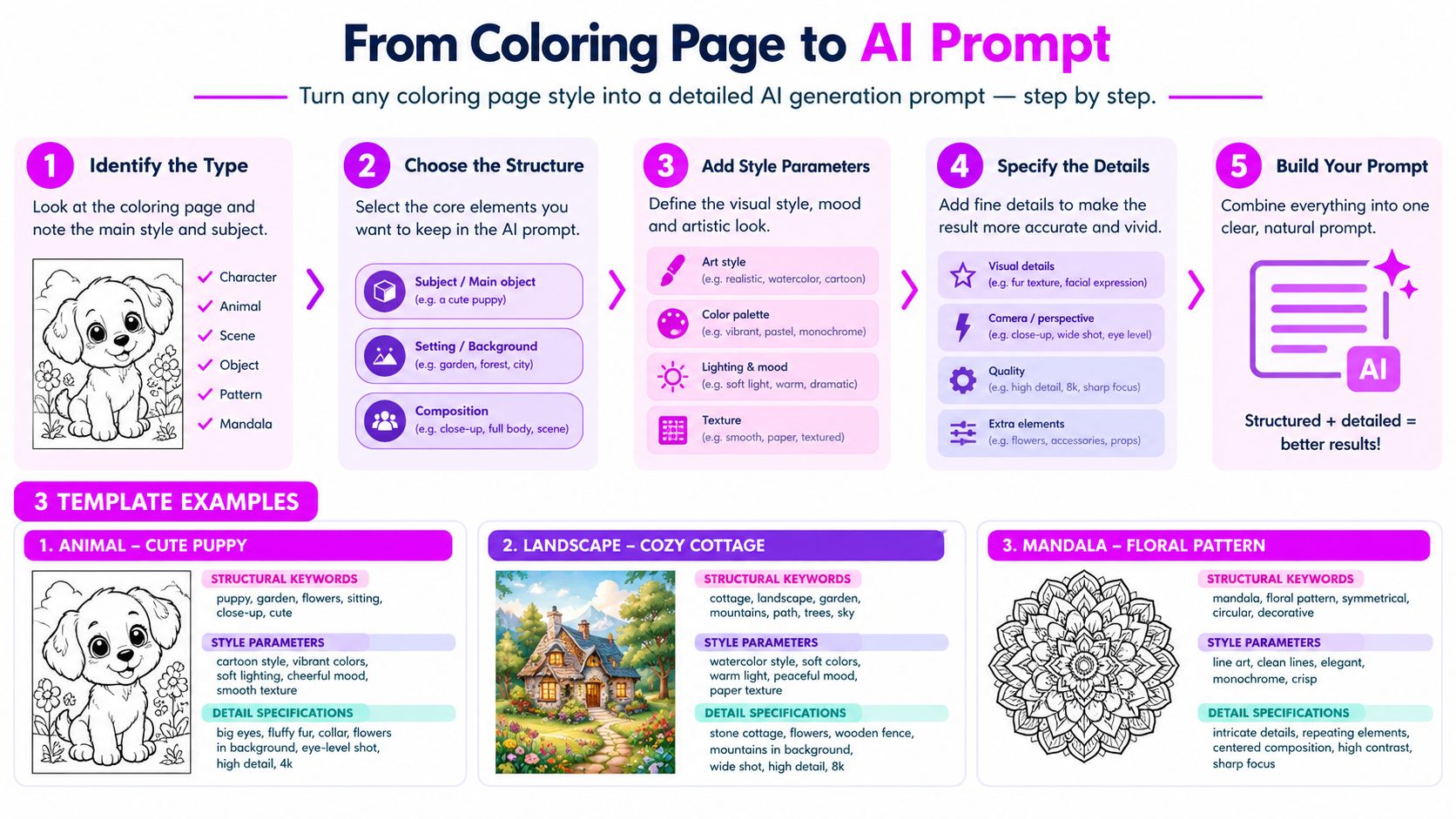
Template for a preschool page
Prompt
Black line art coloring page of one friendly elephant standing in profile, designed for preschool children, thick smooth outline, very large enclosed regions, simple recognizable shapes, no background clutter, no shading, no grayscale, no color, no filled regions, clear closed shapes, white background, printable composition.
Target audience: Young children who need a clear subject and generous coloring areas.
Swap these details:
- Replace “friendly elephant” with “sleepy dinosaur” or “small sailboat.”
- Replace “standing in profile” with “facing forward” or “shown beside one large object.”
Keep one main subject when the page is meant to support early control. Adding a background may be fine later, but it shouldn't compete with the shape the child is learning to identify.
Template for an adult mandala
Prompt
Black line art adult coloring page of a botanical mandala with radial symmetry, medium detail, balanced negative space, repeated leaves and petals, clean consistent outlines, distinct enclosed sections, no shading, no grayscale, no color, no filled regions, white background, centered circular composition, printable line art.
Target audience: Adults and older colorists who enjoy repetition without an overly crowded page.
Swap these details:
- Replace “botanical mandala” with “celestial mandala” or “geometric sun mandala.”
- Replace “medium detail” with “low detail” for a quicker page or “intricate detail” for a longer project.
The phrase balanced negative space matters. Without it, a system may fill every available area with decoration and produce a page that feels exhausting rather than orderly.
Template for an educational page
Prompt
Clean black line art educational coloring worksheet showing the life cycle of a butterfly, four clearly separated stages, simple labeled diagram, arrows showing sequence, word bank at the bottom, clear closed shapes, no shading, no grayscale, no color, no filled regions, white background, classroom printable layout, optional separate answer key.
Target audience: Primary learners using coloring as part of a science lesson.
Swap these details:
- Replace “life cycle of a butterfly” with “parts of a plant” or “water cycle.”
- Replace “word bank” with “matching labels” or “short review questions.”
For classroom material, request legible labels and simple relationships rather than decorative detail. If the system produces distorted text, generate the diagram without labels and add them in a layout tool afterward. A specialized AI coloring page generator can also help creators test subject and style combinations. For batch experiments across several subjects, see AI coloring pages.
Negative prompt checklist
Add these exclusions when the output needs clean printable line art:
- Remove color: no color, monochrome line art, black outlines only.
- Remove shading: no shadows, no gradients, no crosshatching, no grayscale.
- Protect the regions: clear closed shapes, no broken outlines, no overlapping fills.
- Protect the page: no watermark, no frame text, no cropped subject, no background clutter.
- Protect the lesson: no extra objects, no inaccurate labels, no decorative elements that obscure the diagram.
Always print a test page before making a collection. Check line thickness, enclosed regions, label accuracy, and whether the subject remains recognizable at the intended paper size.
Matching Page Types to Real Goals
Start with the outcome, then choose the page.
For educators, bold animals and alphabet sheets fit fine-motor practice and letter recognition. Diagram pages support science and social studies because they place concepts, labels, and sequences together. Seasonal illustrations can lift participation during transitional weeks, but they work best when the teacher gives them a small conversational or observational purpose.
For hobbyists, the choice is more personal. Intricate mandalas and zentangles suit a long, meditative session. Bold-and-easy prints are better for a quick reset, a low-pressure first attempt, or a simple print-on-demand collection. Quote-based pages make practical gifts because the finished sheet can become a card, journal insert, or small piece of wall art.
Therapists and caregivers should inspect accessibility before choosing a subject. Low-detail nature scenes may be easier for someone with tremor or low vision, especially when the outlines are strong and the regions are spacious. Repetitive pattern pages may suit grounding exercises, but only when the repetition feels steady rather than overwhelming.
The same subject can be redrawn in any style. A flower may become a preschool outline, a botanical study, a mandala, or a labeled plant diagram.
Style is the lever that changes the outcome. Choose the subject first only when the content matters most. Otherwise, choose the attention level, line structure, and use case first.
Misconceptions That Limit Your Choices
More detail doesn't automatically mean more relaxation. Intricate grids can engage experienced colorists, but bold-and-easy shapes often offer a calmer entry point for beginners. Recent market coverage shows that accessible designs now hold a substantial place among popular adult coloring books, rather than serving only as children's material.
Coloring isn't just for kids. Adult hobbyists, seniors, educators, and caregivers all use pages for creative focus, instruction, or accessible activity. The page still needs to match the user's vision, motor comfort, patience, and available time.
AI pages aren't automatically unprintable. Specific prompts can request clean line art, closed shapes, white space, and the absence of shading. You still need to inspect generated text, broken outlines, awkward joins, and excessive detail before sharing or selling a page.
Bulk Image Generation lets educators and hobbyists create batches of custom coloring pages, including children's designs, adult patterns, and photo-to-line-art variations. Visit Bulk Image Generation to test page types by audience, structure, and classroom or hobby use case, then turn the strongest ideas into printable collections.